Merseyside · England
Shallow-mount security bollard installation in Prescot
Local installation of shallow-mount bollards in Prescot — free survey, fixed written price, and posts set to the right spacing for people and vehicles.
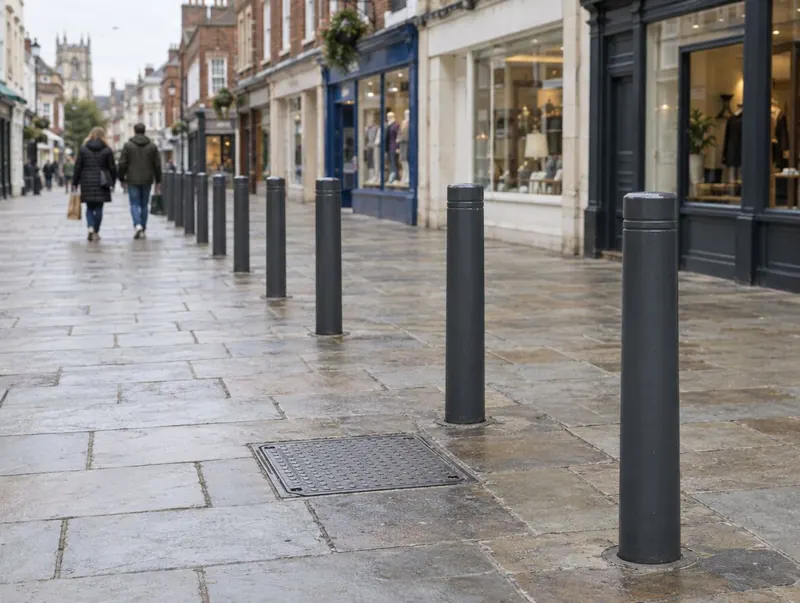 Computer-generated image
About shallow-mount bollards in Prescot
We supply and fit shallow-mount bollards throughout Prescot, typically for sites such as filling-station forecourts, community car parks and small industrial units. Like any rated product, its performance applies only to the configuration and foundation that were tested.
We cover Prescot's L34 and L35 postcode districts, including places such as Huyton with Roby and Tarbock Green. Jobs in Prescot can be combined with work in Huyton (2 miles), St Helens (3.1 miles), Halewood (5 miles) and Kirkby (5.2 miles) (straight-line distances). Prescot is about 7 miles from Liverpool.
Prescot at a glance
- Area
- Merseyside, England
- Highway authority
- Knowsley Council (local roads)
- Planning authority
- Knowsley Council
- Postcodes
- L34 and L35
- Guide price
- Typically £1,945–£8,795 per bollard + VAT; minimum job £4,895
- Survey
- Free, with a fixed written quote
Where shallow-mount bollards go in around Prescot
Typical reasons Prescot sites choose shallow-mount bollards:
- Listed or historic streets where deep digging is unwelcome
- Bridges and structures where excavation depth is limited
- Footways with dense utility runs just below the surface
Guide prices for Prescot
| Specification | Guide price | Includes |
|---|---|---|
| Standard | £1,945–£4,845 + VAT | Rated for a 7.5 t vehicle at 30 mph (48 km/h), tested foundation |
| Upgraded | £3,995–£6,895 + VAT | Rated for 7.5 t at 40 mph (64 km/h), tested foundation |
| Premium | £6,095–£8,795 + VAT | Rated for 7.5 t at 50 mph (80 km/h), or a specialist foundation |
Per bollard position, supplied and installed; -2% for North West. Guide only — the fixed price follows a survey.
Permissions and groundwork in Prescot
The highway authority for local roads in Prescot is Knowsley Council; motorways and trunk roads sit with National Highways. Shallow-mount bollards on the adopted footway are a matter for the highway authority, so we only install there with its written agreement.
Many private-land installations in Prescot need no planning application, but the rules don't clearly cover bollards, so listed buildings, conservation areas and prominent frontages are worth raising with the planning team at Knowsley Council before posts go in.
On decks and roofs, the waterproofing and drainage layers must be protected or rebuilt, and fixings must not puncture membranes unless the structural and waterproofing designers have agreed a detail. Utility owners may set minimum separation distances or ask to be present when digging near their apparatus.
- Keep the test certificate for the exact system and configuration, including the minimum run length and end details.
- Check gaps work for wheelchair users and buggies while still stopping vehicles, referring to Inclusive Mobility guidance.
How the job runs
Map what is underground
Utility records, radar scanning and trial holes establish exactly how much depth is available along the line. This is the survey that decides whether a shallow system will fit at all.
Assemble and level the frame
Frame sections are placed, joined and set to line and level, with posts fixed as the drawing shows. Joints and fixings are photographed before any concrete goes in.
Record and hand over
As-built drawings show the frame position relative to services, which matters for anyone digging nearby later. Product certificates and photographs go to the client's adviser.
Options to consider
| Option | Detail |
|---|---|
| Removable posts within a run | Some systems include removable or retractable positions for maintenance or emergency access. Check how these affect the rating. |
| Modular cassette sections | Pre-made sections joined on site, allowing short runs and changes of direction within the manufacturer's tested limits. |
| Covers and sleeves | Stainless, cast or powder-coated covers fitted over the cores to match surrounding street furniture, supplied or approved by the manufacturer. |
What moves the price in Prescot
When we price shallow-mount bollards in Prescot, these make the biggest difference:
- Changes of direction, end details and removable positions
- Lifting, storing and relaying natural stone paving
- Restricted working hours in busy streets or occupied sites
Looking after them
Pay attention to the surface around the posts, because settlement or loose paving can indicate movement in the bearing layer. If one post is struck, the frame may have transmitted load to its neighbours, so the whole run near the impact should be checked with the manufacturer rather than replacing a single post in isolation.
We can also service, repair or replace existing posts anywhere in Prescot.
Shallow-mount bollards in Prescot: FAQs
Which parts of Prescot do you cover for shallow-mount bollards?
We cover all of Prescot (L34 and L35) and the rest of Merseyside. We also work in Huyton, St Helens and Halewood.
Do I need consent for shallow-mount bollards on a public footway in Prescot?
The highway authority for local roads in Prescot is Knowsley Council; motorways and trunk roads sit with National Highways. Shallow-mount bollards on the adopted footway are a matter for the highway authority, so we only install there with its written agreement.
What's a typical price for shallow-mount bollards in Prescot?
In Prescot, typically £1,945–£8,795 per bollard position, supplied and installed, plus VAT, with a minimum job of £4,895 plus VAT, using our North West guide prices. The fixed figure comes in writing after we've seen the site.
Can shallow-mount bollards go on a car park deck?
Sometimes, if a structural engineer confirms the deck can take the impact loads and the waterproofing can be protected. Decks were not designed with vehicle attacks in mind, so this check comes before anything else. Some manufacturers offer details specifically for structures.
How much shallower is a shallow-mount bollard foundation?
Often a fraction of the depth of a conventional rated foundation, commonly a few hundred millimetres. The exact depth depends on the system and rating chosen. What you gain in depth is usually traded for width, because the load is spread along a linked frame.