Derry City and Strabane · Northern Ireland
Stainless steel bollards and covers in Derry/Londonderry
Local installation of stainless steel bollards in Derry/Londonderry — free survey, fixed written price, and posts set to the right spacing for people and vehicles.
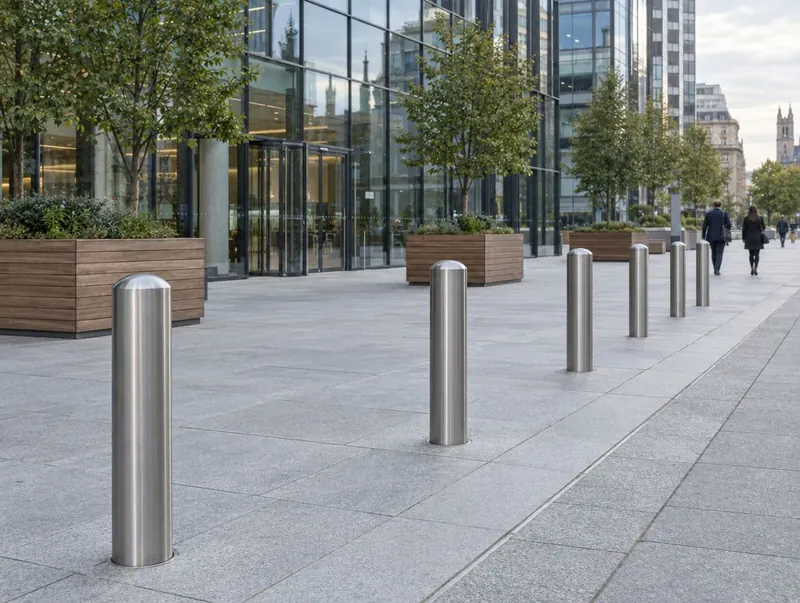 Computer-generated image
About stainless steel bollards in Derry/Londonderry
From leisure centres, college campuses and business parks, Derry/Londonderry has plenty of places where stainless steel bollards earn their keep. Stainless steel bollards and sleeve covers in 304 or 316 grade, for building entrances, plazas and upgrading tired steel posts.
Coverage in Derry/Londonderry takes in the BT48 and BT47 postcode districts. We also cover neighbouring Strabane (13.6 miles) and Limavady (14.7 miles) — distances are straight-line.
Key facts for this area
- Area
- Derry City and Strabane, Northern Ireland
- Roads authority
- the Department for Infrastructure (DfI Roads)
- Planning authority
- Derry City and Strabane District Council
- Postcodes
- BT48 and BT47
- Guide price
- Typically £285–£1,195 per bollard + VAT (£335–£1,445 inc VAT for homes); minimum job £675
- Survey
- Free, with a fixed written quote
Derry/Londonderry: typical stainless steel bollard prices
| Specification | Guide price | Includes |
|---|---|---|
| Standard | £285–£655 + VAT · £335–£785 inc VAT | Standard post, foundation, reinstatement |
| Upgraded | £555–£925 + VAT · £665–£1,095 inc VAT | Upgraded finish or fittings, reflective band, matched keys |
| Premium | £815–£1,195 + VAT · £975–£1,445 inc VAT | Heavy-duty or architectural spec, premium finish |
Per bollard, supplied and installed; -2% for Northern Ireland. Guide only — the fixed price follows a survey.
Typical stainless steel bollards jobs in Derry/Londonderry
Typical reasons Derry/Londonderry sites choose stainless steel bollards:
- Disguising crash-rated cores as ordinary street furniture
- Coastal and poolside sites where paint finishes fail
- Office, hotel and hospital entrances
What we check first in Derry/Londonderry
Across Northern Ireland the Department for Infrastructure's DfI Roads is the roads authority, so stainless steel bollards on a public footway or road in Derry/Londonderry need its agreement before anything is dug. Posts on your own land do not.
If your site in Derry/Londonderry is listed or inside a conservation area, check with the local planning authority (Derry City and Strabane District Council) before choosing a finish — heritage settings often favour cast iron or painted steel over stainless.
The difference is in handling. For solid stainless posts the foundation work is the same as for steel: dig to depth, check for services, set in concrete and reinstate.
- Check with the local planning authority before installing in conservation areas or beside listed buildings, where stainless may not be considered appropriate.
- Keep clear gaps of typically at least 1,000–1,200 mm on pedestrian routes, in line with Inclusive Mobility guidance.
Installation, step by step
Survey and match
A free site survey records existing cores, diameters, heights and the setting, including any salt or coastal exposure that points to 316. You receive a fixed written quote covering grade, finish and fixing.
Prepare the cores
For covers, existing posts are checked for straightness, loose foundations and corrosion. Cores that lean or move are re-bedded first, because a cover will not hide a failing post for long.
Install new posts
New solid stainless posts are set in concrete, bolted down or fitted into sockets, with care taken not to scratch the finish or contaminate it with carbon steel tools.
Choosing the right spec
| Option | Detail |
|---|---|
| Solid stainless posts | Root-fixed, base-plated or removable posts, often concrete-filled or with a steel insert for strength. |
| Contrasting bands | Dark or reflective bands so posts stand out against pale paving, which bare stainless often does not. |
| Grade 304 or 316 | 304 for most inland locations; 316 near the coast, swimming pools, or roads and car parks salted heavily in winter. |
What moves the price in Derry/Londonderry
Our Northern Ireland guide prices are a starting point; the survey in Derry/Londonderry firms them up. What tends to move them:
- Surface reinstatement and protection of the finish during works
- Diameter and height, and any custom heads or engraving
- Manufacturer-approved covers for rated bollards
Keeping them working
Wash it periodically with water and a mild detergent, more often near the coast or busy roads, and rinse off road salt after winter. Light tea staining can be removed with a stainless cleaner and a non-scratch pad, working with the grain of a brushed finish.
For damaged or loose posts in Derry/Londonderry, repairs and replacements are priced in writing first.
Stainless steel bollards in Derry/Londonderry: FAQs
Do you install stainless steel bollards in Derry/Londonderry?
We cover all of Derry/Londonderry (BT48 and BT47) and the rest of Derry City and Strabane. We also work in Strabane and Limavady.
Who gives permission for bollards on the pavement in Derry/Londonderry?
Kerbside work in Derry/Londonderry is a DfI Roads question: the Department for Infrastructure is the roads authority for Northern Ireland, and its permission is needed for anything placed in the public road or footway.
What's a typical price for stainless steel bollards in Derry/Londonderry?
In Derry/Londonderry, typically £285–£1,195 per bollard, supplied and installed, plus VAT (£335–£1,445 including VAT for homeowners), with a minimum job of £675 plus VAT, using our Northern Ireland guide prices. The fixed figure comes in writing after we've seen the site.
Do stainless covers affect a crash rating?
They can if they are not part of the tested product. Use covers supplied or approved by the bollard manufacturer. We fit approved covers and leave the core and foundation exactly as installed.
Can stainless covers go over our existing steel bollards?
Yes, if the existing posts are straight, firmly fixed and a size the covers can be made to fit. Leaning or loose posts are re-bedded first. It is often a quicker way to refresh a frontage than replacing every post.