East Riding of Yorkshire · England
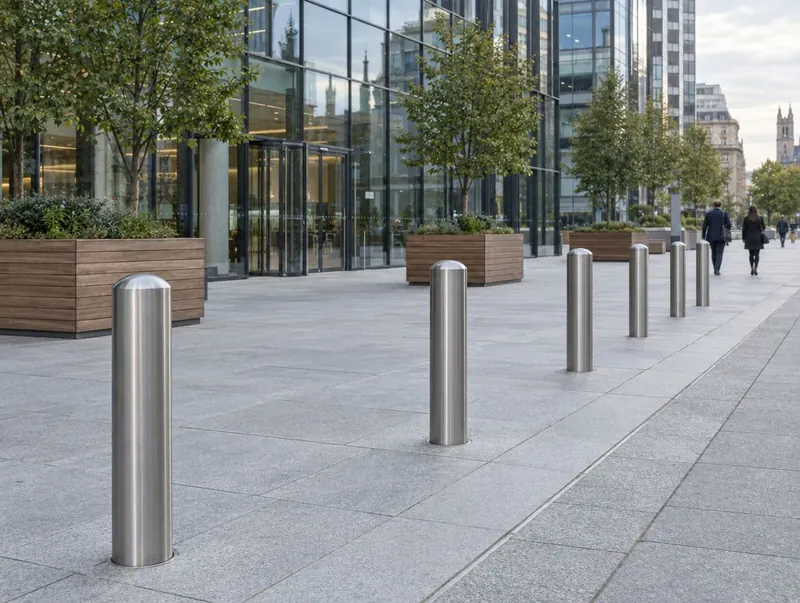
Stainless steel bollards and covers in Hull
Stainless steel bollards for sites across Hull and the rest of East Riding of Yorkshire, from the first measurement to the last relaid paving block.
 Computer-generated image
About stainless steel bollards in Hull
From office forecourts, university campuses and pedestrianised streets, Hull has plenty of places where stainless steel bollards earn their keep. Stainless steel bollards and sleeve covers in 304 or 316 grade, for building entrances, plazas and upgrading tired steel posts.
We cover every part of Hull in the HU1, HU2, HU3, HU5, HU9 and HU8 postcode districts. Nearby, we also work in Beverley (7.9 miles), measured as the crow flies.
Local details
- Area
- East Riding of Yorkshire, England
- Highway authority
- Hull City Council (local roads)
- Planning authority
- Hull City Council
- Postcodes
- HU1, HU2, HU3, HU5, HU9, HU8, HU4 and HU6
- Guide price
- Typically £285–£1,145 per bollard + VAT (£335–£1,345 inc VAT for homes); minimum job £665
- Survey
- Free, with a fixed written quote
- Nearby
- Beverley (7.9 mi)
Typical stainless steel bollards jobs in Hull
Common uses in a place like Hull:
- Sleeving existing painted steel posts that have become tatty
- Disguising crash-rated cores as ordinary street furniture
- Matching stainless canopies, handrails and signage
Guide prices for Hull
| Specification | Guide price | Includes |
|---|---|---|
| Standard | £285–£655 + VAT · £335–£785 inc VAT | Standard post, foundation, reinstatement |
| Upgraded | £545–£915 + VAT · £645–£1,095 inc VAT | Upgraded finish or fittings, reflective band, matched keys |
| Premium | £805–£1,145 + VAT · £965–£1,345 inc VAT | Heavy-duty or architectural spec, premium finish |
Per bollard, supplied and installed; -3% for Yorkshire and the Humber. Guide only — the fixed price follows a survey.
Consents, ground and services in Hull
Hull City Council is the highway authority covering Hull's local roads. If any post would stand on adopted highway rather than your land, that consent is the first thing we sort out.
If your site in Hull is listed or inside a conservation area, check with the local planning authority (Hull City Council) before choosing a finish — heritage settings often favour cast iron or painted steel over stainless.
Where covers go over existing posts, there is usually no excavation at all, but the base of the old post often sits in broken surfacing that is worth making good at the same time so the cover finishes neatly against a clean edge. Stainless can be stained by iron particles from cutting discs, drills and steel tools used nearby, and those particles rust on the surface within days.
- Check with the local planning authority before installing in conservation areas or beside listed buildings, where stainless may not be considered appropriate.
- Add a contrasting band near the top, because bare stainless can blend into pale paving for partially sighted people.
How the job runs
Prepare the cores
For covers, existing posts are checked for straightness, loose foundations and corrosion. Cores that lean or move are re-bedded first, because a cover will not hide a failing post for long.
Install new posts
New solid stainless posts are set in concrete, bolted down or fitted into sockets, with care taken not to scratch the finish or contaminate it with carbon steel tools.
Clean and protect
Fingerprints, grinding dust and adhesive residue are cleaned off with suitable stainless cleaners, and the protective film is removed only when surrounding work is finished.
Choosing the right spec
| Option | Detail |
|---|---|
| Solid stainless posts | Root-fixed, base-plated or removable posts, often concrete-filled or with a steel insert for strength. |
| Brushed or polished finish | Satin brushed finishes hide fingerprints and light scratches; mirror polish is striking but shows every mark. |
| Heads and details | Domed, flat, angled or ball tops, grooved bands, engraved logos and inset reflective strips. |
What moves the price in Hull
Our Yorkshire and the Humber guide prices are a starting point; the survey in Hull firms them up. What tends to move them:
- Grade 304 or 316 and the surface finish
- Condition of existing cores and any re-bedding needed
- Solid posts or covers over existing cores
Looking after them
Light tea staining can be removed with a stainless cleaner and a non-scratch pad, working with the grain of a brushed finish. Avoid wire wool and steel brushes, which leave particles that rust.
If posts in Hull are later hit or damaged, we can repair or replace them — see bollard repairs.
Questions about stainless steel bollards in Hull
Do you install stainless steel bollards in Hull?
We cover all of Hull (HU1, HU2, HU3, HU5, HU9 and HU8) and the rest of East Riding of Yorkshire. We also work in Beverley.
Do I need consent for stainless steel bollards on a public footway in Hull?
Hull City Council is the highway authority covering Hull's local roads. If any post would stand on adopted highway rather than your land, that consent is the first thing we sort out.
What's a typical price for stainless steel bollards in Hull?
In Hull, typically £285–£1,145 per bollard, supplied and installed, plus VAT (£335–£1,345 including VAT for homeowners), with a minimum job of £665 plus VAT, using our Yorkshire and the Humber guide prices. The fixed figure comes in writing after we've seen the site.
Why has our stainless steel gone brown?
Usually because of tea staining from chlorides, a grade unsuited to the location, a coarse finish that holds dirt, or iron contamination from nearby cutting. Most of it cleans off. If it keeps returning, the grade or finish may be wrong for the site.
Do stainless covers affect a crash rating?
They can if they are not part of the tested product. Use covers supplied or approved by the bollard manufacturer. We fit approved covers and leave the core and foundation exactly as installed.