Fife · Scotland
Stainless steel bollards and covers in St Andrews
Planning stainless steel bollards in St Andrews? We check ownership, consents and buried services first, then quote a fixed price.
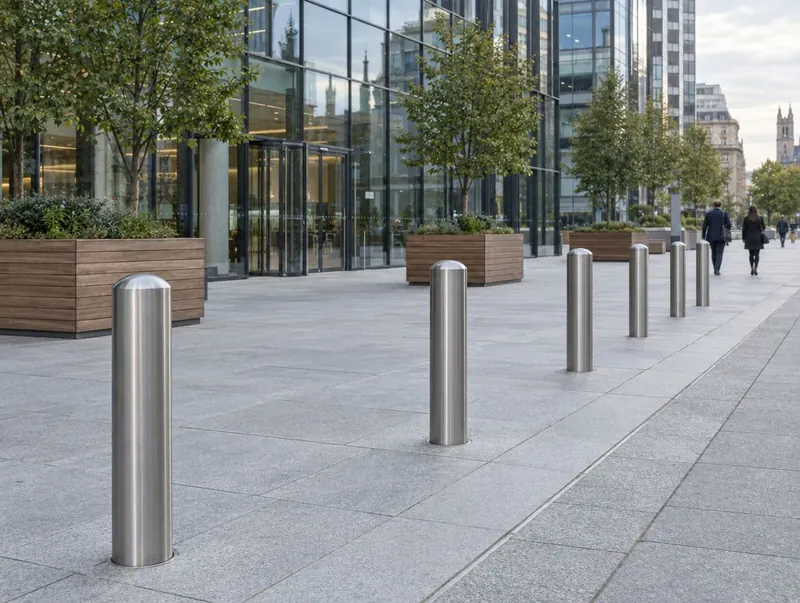 Computer-generated image
St Andrews stainless steel bollards
Across St Andrews, typical sites for stainless steel bollards include community car parks, high street shopfronts and filling-station forecourts. Grade 304 suits most inland sites, while 316 is preferred near the coast, pools or heavy de-icing salt.
We work across KY16 — St Andrews itself and places including Leuchars, Balmullo, Guardbridge and Kingsbarns. We also cover neighbouring Carnoustie (11.9 miles), Methil (13.6 miles), Glenrothes (17.4 miles) and Arbroath (17.5 miles) — distances are straight-line.
St Andrews at a glance
- Area
- Fife, Scotland
- Roads authority
- Fife Council (local roads)
- Planning authority
- Fife Council
- Postcodes
- KY16
- Guide price
- Typically £295–£1,195 per bollard + VAT (£345–£1,445 inc VAT for homes); minimum job £695
- Survey
- Free, with a fixed written quote
- Nearby
- Carnoustie (11.9 mi), Methil (13.6 mi), Glenrothes (17.4 mi), Arbroath (17.5 mi)
Guide prices for St Andrews
| Specification | Guide price | Includes |
|---|---|---|
| Standard | £295–£675 + VAT · £345–£805 inc VAT | Standard post, foundation, reinstatement |
| Upgraded | £565–£945 + VAT · £675–£1,145 inc VAT | Upgraded finish or fittings, reflective band, matched keys |
| Premium | £835–£1,195 + VAT · £995–£1,445 inc VAT | Heavy-duty or architectural spec, premium finish |
Per bollard, supplied and installed; no regional adjustment. Guide only — the fixed price follows a survey.
Typical stainless steel bollards jobs in St Andrews
Typical reasons St Andrews sites choose stainless steel bollards:
- Coastal and poolside sites where paint finishes fail
- Office, hotel and hospital entrances
- Retail parks and shopping centre frontages
Before we dig in St Andrews
For anything on the public footway in St Andrews we check with the roads authority first — Fife Council for local roads, Transport Scotland on trunk routes. Private ground such as a car park or forecourt only needs the owner's go-ahead.
Many private-land installations in St Andrews need no planning application, but the rules don't clearly cover bollards, so listed buildings, conservation areas and prominent frontages are worth raising with the planning team at Fife Council before posts go in.
Paving around new posts is cut before the posts arrive, or the posts are protected while it happens. Stainless can be stained by iron particles from cutting discs, drills and steel tools used nearby, and those particles rust on the surface within days.
- On crash-rated bollards, confirm with the manufacturer that the cover is approved for the tested product.
- Keep clear gaps of typically at least 1,000–1,200 mm on pedestrian routes, in line with Inclusive Mobility guidance.
From survey to handover
Prepare the cores
For covers, existing posts are checked for straightness, loose foundations and corrosion. Cores that lean or move are re-bedded first, because a cover will not hide a failing post for long.
Fit covers
Sleeves are slid over the cores, packed so they cannot rattle, and fixed with concealed fixings. A gap or drainage detail at the base stops water being trapped inside.
Clean and protect
Fingerprints, grinding dust and adhesive residue are cleaned off with suitable stainless cleaners, and the protective film is removed only when surrounding work is finished.
Options to consider
| Option | Detail |
|---|---|
| Contrasting bands | Dark or reflective bands so posts stand out against pale paving, which bare stainless often does not. |
| Heads and details | Domed, flat, angled or ball tops, grooved bands, engraved logos and inset reflective strips. |
| Covers for rated bollards | Manufacturer-supplied or approved covers for crash-tested cores so the security rating is not compromised. |
What affects the quote
When we price stainless steel bollards in St Andrews, these make the biggest difference:
- Manufacturer-approved covers for rated bollards
- Condition of existing cores and any re-bedding needed
- Diameter and height, and any custom heads or engraving
Keeping them working
Wash it periodically with water and a mild detergent, more often near the coast or busy roads, and rinse off road salt after winter. Check covers for loose fixings and rattles, and look at the base for trapped water or rust from an old core underneath.
For damaged or loose posts in St Andrews, repairs and replacements are priced in writing first.
Stainless steel bollards in St Andrews: FAQs
Do you install stainless steel bollards in St Andrews?
We cover all of St Andrews (KY16) and the rest of Fife. We also work in Carnoustie, Methil and Glenrothes.
Do I need consent for stainless steel bollards on a public footway in St Andrews?
In Scotland the council is the roads authority for local roads, which in St Andrews means Fife Council. Stainless steel bollards on an adopted footway need its consent; trunk roads sit with Transport Scotland.
What's a typical price for stainless steel bollards in St Andrews?
In St Andrews, typically £295–£1,195 per bollard, supplied and installed, plus VAT (£345–£1,445 including VAT for homeowners), with a minimum job of £695 plus VAT, using our Scotland guide prices. The fixed figure comes in writing after we've seen the site.
Should I choose 304 or 316 stainless for bollards?
Choose 316 if the bollards are near the sea, a swimming pool or a road that is salted heavily; choose 304 for most other locations. The extra resistance of 316 to chlorides is what stops brown staining in those settings.
Are stainless bollards stronger than steel ones?
Not necessarily. Stainless tube is often thinner-walled, so strength depends on wall thickness, infill and fixing. Many stainless posts get their strength from a concrete fill or a steel core inside.