Greater Manchester · England
Stainless steel bollards and covers in Heywood
Stainless steel bollards for sites across Heywood and the rest of Greater Manchester, from the first measurement to the last relaid paving block.
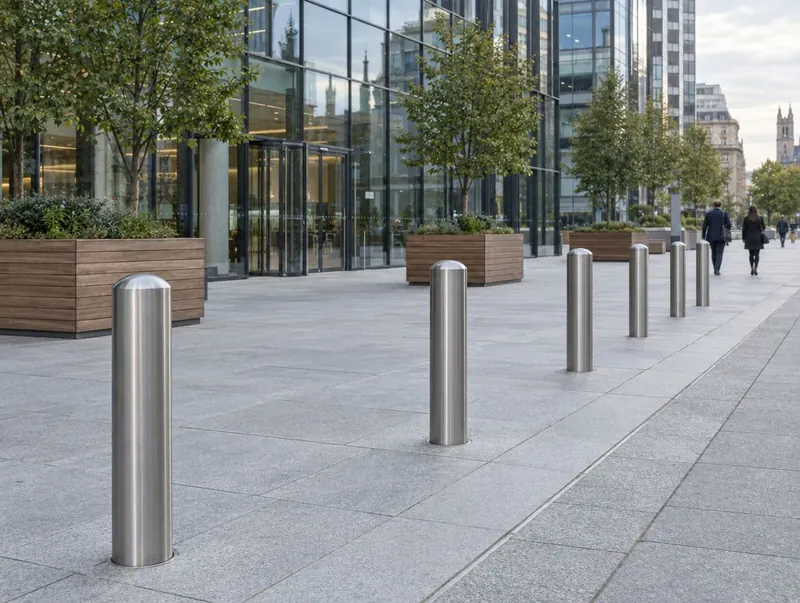 Computer-generated image
Heywood stainless steel bollards
Across Heywood, typical sites for stainless steel bollards include community car parks, town-centre squares and filling-station forecourts. Grade 304 suits most inland sites, while 316 is preferred near the coast, pools or heavy de-icing salt.
We cover every part of Heywood in the OL10 postcode district. We also cover neighbouring Middleton (3 miles), Rochdale (3.2 miles), Bury (3.3 miles) and Royton (4.4 miles) — distances are straight-line. It sits roughly 5 miles from Oldham as the crow flies.
Local details
- Area
- Greater Manchester, England
- Highway authority
- Rochdale Council (local roads)
- Planning authority
- Rochdale Council
- Postcodes
- OL10
- Guide price
- Typically £285–£1,195 per bollard + VAT (£335–£1,445 inc VAT for homes); minimum job £675
- Survey
- Free, with a fixed written quote
Guide prices for Heywood
| Specification | Guide price | Includes |
|---|---|---|
| Standard | £285–£655 + VAT · £335–£785 inc VAT | Standard post, foundation, reinstatement |
| Upgraded | £555–£925 + VAT · £665–£1,095 inc VAT | Upgraded finish or fittings, reflective band, matched keys |
| Premium | £815–£1,195 + VAT · £975–£1,445 inc VAT | Heavy-duty or architectural spec, premium finish |
Per bollard, supplied and installed; -2% for North West. Guide only — the fixed price follows a survey.
What Heywood sites use stainless steel bollards for
Common uses in a place like Heywood:
- Disguising crash-rated cores as ordinary street furniture
- Office, hotel and hospital entrances
- Civic squares and pedestrianised plazas
Permissions and groundwork in Heywood
The highway authority for local roads in Heywood is Rochdale Council; motorways and trunk roads sit with National Highways. Stainless steel bollards on the adopted footway are a matter for the highway authority, so we only install there with its written agreement.
If your site in Heywood is listed or inside a conservation area, check with the local planning authority (Rochdale Council) before choosing a finish — heritage settings often favour cast iron or painted steel over stainless.
Stainless can be stained by iron particles from cutting discs, drills and steel tools used nearby, and those particles rust on the surface within days. Where covers go over existing posts, there is usually no excavation at all, but the base of the old post often sits in broken surfacing that is worth making good at the same time so the cover finishes neatly against a clean edge.
- Add a contrasting band near the top, because bare stainless can blend into pale paving for partially sighted people.
- Check with the local planning authority before installing in conservation areas or beside listed buildings, where stainless may not be considered appropriate.
How the job runs
Survey and match
A free site survey records existing cores, diameters, heights and the setting, including any salt or coastal exposure that points to 316. You receive a fixed written quote covering grade, finish and fixing.
Prepare the cores
For covers, existing posts are checked for straightness, loose foundations and corrosion. Cores that lean or move are re-bedded first, because a cover will not hide a failing post for long.
Fit covers
Sleeves are slid over the cores, packed so they cannot rattle, and fixed with concealed fixings. A gap or drainage detail at the base stops water being trapped inside.
Options to consider
| Option | Detail |
|---|---|
| Grade 304 or 316 | 304 for most inland locations; 316 near the coast, swimming pools, or roads and car parks salted heavily in winter. |
| Contrasting bands | Dark or reflective bands so posts stand out against pale paving, which bare stainless often does not. |
| Brushed or polished finish | Satin brushed finishes hide fingerprints and light scratches; mirror polish is striking but shows every mark. |
What affects the quote
When we price stainless steel bollards in Heywood, these make the biggest difference:
- Surface reinstatement and protection of the finish during works
- Diameter and height, and any custom heads or engraving
- Grade 304 or 316 and the surface finish
Keeping them working
Check covers for loose fixings and rattles, and look at the base for trapped water or rust from an old core underneath. Light tea staining can be removed with a stainless cleaner and a non-scratch pad, working with the grain of a brushed finish.
We can also service, repair or replace existing posts anywhere in Heywood.
Common questions
Which parts of Heywood do you cover for stainless steel bollards?
We cover all of Heywood (OL10) and the rest of Greater Manchester. We also work in Middleton, Rochdale and Bury.
Who gives permission for bollards on the pavement in Heywood?
In Heywood, work on adopted pavements and verges needs consent from Rochdale Council, the local highway authority. Car parks, forecourts and other private land only need the owner's permission.
What's a typical price for stainless steel bollards in Heywood?
In Heywood, typically £285–£1,195 per bollard, supplied and installed, plus VAT (£335–£1,445 including VAT for homeowners), with a minimum job of £675 plus VAT, using our North West guide prices. The fixed figure comes in writing after we've seen the site.
Should I choose 304 or 316 stainless for bollards?
Choose 316 if the bollards are near the sea, a swimming pool or a road that is salted heavily; choose 304 for most other locations. The extra resistance of 316 to chlorides is what stops brown staining in those settings.
Why has our stainless steel gone brown?
Usually because of tea staining from chlorides, a grade unsuited to the location, a coarse finish that holds dirt, or iron contamination from nearby cutting. Most of it cleans off. If it keeps returning, the grade or finish may be wrong for the site.