Highland · Scotland
Stainless steel bollards and covers in Inverness
Local installation of stainless steel bollards in Inverness — free survey, fixed written price, and posts set to the right spacing for people and vehicles.
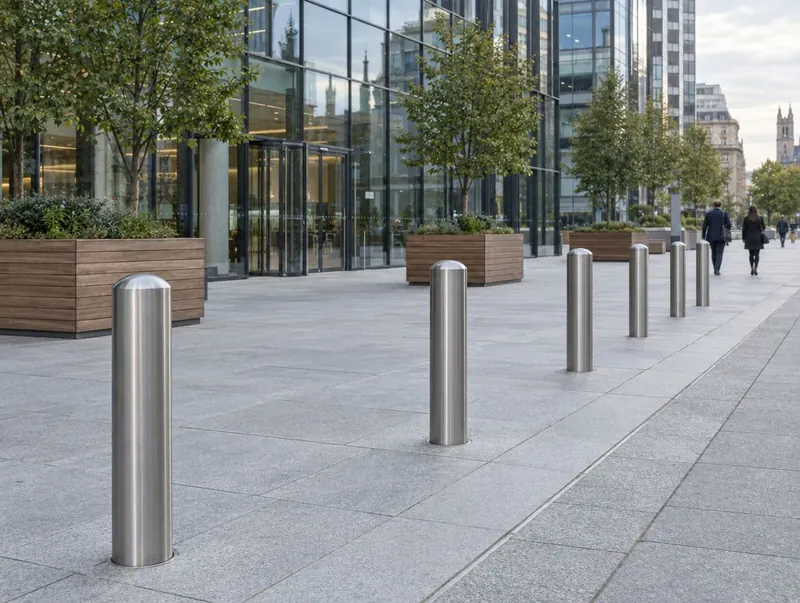 Computer-generated image
About stainless steel bollards in Inverness
We supply and fit stainless steel bollards throughout Inverness, typically for sites such as town-centre squares, schools and community car parks. A stainless bollard cover is a sleeve that slides over an existing or new steel core, changing its look without replacing the structural post.
We cover Inverness's IV1, IV3, IV2 and IV8 postcode districts, including places such as North Kessock, Leachkin, Cradlehall and Ardersier. Inverness is fairly self-contained, with no other large town within about 20 miles.
Inverness at a glance
- Area
- Highland, Scotland
- Roads authority
- The Highland Council (local roads)
- Planning authority
- The Highland Council
- Postcodes
- IV1, IV3, IV2 and IV8
- Guide price
- Typically £295–£1,195 per bollard + VAT (£345–£1,445 inc VAT for homes); minimum job £695
- Survey
- Free, with a fixed written quote
What Inverness sites use stainless steel bollards for
Common uses in a place like Inverness:
- Sleeving existing painted steel posts that have become tatty
- Retail parks and shopping centre frontages
- Office, hotel and hospital entrances
Inverness: typical stainless steel bollard prices
| Specification | Guide price | Includes |
|---|---|---|
| Standard | £295–£675 + VAT · £345–£805 inc VAT | Standard post, foundation, reinstatement |
| Upgraded | £565–£945 + VAT · £675–£1,145 inc VAT | Upgraded finish or fittings, reflective band, matched keys |
| Premium | £835–£1,195 + VAT · £995–£1,445 inc VAT | Heavy-duty or architectural spec, premium finish |
Per bollard, supplied and installed; no regional adjustment. Guide only — the fixed price follows a survey.
Permissions and groundwork in Inverness
Inverness falls under The Highland Council as roads authority. If the line of posts crosses onto adopted road or pavement, permission comes before excavation; on private land it does not.
Bollards on private land often need no planning application, but listed buildings and conservation areas are different; the planning service at The Highland Council can confirm before anything is ordered.
Paving around new posts is cut before the posts arrive, or the posts are protected while it happens. Where covers go over existing posts, there is usually no excavation at all, but the base of the old post often sits in broken surfacing that is worth making good at the same time so the cover finishes neatly against a clean edge.
- Keep clear gaps of typically at least 1,000–1,200 mm on pedestrian routes, in line with Inclusive Mobility guidance.
- Check with the local planning authority before installing in conservation areas or beside listed buildings, where stainless may not be considered appropriate.
From survey to handover
Prepare the cores
For covers, existing posts are checked for straightness, loose foundations and corrosion. Cores that lean or move are re-bedded first, because a cover will not hide a failing post for long.
Fit covers
Sleeves are slid over the cores, packed so they cannot rattle, and fixed with concealed fixings. A gap or drainage detail at the base stops water being trapped inside.
Clean and protect
Fingerprints, grinding dust and adhesive residue are cleaned off with suitable stainless cleaners, and the protective film is removed only when surrounding work is finished.
Options to consider
| Option | Detail |
|---|---|
| Solid stainless posts | Root-fixed, base-plated or removable posts, often concrete-filled or with a steel insert for strength. |
| Heads and details | Domed, flat, angled or ball tops, grooved bands, engraved logos and inset reflective strips. |
| Sleeve covers | Stainless sleeves over existing or new steel cores, sized to the core diameter, to refresh or upgrade appearance. |
What affects the quote
Our Scotland guide prices are a starting point; the survey in Inverness firms them up. What tends to move them:
- Condition of existing cores and any re-bedding needed
- Diameter and height, and any custom heads or engraving
- Surface reinstatement and protection of the finish during works
Keeping them working
Stainless steel is low maintenance, not no maintenance. Light tea staining can be removed with a stainless cleaner and a non-scratch pad, working with the grain of a brushed finish.
If posts in Inverness are later hit or damaged, we can repair or replace them — see bollard repairs.
Stainless steel bollards in Inverness: FAQs
Can you install stainless steel bollards anywhere in Inverness?
We cover all of Inverness (IV1, IV3, IV2 and IV8) and the rest of Highland.
Do I need consent for stainless steel bollards on a public footway in Inverness?
In Scotland the council is the roads authority for local roads, which in Inverness means The Highland Council. Stainless steel bollards on an adopted footway need its consent; trunk roads sit with Transport Scotland.
How much do stainless steel bollards cost in Inverness?
In Inverness, typically £295–£1,195 per bollard, supplied and installed, plus VAT (£345–£1,445 including VAT for homeowners), with a minimum job of £695 plus VAT, using our Scotland guide prices. The fixed figure comes in writing after we've seen the site.
Why has our stainless steel gone brown?
Usually because of tea staining from chlorides, a grade unsuited to the location, a coarse finish that holds dirt, or iron contamination from nearby cutting. Most of it cleans off. If it keeps returning, the grade or finish may be wrong for the site.
Should I choose 304 or 316 stainless for bollards?
Choose 316 if the bollards are near the sea, a swimming pool or a road that is salted heavily; choose 304 for most other locations. The extra resistance of 316 to chlorides is what stops brown staining in those settings.