Norfolk · England
Stainless steel bollards and covers in Norwich
Planning stainless steel bollards in Norwich? We check ownership, consents and buried services first, then quote a fixed price.
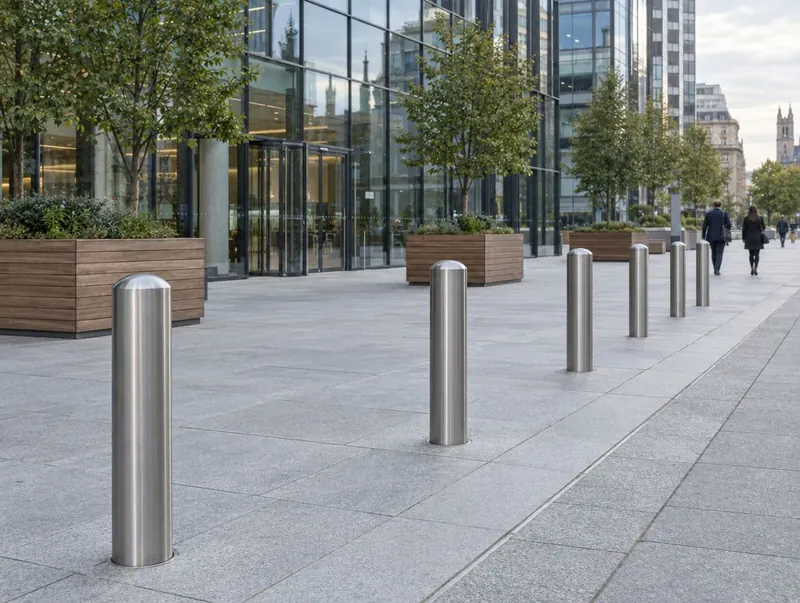 Computer-generated image
Norwich stainless steel bollards
Across Norwich, typical sites for stainless steel bollards include retail parks, town-centre streets and industrial estates. Stainless steel bollards and sleeve covers in 304 or 316 grade, for building entrances, plazas and upgrading tired steel posts.
Coverage in Norwich takes in the NR1, NR2, NR3, NR7, NR4 and NR6 postcode districts and nearby places like Colney. We also cover neighbouring Great Yarmouth (18.2 miles) and Lowestoft (21.8 miles) — distances are straight-line.
Key facts for this area
- Area
- Norfolk, England
- Highway authority
- Norfolk County Council (local roads)
- Planning authority
- the council for Norwich
- Postcodes
- NR1, NR2, NR3, NR7, NR4, NR6 and NR5
- Guide price
- Typically £305–£1,245 per bollard + VAT (£365–£1,495 inc VAT for homes); minimum job £715
- Survey
- Free, with a fixed written quote
- Nearby
- Great Yarmouth (18.2 mi), Lowestoft (21.8 mi)
What stainless steel bollards cost in Norwich
| Specification | Guide price | Includes |
|---|---|---|
| Standard | £305–£695 + VAT · £365–£825 inc VAT | Standard post, foundation, reinstatement |
| Upgraded | £585–£975 + VAT · £695–£1,145 inc VAT | Upgraded finish or fittings, reflective band, matched keys |
| Premium | £865–£1,245 + VAT · £1,045–£1,495 inc VAT | Heavy-duty or architectural spec, premium finish |
Per bollard, supplied and installed; +3% for East of England. Guide only — the fixed price follows a survey.
Typical stainless steel bollards jobs in Norwich
Common uses in a place like Norwich:
- Coastal and poolside sites where paint finishes fail
- Civic squares and pedestrianised plazas
- Disguising crash-rated cores as ordinary street furniture
What we check first in Norwich
In Norwich, work on adopted pavements and verges needs consent from Norfolk County Council, the local highway authority. Car parks, forecourts and other private land only need the owner's permission.
If your site in Norwich is listed or inside a conservation area, check with the local planning authority (the council for Norwich) before choosing a finish — heritage settings often favour cast iron or painted steel over stainless.
For solid stainless posts the foundation work is the same as for steel: dig to depth, check for services, set in concrete and reinstate. Where covers go over existing posts, there is usually no excavation at all, but the base of the old post often sits in broken surfacing that is worth making good at the same time so the cover finishes neatly against a clean edge.
- Check with the local planning authority before installing in conservation areas or beside listed buildings, where stainless may not be considered appropriate.
- Keep clear gaps of typically at least 1,000–1,200 mm on pedestrian routes, in line with Inclusive Mobility guidance.
How the job runs
Install new posts
New solid stainless posts are set in concrete, bolted down or fitted into sockets, with care taken not to scratch the finish or contaminate it with carbon steel tools.
Fit covers
Sleeves are slid over the cores, packed so they cannot rattle, and fixed with concealed fixings. A gap or drainage detail at the base stops water being trapped inside.
Clean and protect
Fingerprints, grinding dust and adhesive residue are cleaned off with suitable stainless cleaners, and the protective film is removed only when surrounding work is finished.
Finishes and options
| Option | Detail |
|---|---|
| Grade 304 or 316 | 304 for most inland locations; 316 near the coast, swimming pools, or roads and car parks salted heavily in winter. |
| Sleeve covers | Stainless sleeves over existing or new steel cores, sized to the core diameter, to refresh or upgrade appearance. |
| Covers for rated bollards | Manufacturer-supplied or approved covers for crash-tested cores so the security rating is not compromised. |
Pricing stainless steel bollards in Norwich
Our East of England guide prices are a starting point; the survey in Norwich firms them up. What tends to move them:
- Manufacturer-approved covers for rated bollards
- Solid posts or covers over existing cores
- Surface reinstatement and protection of the finish during works
Looking after them
Light tea staining can be removed with a stainless cleaner and a non-scratch pad, working with the grain of a brushed finish. Stainless steel is low maintenance, not no maintenance.
If posts in Norwich are later hit or damaged, we can repair or replace them — see bollard repairs.
Stainless steel bollards in Norwich: FAQs
Which parts of Norwich do you cover for stainless steel bollards?
We cover all of Norwich (NR1, NR2, NR3, NR7, NR4 and NR6) and the rest of Norfolk. We also work in Great Yarmouth and Lowestoft.
Who gives permission for bollards on the pavement in Norwich?
The highway authority for local roads in Norwich is Norfolk County Council; motorways and trunk roads sit with National Highways. Stainless steel bollards on the adopted footway are a matter for the highway authority, so we only install there with its written agreement.
What's a typical price for stainless steel bollards in Norwich?
In Norwich, typically £305–£1,245 per bollard, supplied and installed, plus VAT (£365–£1,495 including VAT for homeowners), with a minimum job of £715 plus VAT, using our East of England guide prices. The fixed figure comes in writing after we've seen the site.
Should I choose 304 or 316 stainless for bollards?
Choose 316 if the bollards are near the sea, a swimming pool or a road that is salted heavily; choose 304 for most other locations. The extra resistance of 316 to chlorides is what stops brown staining in those settings.
Why has our stainless steel gone brown?
Usually because of tea staining from chlorides, a grade unsuited to the location, a coarse finish that holds dirt, or iron contamination from nearby cutting. Most of it cleans off. If it keeps returning, the grade or finish may be wrong for the site.