Cheshire · England
Steel security bollard installation in Widnes
Steel security bollards for sites across Widnes and the rest of Cheshire, from the first measurement to the last relaid paving block.
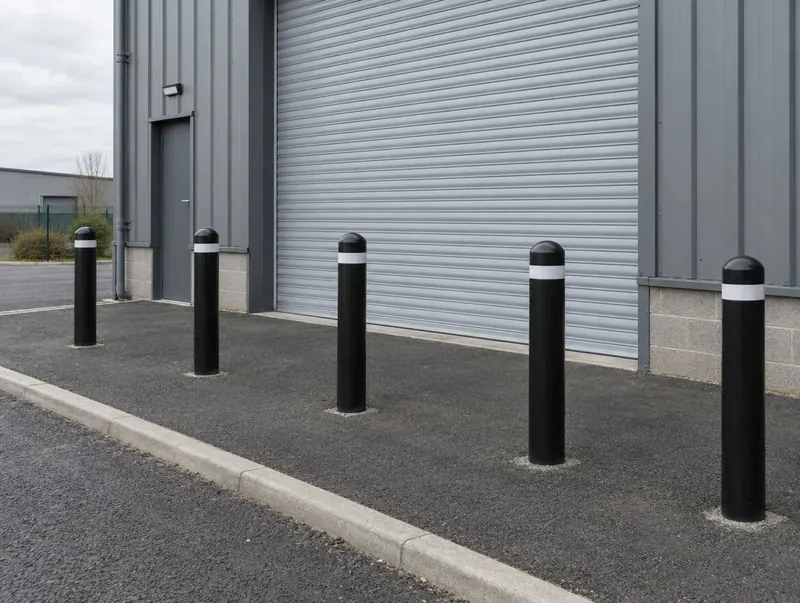 Computer-generated image
Steel security bollards in Widnes
We supply and fit steel security bollards throughout Widnes, typically for sites such as schools, town-centre squares and high street shopfronts. Concrete-filled steel bollards, root-fixed or base-plated, for car parks, forecourts, boundaries and nuisance vehicle control.
We cover Widnes's WA8 postcode district, including places such as Hale Bank. We also cover neighbouring Runcorn (1.4 miles), Halewood (4 miles), Prescot (5.4 miles) and Huyton (5.5 miles) — distances are straight-line. Liverpool is around 11 miles away.
Widnes at a glance
- Area
- Cheshire, England
- Highway authority
- Halton Borough Council (local roads)
- Planning authority
- Halton Borough Council
- Postcodes
- WA8
- Guide price
- Typically £195–£875 per bollard + VAT (£225–£1,045 inc VAT for homes); minimum job £575
- Survey
- Free, with a fixed written quote
Widnes: typical steel security bollard prices
| Specification | Guide price | Includes |
|---|---|---|
| Standard | £195–£475 + VAT · £225–£565 inc VAT | Standard post, foundation, reinstatement |
| Upgraded | £395–£685 + VAT · £465–£815 inc VAT | Upgraded finish or fittings, reflective band, matched keys |
| Premium | £605–£875 + VAT · £725–£1,045 inc VAT | Heavy-duty or architectural spec, premium finish |
Per bollard, supplied and installed; -2% for North West. Guide only — the fixed price follows a survey.
Steel security bollards in Widnes: common uses
Common uses in a place like Widnes:
- Car park perimeters, end-of-bay protection and walkway edges
- Social housing estates with nuisance parking
- Forecourts and building entrances needing a visible boundary
Before we dig in Widnes
The highway authority for local roads in Widnes is Halton Borough Council; motorways and trunk roads sit with National Highways. Steel security bollards on the adopted footway are a matter for the highway authority, so we only install there with its written agreement.
Bollards on private land often don't need planning permission, but it depends on the council's view, the height and the location; in a conservation area, next to a listed building or under an Article 4 direction, ask the local planning authority (Halton Borough Council) first — we flag this at survey.
Reinstatement matches the surface, whether tarmac, block paving, flags or turf. Base plates must sit on a slab thick and sound enough to hold resin anchors; cracked or thin concrete will let the anchors pull out on the first knock.
- Do not describe unrated posts as anti-ram or HVM protection in risk assessments or to insurers.
- Check whether the land is public highway or adopted verge before installing; the highway authority's agreement is usually needed.
From survey to handover
Survey and set out
A free site survey confirms positions, surfaces, buried services and whether root-fixing or base plates suit the ground. You receive a fixed written quote listing post size, finish and fixing.
Break out and excavate
For root-fixed posts, the surface is cut neatly and each hole is dug to depth, by hand near known services. For base plates, the slab is checked for thickness and soundness.
Reinstate and finish
The surface around each post is made good to match, and reflective bands are fitted. Damaged galvanising from handling is touched up.
Specification choices
| Option | Detail |
|---|---|
| Caps and heads | Dome, flat, chamfered or ball tops, with welded caps to keep water out of hollow posts. |
| Tube size and wall thickness | Common diameters include 76, 114, 140, 168 and 219 mm, with heavier walls for service yards and vehicle routes. |
| Root-fixed | Cast into a concrete foundation, typically with several hundred millimetres of post below ground. The usual choice where digging is possible. |
Pricing steel security bollards in Widnes
Two Widnes jobs with the same number of posts can price quite differently. The usual reasons:
- Root-fixed or base-plated installation
- Surface reinstatement such as block paving or tarmac
- Number of posts and length of the line
Looking after them
Reflective bands fade and peel and are easy to renew. A post that leans after a knock usually means the foundation has moved or cracked; it should be re-bedded or replaced rather than left as a trip or snag hazard.
If posts in Widnes are later hit or damaged, we can repair or replace them — see bollard repairs.
Common questions
Which parts of Widnes do you cover for steel security bollards?
We cover all of Widnes (WA8) and the rest of Cheshire. We also work in Runcorn, Halewood and Prescot.
Who gives permission for bollards on the pavement in Widnes?
The highway authority for local roads in Widnes is Halton Borough Council; motorways and trunk roads sit with National Highways. Steel security bollards on the adopted footway are a matter for the highway authority, so we only install there with its written agreement.
What's a typical price for steel security bollards in Widnes?
In Widnes, typically £195–£875 per bollard, supplied and installed, plus VAT (£225–£1,045 including VAT for homeowners), with a minimum job of £575 plus VAT, using our North West guide prices. The fixed figure comes in writing after we've seen the site.
Will galvanised posts rust?
Hot-dip galvanising protects steel for a long time in normal outdoor conditions. Powder coat over the galvanising adds colour and extra protection. Touch up chips promptly in coastal or heavily salted locations.
Are unrated steel bollards anti-ram?
No. They have not been crash-tested, so their performance against a deliberate vehicle attack is unknown. They are suited to nuisance parking and low-speed knocks; tested products are needed where an attack is the concern.