Kent · England
Steel security bollard installation in Dover
Planning steel security bollards in Dover? We check ownership, consents and buried services first, then quote a fixed price.
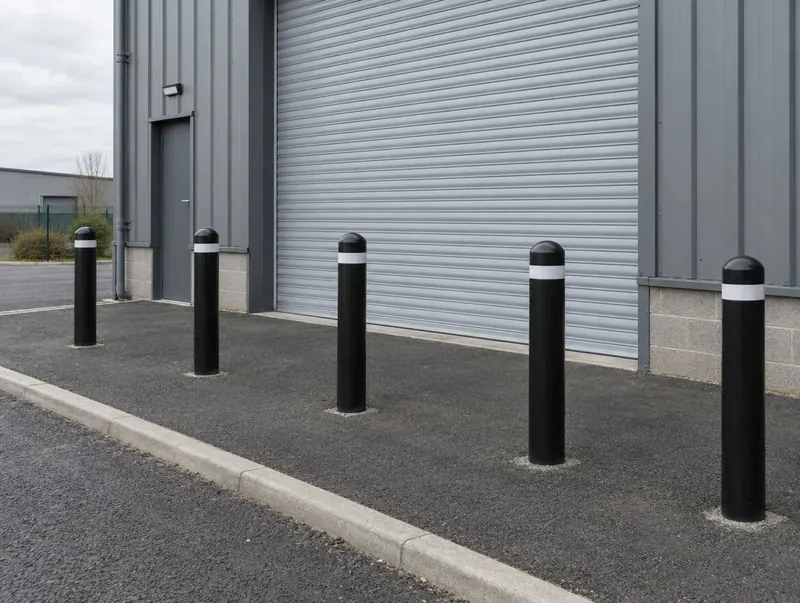 Computer-generated image
About steel security bollards in Dover
Across Dover, typical sites for steel security bollards include community car parks, schools and small industrial units. Concrete-filled steel bollards, root-fixed or base-plated, for car parks, forecourts, boundaries and nuisance vehicle control.
Coverage in Dover takes in the CT17, CT16 and CT15 postcode districts and nearby places like Whitfield, Church Whitfield, St Margaret's at Cliffe and Eythorne. We also cover neighbouring Folkestone (7 miles), Deal (7.8 miles), Canterbury (14.6 miles) and Ramsgate (15.2 miles) — distances are straight-line.
Dover at a glance
- Area
- Kent, England
- Highway authority
- Kent County Council (local roads)
- Planning authority
- the council for Dover
- Postcodes
- CT17, CT16 and CT15
- Guide price
- Typically £205–£945 per bollard + VAT (£245–£1,145 inc VAT for homes); minimum job £625
- Survey
- Free, with a fixed written quote
- Nearby
- Folkestone (7 mi), Deal (7.8 mi), Canterbury (14.6 mi), Ramsgate (15.2 mi)
Guide prices for Dover
| Specification | Guide price | Includes |
|---|---|---|
| Standard | £205–£515 + VAT · £245–£615 inc VAT | Standard post, foundation, reinstatement |
| Upgraded | £425–£745 + VAT · £505–£885 inc VAT | Upgraded finish or fittings, reflective band, matched keys |
| Premium | £655–£945 + VAT · £785–£1,145 inc VAT | Heavy-duty or architectural spec, premium finish |
Per bollard, supplied and installed; +6% for South East. Guide only — the fixed price follows a survey.
Where steel security bollards go in around Dover
Common uses in a place like Dover:
- Forecourts and building entrances needing a visible boundary
- Protecting meter boxes, gas kiosks, pillars and corners
- Car park perimeters, end-of-bay protection and walkway edges
What we check first in Dover
The highway authority for local roads in Dover is Kent County Council; motorways and trunk roads sit with National Highways. Steel security bollards on the adopted footway are a matter for the highway authority, so we only install there with its written agreement.
Many private-land installations in Dover need no planning application, but the rules don't clearly cover bollards, so listed buildings, conservation areas and prominent frontages are worth raising with the planning team at the council for Dover before posts go in.
Root-fixed posts need firm ground and enough depth to carry the post's root plus a concrete surround. Service runs commonly follow kerb lines and verges, which is exactly where steel posts tend to go, so positions are checked with records and scanning before digging.
- Keep clear gaps of typically at least 1,000–1,200 mm where pedestrians, wheelchair users or buggies pass between posts.
- Check whether the land is public highway or adopted verge before installing; the highway authority's agreement is usually needed.
What happens on site
Survey and set out
A free site survey confirms positions, surfaces, buried services and whether root-fixing or base plates suit the ground. You receive a fixed written quote listing post size, finish and fixing.
Break out and excavate
For root-fixed posts, the surface is cut neatly and each hole is dug to depth, by hand near known services. For base plates, the slab is checked for thickness and soundness.
Set the posts
Posts are set plumb and to a consistent height along the line, and concreted in. Base-plated posts are drilled, anchored with resin and torqued once cured.
Options to consider
| Option | Detail |
|---|---|
| Tube size and wall thickness | Common diameters include 76, 114, 140, 168 and 219 mm, with heavier walls for service yards and vehicle routes. |
| Visibility bands | Reflective or contrasting bands near the top for drivers at night and for partially sighted pedestrians. |
| Finishes | Hot-dip galvanised, then powder-coated in a RAL colour if wanted. Black, grey, yellow and green are common. |
What moves the price in Dover
Two Dover jobs with the same number of posts can price quite differently. The usual reasons:
- Number of posts and length of the line
- Ground conditions and buried services
- Tube diameter, wall thickness and concrete infill
Looking after them
Galvanised steel posts need little attention for years at a time. Reflective bands fade and peel and are easy to renew.
If posts in Dover are later hit or damaged, we can repair or replace them — see bollard repairs.
Steel security bollards in Dover: FAQs
Do you install steel security bollards in Dover?
We cover all of Dover (CT17, CT16 and CT15) and the rest of Kent. We also work in Folkestone, Deal and Canterbury.
Who gives permission for bollards on the pavement in Dover?
The highway authority for local roads in Dover is Kent County Council; motorways and trunk roads sit with National Highways. Steel security bollards on the adopted footway are a matter for the highway authority, so we only install there with its written agreement.
How much do steel security bollards cost in Dover?
In Dover, typically £205–£945 per bollard, supplied and installed, plus VAT (£245–£1,145 including VAT for homeowners), with a minimum job of £625 plus VAT, using our South East guide prices. The fixed figure comes in writing after we've seen the site.
Why fill a steel bollard with concrete?
Concrete infill adds weight and stiffness, so the post dents less and is harder to cut. It also stops water collecting inside a hollow tube. It is usual for security and impact positions.
Will galvanised posts rust?
Hot-dip galvanising protects steel for a long time in normal outdoor conditions. Powder coat over the galvanising adds colour and extra protection. Touch up chips promptly in coastal or heavily salted locations.
Steel security bollards in nearby towns
- Folkestone (7 mi)
- Deal (7.8 mi)
- Canterbury (14.6 mi)
- Ramsgate (15.2 mi)
- Broadstairs (17 mi)
- Margate (17.9 mi)