West Yorkshire · England
Steel security bollard installation in Wakefield
Planning steel security bollards in Wakefield? We check ownership, consents and buried services first, then quote a fixed price.
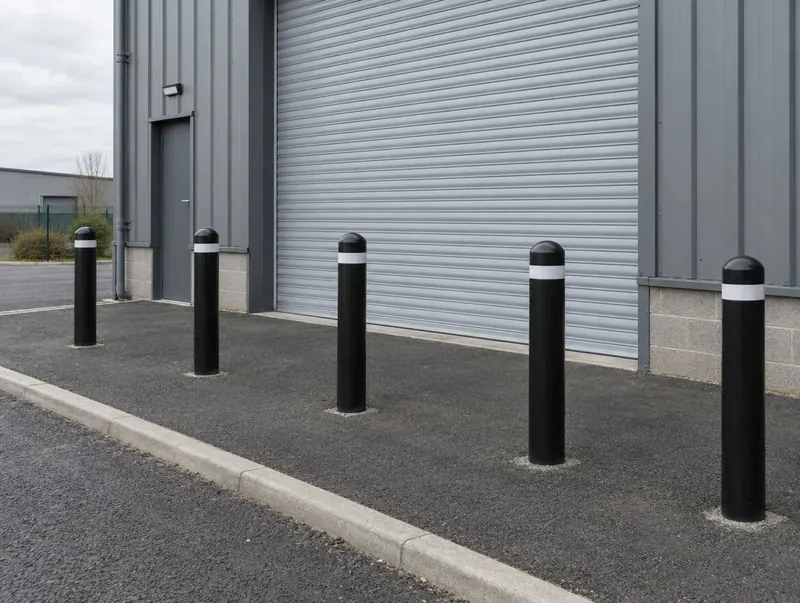 Computer-generated image
Steel security bollards in Wakefield
From business parks, college campuses and industrial estates, Wakefield has plenty of places where steel security bollards earn their keep. Concrete-filled steel bollards, root-fixed or base-plated, for car parks, forecourts, boundaries and nuisance vehicle control.
We cover Wakefield's WF1, WF2, WF3 and WF4 postcode districts, including places such as Kirkthorpe, Warmfield, Horse Race End and Kirkhamgate. We also cover neighbouring Ossett (3.4 miles), Dewsbury (5.4 miles), Batley (5.7 miles) and Morley (5.7 miles) — distances are straight-line. Wakefield is about 8 miles from Leeds.
Key facts for this area
- Area
- West Yorkshire, England
- Highway authority
- Wakefield Council (local roads)
- Planning authority
- Wakefield Council
- Postcodes
- WF1, WF2, WF3 and WF4
- Guide price
- Typically £185–£865 per bollard + VAT (£215–£1,045 inc VAT for homes); minimum job £575
- Survey
- Free, with a fixed written quote
Steel security bollard prices in Wakefield
| Specification | Guide price | Includes |
|---|---|---|
| Standard | £185–£475 + VAT · £215–£565 inc VAT | Standard post, foundation, reinstatement |
| Upgraded | £395–£675 + VAT · £465–£805 inc VAT | Upgraded finish or fittings, reflective band, matched keys |
| Premium | £595–£865 + VAT · £705–£1,045 inc VAT | Heavy-duty or architectural spec, premium finish |
Per bollard, supplied and installed; -3% for Yorkshire and the Humber. Guide only — the fixed price follows a survey.
Steel security bollards in Wakefield: common uses
Typical reasons Wakefield sites choose steel security bollards:
- Protecting meter boxes, gas kiosks, pillars and corners
- Social housing estates with nuisance parking
- Grass verges and landscaped areas that vans keep driving over
What we check first in Wakefield
The highway authority for local roads in Wakefield is Wakefield Council; motorways and trunk roads sit with National Highways. Steel security bollards on the adopted footway are a matter for the highway authority, so we only install there with its written agreement.
Bollards on private land often don't need planning permission, but it depends on the council's view, the height and the location; in a conservation area, next to a listed building or under an Article 4 direction, ask the local planning authority (Wakefield Council) first — we flag this at survey.
Reinstatement matches the surface, whether tarmac, block paving, flags or turf. Service runs commonly follow kerb lines and verges, which is exactly where steel posts tend to go, so positions are checked with records and scanning before digging.
- Check whether the land is public highway or adopted verge before installing; the highway authority's agreement is usually needed.
- Do not describe unrated posts as anti-ram or HVM protection in risk assessments or to insurers.
From survey to handover
Set the posts
Posts are set plumb and to a consistent height along the line, and concreted in. Base-plated posts are drilled, anchored with resin and torqued once cured.
Fill and cap
Where specified, posts are filled with concrete and capped so water cannot collect inside the tube.
Reinstate and finish
The surface around each post is made good to match, and reflective bands are fitted. Damaged galvanising from handling is touched up.
Specification choices
| Option | Detail |
|---|---|
| Tube size and wall thickness | Common diameters include 76, 114, 140, 168 and 219 mm, with heavier walls for service yards and vehicle routes. |
| Base-plated | Bolted to a sound concrete slab with resin anchors. Quick to fit and easy to remove later, suited to light-duty and indoor use. |
| Caps and heads | Dome, flat, chamfered or ball tops, with welded caps to keep water out of hollow posts. |
What moves the price in Wakefield
When we price steel security bollards in Wakefield, these make the biggest difference:
- Finish: galvanised only or powder-coated
- Tube diameter, wall thickness and concrete infill
- Number of posts and length of the line
Looking after them
Powder coat chipped by vehicles should be touched up before the galvanising underneath starts to weather. A post that leans after a knock usually means the foundation has moved or cracked; it should be re-bedded or replaced rather than left as a trip or snag hazard.
If posts in Wakefield are later hit or damaged, we can repair or replace them — see bollard repairs.
Common questions
Which parts of Wakefield do you cover for steel security bollards?
We cover all of Wakefield (WF1, WF2, WF3 and WF4) and the rest of West Yorkshire. We also work in Ossett, Dewsbury and Batley.
Who gives permission for bollards on the pavement in Wakefield?
The highway authority for local roads in Wakefield is Wakefield Council; motorways and trunk roads sit with National Highways. Steel security bollards on the adopted footway are a matter for the highway authority, so we only install there with its written agreement.
What's a typical price for steel security bollards in Wakefield?
In Wakefield, typically £185–£865 per bollard, supplied and installed, plus VAT (£215–£1,045 including VAT for homeowners), with a minimum job of £575 plus VAT, using our Yorkshire and the Humber guide prices. The fixed figure comes in writing after we've seen the site.
What diameter of steel bollard do I need?
Match it to the job. Around 114 mm suits car park walkways and verges; 168 or 219 mm with a heavier wall suits service yards and corners that lorries pass. The survey looks at what is likely to hit the posts.
Can new posts match our existing ones?
Usually, if we can measure the existing diameter, height, cap and colour. Galvanised steel in standard sizes is easy to match; older or unusual sections may need a close equivalent.