Wrexham · Wales
Steel security bollard installation in Coedpoeth
Steel security bollards supplied and fitted in Coedpoeth, Wrexham: surveyed, scanned for services, set in proper foundations and finished to match the ground.
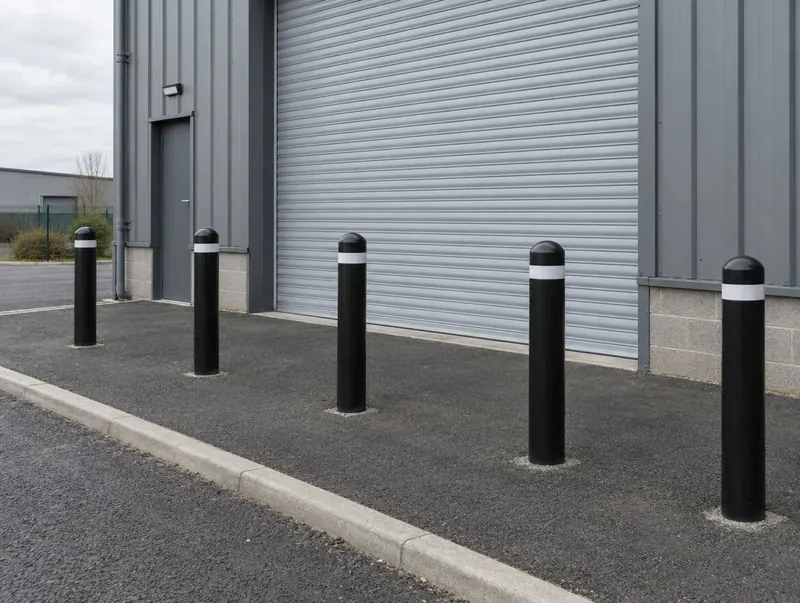 Computer-generated image
Coedpoeth steel security bollards
Whether it's small industrial units, filling-station forecourts and high street shopfronts, steel security bollards in Coedpoeth are planned around who needs to get through and who doesn't. Unrated steel bollards have not been crash-tested, so they deter vehicles and stop low-speed knocks and casual misuse rather than a determined attack.
We cover Coedpoeth's LL14 postcode district, including places such as Rhosllannerchrugog, Pen-y-cae, Rhostyllen and Cefn-bychan. We also cover neighbouring Wrexham (3 miles), Mold (8.5 miles), Deeside (10.2 miles) and Flint (13.5 miles) — distances are straight-line.
Coedpoeth at a glance
- Area
- Wrexham, Wales
- Highway authority
- Wrexham County Borough Council (local roads)
- Planning authority
- Wrexham County Borough Council
- Postcodes
- LL14
- Guide price
- Typically £185–£865 per bollard + VAT (£215–£1,045 inc VAT for homes); minimum job £575
- Survey
- Free, with a fixed written quote
Guide prices for Coedpoeth
| Specification | Guide price | Includes |
|---|---|---|
| Standard | £185–£475 + VAT · £215–£565 inc VAT | Standard post, foundation, reinstatement |
| Upgraded | £395–£675 + VAT · £465–£805 inc VAT | Upgraded finish or fittings, reflective band, matched keys |
| Premium | £595–£865 + VAT · £705–£1,045 inc VAT | Heavy-duty or architectural spec, premium finish |
Per bollard, supplied and installed; -3% for Wales. Guide only — the fixed price follows a survey.
What Coedpoeth sites use steel security bollards for
Typical reasons Coedpoeth sites choose steel security bollards:
- Protecting meter boxes, gas kiosks, pillars and corners
- Stopping cut-through traffic on private roads and estates
- Forecourts and building entrances needing a visible boundary
Permissions and groundwork in Coedpoeth
Before digging near the kerb in Coedpoeth we establish who owns the ground: adopted footways are Wrexham County Borough Council's responsibility, trunk roads the Welsh Government's, and everything else belongs to the site owner.
Bollards on private land often don't need planning permission, but it depends on the council's view, the height and the location; in a conservation area, next to a listed building or under an Article 4 direction, ask the local planning authority (Wrexham County Borough Council) first — we flag this at survey.
Base plates must sit on a slab thick and sound enough to hold resin anchors; cracked or thin concrete will let the anchors pull out on the first knock. Service runs commonly follow kerb lines and verges, which is exactly where steel posts tend to go, so positions are checked with records and scanning before digging.
- Do not describe unrated posts as anti-ram or HVM protection in risk assessments or to insurers.
- Avoid linking posts with chains across pedestrian routes, which can be a trip hazard for blind and partially sighted people.
Installation, step by step
Set the posts
Posts are set plumb and to a consistent height along the line, and concreted in. Base-plated posts are drilled, anchored with resin and torqued once cured.
Fill and cap
Where specified, posts are filled with concrete and capped so water cannot collect inside the tube.
Reinstate and finish
The surface around each post is made good to match, and reflective bands are fitted. Damaged galvanising from handling is touched up.
Choosing the right spec
| Option | Detail |
|---|---|
| Root-fixed | Cast into a concrete foundation, typically with several hundred millimetres of post below ground. The usual choice where digging is possible. |
| Finishes | Hot-dip galvanised, then powder-coated in a RAL colour if wanted. Black, grey, yellow and green are common. |
| Base-plated | Bolted to a sound concrete slab with resin anchors. Quick to fit and easy to remove later, suited to light-duty and indoor use. |
What moves the price in Coedpoeth
When we price steel security bollards in Coedpoeth, these make the biggest difference:
- Ground conditions and buried services
- Finish: galvanised only or powder-coated
- Number of posts and length of the line
After installation
Check periodically for impact damage, loose base plates and cracked surfacing around the root. Powder coat chipped by vehicles should be touched up before the galvanising underneath starts to weather.
We can also service, repair or replace existing posts anywhere in Coedpoeth.
Common questions
Do you install steel security bollards in Coedpoeth?
We cover all of Coedpoeth (LL14) and the rest of Wrexham. We also work in Wrexham, Mold and Deeside.
Who gives permission for bollards on the pavement in Coedpoeth?
Before digging near the kerb in Coedpoeth we establish who owns the ground: adopted footways are Wrexham County Borough Council's responsibility, trunk roads the Welsh Government's, and everything else belongs to the site owner.
How much do steel security bollards cost in Coedpoeth?
In Coedpoeth, typically £185–£865 per bollard, supplied and installed, plus VAT (£215–£1,045 including VAT for homeowners), with a minimum job of £575 plus VAT, using our Wales guide prices. The fixed figure comes in writing after we've seen the site.
Should I choose root-fixed or base-plated steel bollards?
Root-fixed where you can dig and want the stronger post; base-plated where there is a sound slab and you want quick installation or the option to remove posts later. Base plates are limited by the slab and anchors, so they are not the right choice where vehicles hit hard.
Will galvanised posts rust?
Hot-dip galvanising protects steel for a long time in normal outdoor conditions. Powder coat over the galvanising adds colour and extra protection. Touch up chips promptly in coastal or heavily salted locations.