Conwy · Wales
Telescopic bollard installation in Colwyn Bay
Telescopic bollards for sites across Colwyn Bay and the rest of Conwy, from the first measurement to the last relaid paving block.
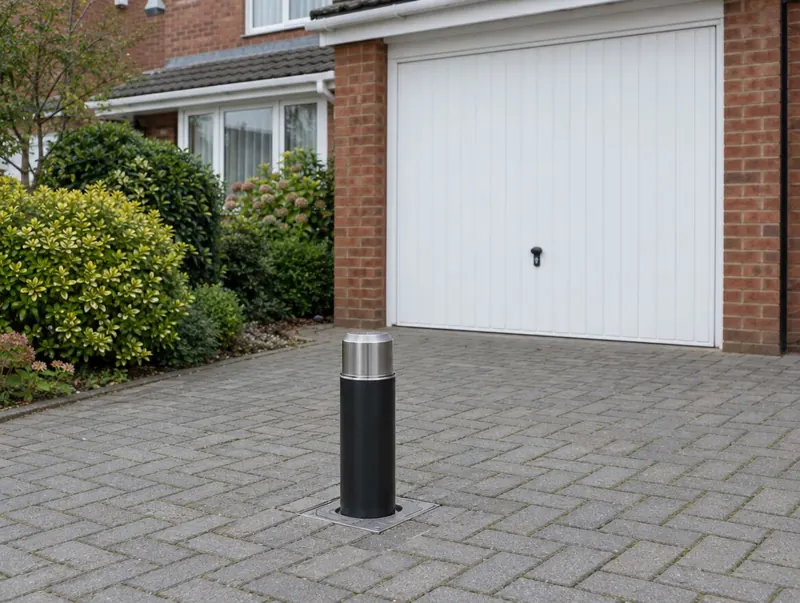 Computer-generated image
About telescopic bollards in Colwyn Bay
Whether it's schools, community car parks and local parades, telescopic bollards in Colwyn Bay are planned around who needs to get through and who doesn't. Because the post stays in its cassette, there is nothing to store and nothing to lose.
We work across LL29 and LL28 — Colwyn Bay itself and places including Mynydd Marian, Llysfaen, Llansanffraid Glan Conwy and Eglwysbach. Nearby, we also work in Llandudno (4.8 miles), Abergele (6 miles), Rhyl (9.8 miles) and Prestatyn (13.5 miles), measured as the crow flies.
Colwyn Bay at a glance
- Area
- Conwy, Wales
- Highway authority
- Conwy County Borough Council (local roads)
- Planning authority
- Conwy County Borough Council
- Postcodes
- LL29 and LL28
- Guide price
- Typically £335–£1,145 per bollard + VAT (£395–£1,345 inc VAT for homes); minimum job £625
- Survey
- Free, with a fixed written quote
Colwyn Bay: typical telescopic bollard prices
| Specification | Guide price | Includes |
|---|---|---|
| Standard | £335–£685 + VAT · £395–£815 inc VAT | Standard post, foundation, reinstatement |
| Upgraded | £585–£925 + VAT · £695–£1,095 inc VAT | Upgraded finish or fittings, reflective band, matched keys |
| Premium | £825–£1,145 + VAT · £985–£1,345 inc VAT | Heavy-duty or architectural spec, premium finish |
Per bollard with cassette, supplied and installed; -3% for Wales. Guide only — the fixed price follows a survey.
Telescopic bollards in Colwyn Bay: common uses
Common uses in a place like Colwyn Bay:
- Shared drives that need occasional closing
- Access roads closed outside working hours
- Car parks where a removable post would go missing
What we check first in Colwyn Bay
In Colwyn Bay the highway authority for local roads is Conwy County Borough Council. We confirm whether the ground is adopted highway before quoting, because telescopic bollards on a public footway need its agreement first.
If your site in Colwyn Bay is listed or inside a conservation area, check with the local planning authority (Conwy County Borough Council) before choosing a finish — heritage settings often favour cast iron or painted steel over stainless.
Positions are scanned and hand-dug before committing. Clay soils and high water tables mean a gravel base alone will not drain the cassette; a connection to a surface water drain or a separate soakaway is then needed, and foul drains are not used.
- Confirm the bollard is on your land; bollards on a public footway or dropped kerb need the highway authority's agreement.
- Connect drainage only to surface water systems or a soakaway, never to a foul drain.
Installation, step by step
Cut and excavate
The surface is cut neatly and the hole dug to the cassette's full depth plus a drainage layer, with care near any service that crosses the drive.
Form the drainage
A gravel soakaway is placed beneath the cassette, or a pipe is laid to a surface water drain or new soakaway.
Reinstate and test
The surface is made good to match. The post is raised, locked, lowered and locked several times to confirm smooth operation, and keys are handed over.
Specification choices
| Option | Detail |
|---|---|
| Standard or lift-assisted | Lift-assisted models use a spring or counterweight so the post rises with little effort, useful for daily domestic use. |
| Lock types | Keyed cylinder locks, often with a cover to keep out dirt; keyed alike for multi-bay sites where one key should open every post. |
| Finishes | Galvanised, powder-coated in common colours, or stainless steel to suit the frontage. |
Pricing telescopic bollards in Colwyn Bay
Our Wales guide prices are a starting point; the survey in Colwyn Bay firms them up. What tends to move them:
- Excavation depth and the presence of services under the drive
- Surface type and quality of reinstatement
- Number of posts and keyed-alike locks
Looking after them
Lower and raise the bollard regularly, even if you rarely need to, so the mechanism stays free. If the post becomes stiff or will not lower fully, the usual causes are debris in the cassette or a blocked drain, both of which are easier to fix early than after the post has seized.
If posts in Colwyn Bay are later hit or damaged, we can repair or replace them — see bollard repairs.
Questions about telescopic bollards in Colwyn Bay
Do you install telescopic bollards in Colwyn Bay?
We cover all of Colwyn Bay (LL29 and LL28) and the rest of Conwy. We also work in Llandudno, Abergele and Rhyl.
Who gives permission for bollards on the pavement in Colwyn Bay?
In Colwyn Bay the highway authority for local roads is Conwy County Borough Council. We confirm whether the ground is adopted highway before quoting, because telescopic bollards on a public footway need its agreement first.
What's a typical price for telescopic bollards in Colwyn Bay?
In Colwyn Bay, typically £335–£1,145 per bollard with cassette, supplied and installed, plus VAT (£395–£1,345 including VAT for homeowners), with a minimum job of £625 plus VAT, using our Wales guide prices. The fixed figure comes in writing after we've seen the site.
Why does my telescopic bollard fill with water?
Because the cassette is not draining, either through a blocked base, clay ground or no drainage provision at installation. Standing water rusts the post and can freeze it in place. Fixing the drainage usually solves the problem.
What if it freezes in winter?
Freezing usually means water is standing in the cassette. Do not force the post; pour warm, not boiling, water around the lid and lift once free. Then have the drainage checked.