Devon · England
Telescopic bollard installation in Plymouth
Telescopic bollards for sites across Plymouth and the rest of Devon, from the first measurement to the last relaid paving block.
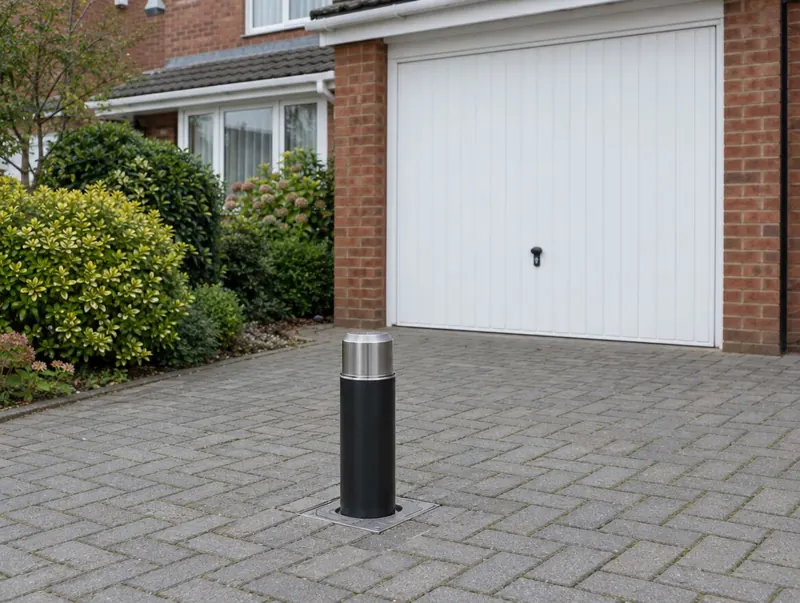 Computer-generated image
Plymouth telescopic bollards
In the city of Plymouth, telescopic bollards tend to go in at multi-storey car parks, office forecourts and pedestrianised streets. Because the post stays in its cassette, there is nothing to store and nothing to lose.
Coverage in Plymouth takes in the PL1, PL4, PL3, PL2, PL9 and PL5 postcode districts. Nearby, we also work in Plymstock (2.4 miles), measured as the crow flies.
Plymouth at a glance
- Area
- Devon, England
- Highway authority
- Plymouth City Council (local roads)
- Planning authority
- Plymouth City Council
- Postcodes
- PL1, PL4, PL3, PL2, PL9, PL5, PL6 and PL7
- Guide price
- Typically £345–£1,195 per bollard + VAT (£405–£1,445 inc VAT for homes); minimum job £645
- Survey
- Free, with a fixed written quote
- Nearby
- Plymstock (2.4 mi)
Plymouth: typical telescopic bollard prices
| Specification | Guide price | Includes |
|---|---|---|
| Standard | £345–£705 + VAT · £405–£845 inc VAT | Standard post, foundation, reinstatement |
| Upgraded | £605–£955 + VAT · £725–£1,145 inc VAT | Upgraded finish or fittings, reflective band, matched keys |
| Premium | £855–£1,195 + VAT · £1,045–£1,445 inc VAT | Heavy-duty or architectural spec, premium finish |
Per bollard with cassette, supplied and installed; no regional adjustment. Guide only — the fixed price follows a survey.
Where telescopic bollards go in around Plymouth
Typical reasons Plymouth sites choose telescopic bollards:
- Domestic driveways where the bollard is used daily
- Access roads closed outside working hours
- Allocated parking bays in flats and private developments
What we check first in Plymouth
In Plymouth, work on adopted pavements and verges needs consent from Plymouth City Council, the local highway authority. Car parks, forecourts and other private land only need the owner's permission.
Bollards on private land often don't need planning permission, but it depends on the council's view, the height and the location; in a conservation area, next to a listed building or under an Article 4 direction, ask the local planning authority (Plymouth City Council) first — we flag this at survey.
Clay soils and high water tables mean a gravel base alone will not drain the cassette; a connection to a surface water drain or a separate soakaway is then needed, and foul drains are not used. Drives commonly hide the water supply pipe, gas service, electric cable and drainage runs, often at shallow depth, and they cluster near the property boundary where posts are usually wanted.
- Connect drainage only to surface water systems or a soakaway, never to a foul drain.
- If the drive is shared, agree positions and keys with the other users first.
From survey to handover
Check depth and drainage
The free site survey checks how far down we can dig, where services run under the drive and how the ground drains. If water will stand, a drain connection is priced into the fixed written quote.
Cut and excavate
The surface is cut neatly and the hole dug to the cassette's full depth plus a drainage layer, with care near any service that crosses the drive.
Form the drainage
A gravel soakaway is placed beneath the cassette, or a pipe is laid to a surface water drain or new soakaway.
Finishes and options
| Option | Detail |
|---|---|
| Finishes | Galvanised, powder-coated in common colours, or stainless steel to suit the frontage. |
| Standard or lift-assisted | Lift-assisted models use a spring or counterweight so the post rises with little effort, useful for daily domestic use. |
| Reflective bands | Bands near the top help drivers see a raised post at night, particularly on drives shared with visitors. |
What moves the price in Plymouth
Two Plymouth jobs with the same number of posts can price quite differently. The usual reasons:
- Number of posts and keyed-alike locks
- Post size and whether lift assistance is wanted
- Surface type and quality of reinstatement
After installation
Lower and raise the bollard regularly, even if you rarely need to, so the mechanism stays free. Lubricate the lock with a suitable spray, especially before winter.
We can also service, repair or replace existing posts anywhere in Plymouth.
Common questions
Can you install telescopic bollards anywhere in Plymouth?
We cover all of Plymouth (PL1, PL4, PL3, PL2, PL9 and PL5) and the rest of Devon. We also work in Plymstock.
Do I need consent for telescopic bollards on a public footway in Plymouth?
Plymouth City Council is the highway authority covering Plymouth's local roads. If any post would stand on adopted highway rather than your land, that consent is the first thing we sort out.
What's a typical price for telescopic bollards in Plymouth?
In Plymouth, typically £345–£1,195 per bollard with cassette, supplied and installed, plus VAT (£405–£1,445 including VAT for homeowners), with a minimum job of £645 plus VAT, using our South West guide prices. The fixed figure comes in writing after we've seen the site.
Is a telescopic bollard harder to lift than a removable one?
Usually easier, because you only lift it up a short distance within its cassette and many models have lift assistance. You also never carry it or store it anywhere.
Will a telescopic bollard stop my car being stolen?
It adds a physical barrier that a thief has to defeat before driving away, which slows them down and makes the car a less attractive target. It is one layer of protection, not a complete answer to keyless car theft.