East Dunbartonshire · Scotland
Telescopic bollard installation in Bishopbriggs
Local installation of telescopic bollards in Bishopbriggs — free survey, fixed written price, and posts set to the right spacing for people and vehicles.
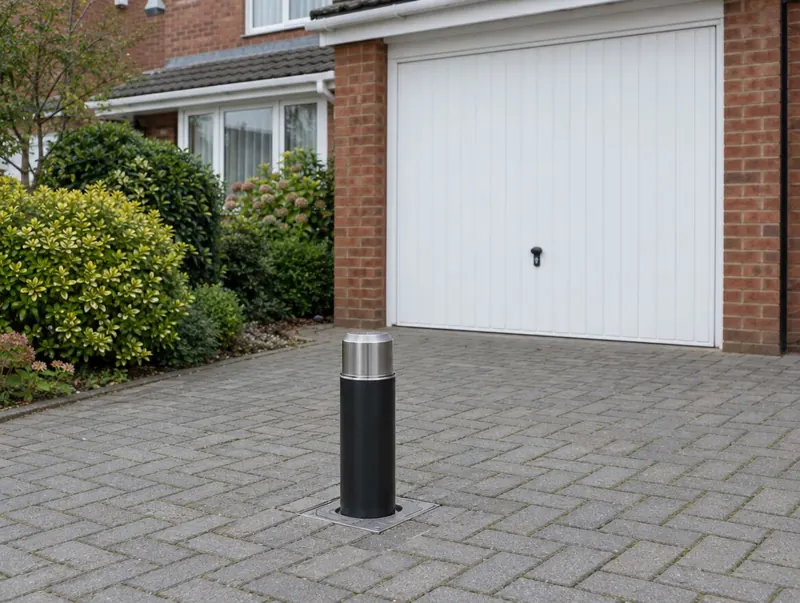 Computer-generated image
Telescopic bollards in Bishopbriggs
In the town of Bishopbriggs, telescopic bollards tend to go in at filling-station forecourts, high street shopfronts and community car parks. Key-locked telescopic bollards that retract into a ground cassette, for driveways, private bays and access roads.
We cover Bishopbriggs's G64 postcode district, including places such as Torrance and Balmore. We also cover neighbouring Glasgow (3.2 miles), Kirkintilloch (3.4 miles), Bearsden (4.5 miles) and Milngavie (4.7 miles) — distances are straight-line. Glasgow is around 3 miles away.
Key facts for this area
- Area
- East Dunbartonshire, Scotland
- Roads authority
- East Dunbartonshire Council (local roads)
- Planning authority
- East Dunbartonshire Council
- Postcodes
- G64
- Guide price
- Typically £345–£1,195 per bollard + VAT (£405–£1,445 inc VAT for homes); minimum job £645
- Survey
- Free, with a fixed written quote
- Nearby
- Glasgow (3.2 mi), Kirkintilloch (3.4 mi), Bearsden (4.5 mi), Milngavie (4.7 mi)
Guide prices for Bishopbriggs
| Specification | Guide price | Includes |
|---|---|---|
| Standard | £345–£705 + VAT · £405–£845 inc VAT | Standard post, foundation, reinstatement |
| Upgraded | £605–£955 + VAT · £725–£1,145 inc VAT | Upgraded finish or fittings, reflective band, matched keys |
| Premium | £855–£1,195 + VAT · £1,045–£1,445 inc VAT | Heavy-duty or architectural spec, premium finish |
Per bollard with cassette, supplied and installed; no regional adjustment. Guide only — the fixed price follows a survey.
What Bishopbriggs sites use telescopic bollards for
Common uses in a place like Bishopbriggs:
- Car parks where a removable post would go missing
- Sites with no power for automatic bollards
- Access roads closed outside working hours
Consents, ground and services in Bishopbriggs
Bishopbriggs falls under East Dunbartonshire Council as roads authority. If the line of posts crosses onto adopted road or pavement, permission comes before excavation; on private land it does not.
If your site in Bishopbriggs is listed or inside a conservation area, check with the local planning authority (East Dunbartonshire Council) before choosing a finish — heritage settings often favour cast iron or painted steel over stainless.
Positions are scanned and hand-dug before committing. Telescopic bollards need a deeper excavation than other manual bollards, so ground and services decide where they can go.
- Connect drainage only to surface water systems or a soakaway, never to a foul drain.
- If the drive is shared, agree positions and keys with the other users first.
From survey to handover
Cut and excavate
The surface is cut neatly and the hole dug to the cassette's full depth plus a drainage layer, with care near any service that crosses the drive.
Form the drainage
A gravel soakaway is placed beneath the cassette, or a pipe is laid to a surface water drain or new soakaway.
Reinstate and test
The surface is made good to match. The post is raised, locked, lowered and locked several times to confirm smooth operation, and keys are handed over.
Specification choices
| Option | Detail |
|---|---|
| Lock types | Keyed cylinder locks, often with a cover to keep out dirt; keyed alike for multi-bay sites where one key should open every post. |
| Reflective bands | Bands near the top help drivers see a raised post at night, particularly on drives shared with visitors. |
| Finishes | Galvanised, powder-coated in common colours, or stainless steel to suit the frontage. |
What moves the price in Bishopbriggs
Two Bishopbriggs jobs with the same number of posts can price quite differently. The usual reasons:
- Post size and whether lift assistance is wanted
- Surface type and quality of reinstatement
- Stainless or powder-coated finish
Looking after them
Clear leaves and grit from around the lid, and a few times a year lift the post fully and look into the cassette for standing water or silt. If the post becomes stiff or will not lower fully, the usual causes are debris in the cassette or a blocked drain, both of which are easier to fix early than after the post has seized.
For damaged or loose posts in Bishopbriggs, repairs and replacements are priced in writing first.
Questions about telescopic bollards in Bishopbriggs
Do you install telescopic bollards in Bishopbriggs?
We cover all of Bishopbriggs (G64) and the rest of East Dunbartonshire. We also work in Glasgow, Kirkintilloch and Bearsden.
Who gives permission for bollards on the pavement in Bishopbriggs?
In Scotland the council is the roads authority for local roads, which in Bishopbriggs means East Dunbartonshire Council. Telescopic bollards on an adopted footway need its consent; trunk roads sit with Transport Scotland.
How much do telescopic bollards cost in Bishopbriggs?
In Bishopbriggs, typically £345–£1,195 per bollard with cassette, supplied and installed, plus VAT (£405–£1,445 including VAT for homeowners), with a minimum job of £645 plus VAT, using our Scotland guide prices. The fixed figure comes in writing after we've seen the site.
Can a telescopic bollard be fitted into a resin or imprinted drive?
Yes, though the cut has to be made cleanly and the surface patched around the lid. Resin and imprinted finishes are hard to match exactly, so we plan positions to keep visible patching small.
How deep does a telescopic bollard go into the ground?
Usually around the exposed height of the post plus the cassette base and drainage layer, which often comes to a metre or more. The exact depth depends on the model. That depth is why we check for services under the drive first.
Telescopic bollards in nearby towns
- Glasgow (3.2 mi)
- Kirkintilloch (3.4 mi)
- Bearsden (4.5 mi)
- Milngavie (4.7 mi)
- Rutherglen (5.4 mi)
- Cambuslang (7.1 mi)