Greater Manchester · England
Telescopic bollard installation in Ashton-in-Makerfield
Local installation of telescopic bollards in Ashton-in-Makerfield — free survey, fixed written price, and posts set to the right spacing for people and vehicles.
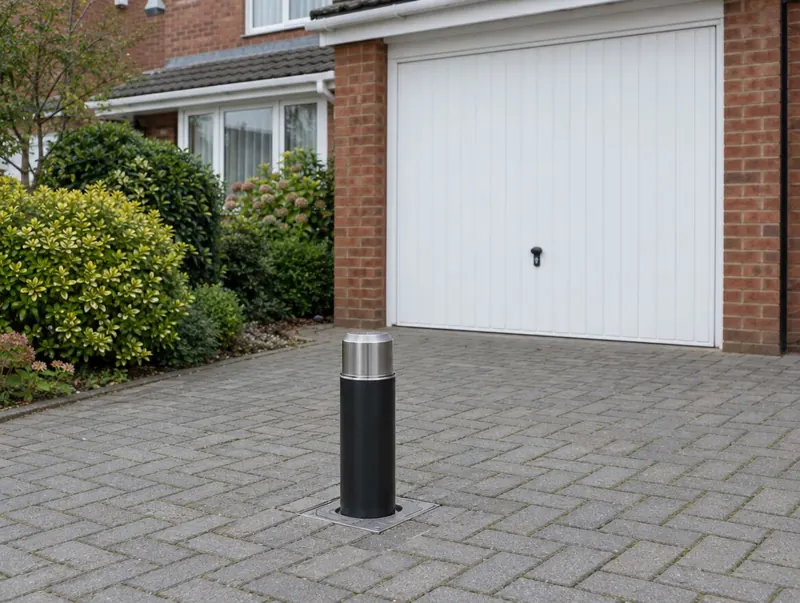 Computer-generated image
Telescopic bollards in Ashton-in-Makerfield
In the town of Ashton-in-Makerfield, telescopic bollards tend to go in at small industrial units, schools and residential driveways. Key-locked telescopic bollards that retract into a ground cassette, for driveways, private bays and access roads.
Coverage in Ashton-in-Makerfield takes in the WN4 postcode district and nearby places like Land Gate and Simm's Lane End. Jobs in Ashton-in-Makerfield can be combined with work in Golborne (2 miles), Newton-le-Willows (3.1 miles), Wigan (3.9 miles) and Hindley (4 miles) (straight-line distances). Ashton-in-Makerfield is about 15 miles from Liverpool.
Ashton-in-Makerfield at a glance
- Area
- Greater Manchester, England
- Highway authority
- Wigan Council (local roads)
- Planning authority
- Wigan Council
- Postcodes
- WN4
- Guide price
- Typically £335–£1,195 per bollard + VAT (£395–£1,445 inc VAT for homes); minimum job £625
- Survey
- Free, with a fixed written quote
- Nearby
- Golborne (2 mi), Newton-le-Willows (3.1 mi), Wigan (3.9 mi), Hindley (4 mi)
Ashton-in-Makerfield: typical telescopic bollard prices
| Specification | Guide price | Includes |
|---|---|---|
| Standard | £335–£685 + VAT · £395–£815 inc VAT | Standard post, foundation, reinstatement |
| Upgraded | £585–£935 + VAT · £695–£1,095 inc VAT | Upgraded finish or fittings, reflective band, matched keys |
| Premium | £835–£1,195 + VAT · £995–£1,445 inc VAT | Heavy-duty or architectural spec, premium finish |
Per bollard with cassette, supplied and installed; -2% for North West. Guide only — the fixed price follows a survey.
Telescopic bollards in Ashton-in-Makerfield: common uses
Common uses in a place like Ashton-in-Makerfield:
- Car parks where a removable post would go missing
- Domestic driveways where the bollard is used daily
- Commercial yards where posts must not be left lying around
Consents, ground and services in Ashton-in-Makerfield
Wigan Council is the highway authority covering Ashton-in-Makerfield's local roads. If any post would stand on adopted highway rather than your land, that consent is the first thing we sort out.
If your site in Ashton-in-Makerfield is listed or inside a conservation area, check with the local planning authority (Wigan Council) before choosing a finish — heritage settings often favour cast iron or painted steel over stainless.
Clay soils and high water tables mean a gravel base alone will not drain the cassette; a connection to a surface water drain or a separate soakaway is then needed, and foul drains are not used. Drives commonly hide the water supply pipe, gas service, electric cable and drainage runs, often at shallow depth, and they cluster near the property boundary where posts are usually wanted.
- Connect drainage only to surface water systems or a soakaway, never to a foul drain.
- Leave access for emergency services on commercial and multi-occupancy sites, and record who holds keys.
From survey to handover
Check depth and drainage
The free site survey checks how far down we can dig, where services run under the drive and how the ground drains. If water will stand, a drain connection is priced into the fixed written quote.
Set the cassette
The cassette is set vertical and its top exactly at finished surface level and fall, then concreted in. A cassette set high or low is a common cause of tyre damage and trip edges.
Reinstate and test
The surface is made good to match. The post is raised, locked, lowered and locked several times to confirm smooth operation, and keys are handed over.
Finishes and options
| Option | Detail |
|---|---|
| Reflective bands | Bands near the top help drivers see a raised post at night, particularly on drives shared with visitors. |
| Diameter and height | Commonly around 90–140 mm diameter and 600–900 mm raised height, with larger posts for commercial use. |
| Lock types | Keyed cylinder locks, often with a cover to keep out dirt; keyed alike for multi-bay sites where one key should open every post. |
What affects the quote
Our North West guide prices are a starting point; the survey in Ashton-in-Makerfield firms them up. What tends to move them:
- Excavation depth and the presence of services under the drive
- Drainage: simple soakaway or a connection to a drain
- Surface type and quality of reinstatement
Keeping them working
If the post becomes stiff or will not lower fully, the usual causes are debris in the cassette or a blocked drain, both of which are easier to fix early than after the post has seized. Lower and raise the bollard regularly, even if you rarely need to, so the mechanism stays free.
For damaged or loose posts in Ashton-in-Makerfield, repairs and replacements are priced in writing first.
Common questions
Which parts of Ashton-in-Makerfield do you cover for telescopic bollards?
We cover all of Ashton-in-Makerfield (WN4) and the rest of Greater Manchester. We also work in Golborne, Newton-le-Willows and Wigan.
Do I need consent for telescopic bollards on a public footway in Ashton-in-Makerfield?
Wigan Council is the highway authority covering Ashton-in-Makerfield's local roads. If any post would stand on adopted highway rather than your land, that consent is the first thing we sort out.
What's a typical price for telescopic bollards in Ashton-in-Makerfield?
In Ashton-in-Makerfield, typically £335–£1,195 per bollard with cassette, supplied and installed, plus VAT (£395–£1,445 including VAT for homeowners), with a minimum job of £625 plus VAT, using our North West guide prices. The fixed figure comes in writing after we've seen the site.
What if it freezes in winter?
Freezing usually means water is standing in the cassette. Do not force the post; pour warm, not boiling, water around the lid and lift once free. Then have the drainage checked.
Can a telescopic bollard be fitted into a resin or imprinted drive?
Yes, though the cut has to be made cleanly and the surface patched around the lid. Resin and imprinted finishes are hard to match exactly, so we plan positions to keep visible patching small.