Powys · Wales
Telescopic bollard installation in Newtown
Local installation of telescopic bollards in Newtown — free survey, fixed written price, and posts set to the right spacing for people and vehicles.
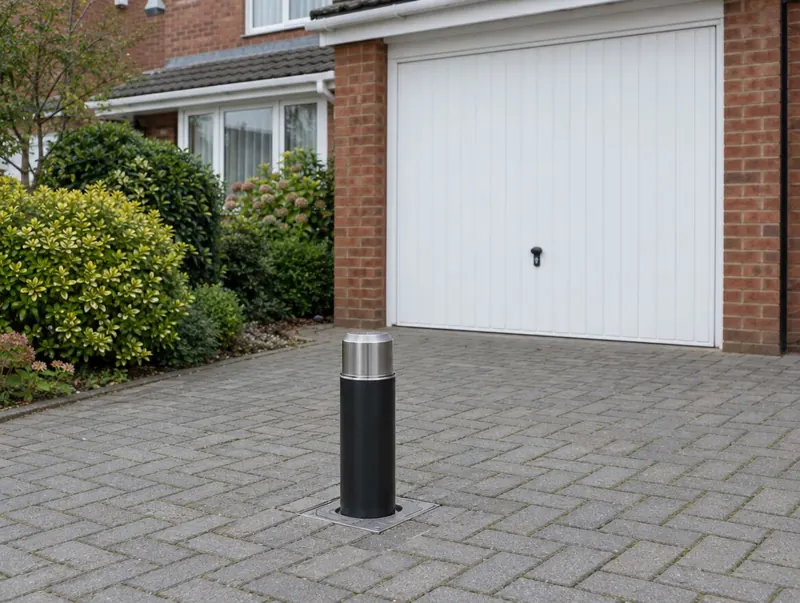 Computer-generated image
About telescopic bollards in Newtown
Across Newtown, typical sites for telescopic bollards include schools, community buildings and high street shopfronts. Key-locked telescopic bollards that retract into a ground cassette, for driveways, private bays and access roads.
We cover Newtown's SY16 postcode district, including places such as Llanllwchaiarn, Tregynon, Aberhafesp and Bettws Cedewain. There are no other towns of Newtown's size close by, so crews travel in specifically for jobs here.
Local details
- Area
- Powys, Wales
- Highway authority
- Powys County Council (local roads)
- Planning authority
- Powys County Council
- Postcodes
- SY16
- Guide price
- Typically £335–£1,145 per bollard + VAT (£395–£1,345 inc VAT for homes); minimum job £625
- Survey
- Free, with a fixed written quote
What telescopic bollards cost in Newtown
| Specification | Guide price | Includes |
|---|---|---|
| Standard | £335–£685 + VAT · £395–£815 inc VAT | Standard post, foundation, reinstatement |
| Upgraded | £585–£925 + VAT · £695–£1,095 inc VAT | Upgraded finish or fittings, reflective band, matched keys |
| Premium | £825–£1,145 + VAT · £985–£1,345 inc VAT | Heavy-duty or architectural spec, premium finish |
Per bollard with cassette, supplied and installed; -3% for Wales. Guide only — the fixed price follows a survey.
Typical telescopic bollards jobs in Newtown
Around Newtown, telescopic bollards usually solve one of these:
- Car parks where a removable post would go missing
- Shared drives that need occasional closing
- Sites with no power for automatic bollards
Before we dig in Newtown
Before digging near the kerb in Newtown we establish who owns the ground: adopted footways are Powys County Council's responsibility, trunk roads the Welsh Government's, and everything else belongs to the site owner.
Bollards on private land often don't need planning permission, but it depends on the council's view, the height and the location; in a conservation area, next to a listed building or under an Article 4 direction, ask the local planning authority (Powys County Council) first — we flag this at survey.
Reinstatement matches the drive, whether block paving, tarmac, resin-bound or imprinted concrete. Drives commonly hide the water supply pipe, gas service, electric cable and drainage runs, often at shallow depth, and they cluster near the property boundary where posts are usually wanted.
- Confirm the bollard is on your land; bollards on a public footway or dropped kerb need the highway authority's agreement.
- Leave access for emergency services on commercial and multi-occupancy sites, and record who holds keys.
From survey to handover
Cut and excavate
The surface is cut neatly and the hole dug to the cassette's full depth plus a drainage layer, with care near any service that crosses the drive.
Form the drainage
A gravel soakaway is placed beneath the cassette, or a pipe is laid to a surface water drain or new soakaway.
Set the cassette
The cassette is set vertical and its top exactly at finished surface level and fall, then concreted in. A cassette set high or low is a common cause of tyre damage and trip edges.
Specification choices
| Option | Detail |
|---|---|
| Reflective bands | Bands near the top help drivers see a raised post at night, particularly on drives shared with visitors. |
| Lid and head designs | Flush hinged lids, removable caps or integrated heads that close the cassette top when lowered. |
| Lock types | Keyed cylinder locks, often with a cover to keep out dirt; keyed alike for multi-bay sites where one key should open every post. |
What moves the price in Newtown
Two Newtown jobs with the same number of posts can price quite differently. The usual reasons:
- Excavation depth and the presence of services under the drive
- Post size and whether lift assistance is wanted
- Number of posts and keyed-alike locks
Looking after them
If the post becomes stiff or will not lower fully, the usual causes are debris in the cassette or a blocked drain, both of which are easier to fix early than after the post has seized. Clear leaves and grit from around the lid, and a few times a year lift the post fully and look into the cassette for standing water or silt.
For damaged or loose posts in Newtown, repairs and replacements are priced in writing first.
Telescopic bollards in Newtown: FAQs
Do you install telescopic bollards in Newtown?
We cover all of Newtown (SY16) and the rest of Powys.
Do I need consent for telescopic bollards on a public footway in Newtown?
Local roads and pavements in Newtown are the responsibility of Powys County Council as highway authority, with the Welsh Government's trunk road agents handling trunk roads. Posts on the public highway need that authority's consent; private land does not.
What's a typical price for telescopic bollards in Newtown?
In Newtown, typically £335–£1,145 per bollard with cassette, supplied and installed, plus VAT (£395–£1,345 including VAT for homeowners), with a minimum job of £625 plus VAT, using our Wales guide prices. The fixed figure comes in writing after we've seen the site.
Why does my telescopic bollard fill with water?
Because the cassette is not draining, either through a blocked base, clay ground or no drainage provision at installation. Standing water rusts the post and can freeze it in place. Fixing the drainage usually solves the problem.
Is a telescopic bollard harder to lift than a removable one?
Usually easier, because you only lift it up a short distance within its cassette and many models have lift assistance. You also never carry it or store it anywhere.