Staffordshire · England
Telescopic bollard installation in Rugeley
Local installation of telescopic bollards in Rugeley — free survey, fixed written price, and posts set to the right spacing for people and vehicles.
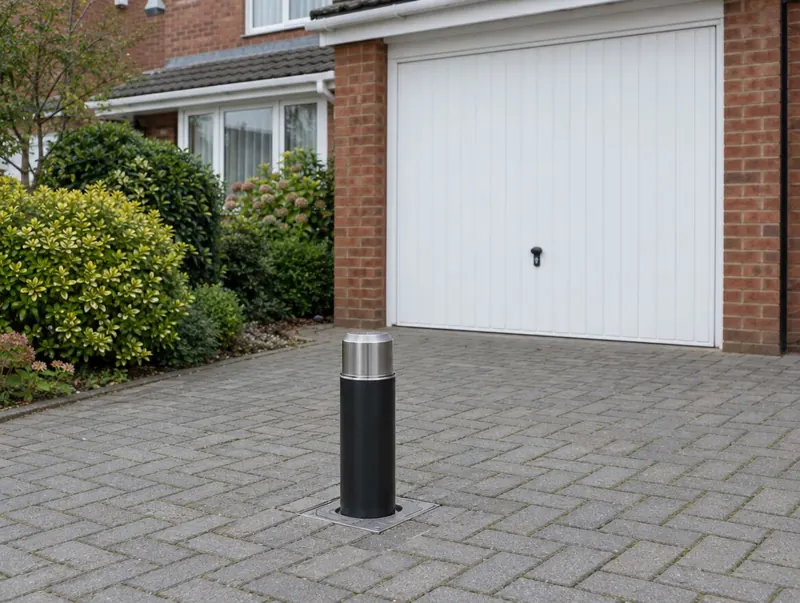 Computer-generated image
About telescopic bollards in Rugeley
Whether it's residential driveways, community car parks and local parades, telescopic bollards in Rugeley are planned around who needs to get through and who doesn't. Because the post stays in its cassette, there is nothing to store and nothing to lose.
We cover Rugeley's WS15 postcode district, including places such as Cannock Wood. Nearby, we also work in Burntwood (5.4 miles), Cannock (6.2 miles), Lichfield (7.1 miles) and Stafford (8.1 miles), measured as the crow flies. Wolverhampton is around 14 miles away.
Rugeley at a glance
- Area
- Staffordshire, England
- Highway authority
- Staffordshire County Council (local roads)
- Planning authority
- the council for Cannock Chase
- Postcodes
- WS15
- Guide price
- Typically £345–£1,195 per bollard + VAT (£405–£1,445 inc VAT for homes); minimum job £645
- Survey
- Free, with a fixed written quote
Rugeley: typical telescopic bollard prices
| Specification | Guide price | Includes |
|---|---|---|
| Standard | £345–£705 + VAT · £405–£845 inc VAT | Standard post, foundation, reinstatement |
| Upgraded | £605–£955 + VAT · £725–£1,145 inc VAT | Upgraded finish or fittings, reflective band, matched keys |
| Premium | £855–£1,195 + VAT · £1,045–£1,445 inc VAT | Heavy-duty or architectural spec, premium finish |
Per bollard with cassette, supplied and installed; no regional adjustment. Guide only — the fixed price follows a survey.
What Rugeley sites use telescopic bollards for
Around Rugeley, telescopic bollards usually solve one of these:
- Sites with no power for automatic bollards
- Access roads closed outside working hours
- Commercial yards where posts must not be left lying around
What we check first in Rugeley
Staffordshire County Council is the highway authority covering Rugeley's local roads. If any post would stand on adopted highway rather than your land, that consent is the first thing we sort out.
Bollards on private land often don't need planning permission, but it depends on the council's view, the height and the location; in a conservation area, next to a listed building or under an Article 4 direction, ask the local planning authority (the council for Cannock Chase) first — we flag this at survey.
Drives commonly hide the water supply pipe, gas service, electric cable and drainage runs, often at shallow depth, and they cluster near the property boundary where posts are usually wanted. Reinstatement matches the drive, whether block paving, tarmac, resin-bound or imprinted concrete.
- Confirm the bollard is on your land; bollards on a public footway or dropped kerb need the highway authority's agreement.
- Leave access for emergency services on commercial and multi-occupancy sites, and record who holds keys.
Installation, step by step
Cut and excavate
The surface is cut neatly and the hole dug to the cassette's full depth plus a drainage layer, with care near any service that crosses the drive.
Form the drainage
A gravel soakaway is placed beneath the cassette, or a pipe is laid to a surface water drain or new soakaway.
Reinstate and test
The surface is made good to match. The post is raised, locked, lowered and locked several times to confirm smooth operation, and keys are handed over.
Specification choices
| Option | Detail |
|---|---|
| Lock types | Keyed cylinder locks, often with a cover to keep out dirt; keyed alike for multi-bay sites where one key should open every post. |
| Standard or lift-assisted | Lift-assisted models use a spring or counterweight so the post rises with little effort, useful for daily domestic use. |
| Diameter and height | Commonly around 90–140 mm diameter and 600–900 mm raised height, with larger posts for commercial use. |
What affects the quote
Our West Midlands guide prices are a starting point; the survey in Rugeley firms them up. What tends to move them:
- Drainage: simple soakaway or a connection to a drain
- Excavation depth and the presence of services under the drive
- Post size and whether lift assistance is wanted
After installation
Clear leaves and grit from around the lid, and a few times a year lift the post fully and look into the cassette for standing water or silt. Lower and raise the bollard regularly, even if you rarely need to, so the mechanism stays free.
If posts in Rugeley are later hit or damaged, we can repair or replace them — see bollard repairs.
Questions about telescopic bollards in Rugeley
Do you install telescopic bollards in Rugeley?
We cover all of Rugeley (WS15) and the rest of Staffordshire. We also work in Burntwood, Cannock and Lichfield.
Do I need consent for telescopic bollards on a public footway in Rugeley?
In Rugeley, work on adopted pavements and verges needs consent from Staffordshire County Council, the local highway authority. Car parks, forecourts and other private land only need the owner's permission.
What's a typical price for telescopic bollards in Rugeley?
In Rugeley, typically £345–£1,195 per bollard with cassette, supplied and installed, plus VAT (£405–£1,445 including VAT for homeowners), with a minimum job of £645 plus VAT, using our West Midlands guide prices. The fixed figure comes in writing after we've seen the site.
Can a telescopic bollard be fitted into a resin or imprinted drive?
Yes, though the cut has to be made cleanly and the surface patched around the lid. Resin and imprinted finishes are hard to match exactly, so we plan positions to keep visible patching small.
Is a telescopic bollard harder to lift than a removable one?
Usually easier, because you only lift it up a short distance within its cassette and many models have lift assistance. You also never carry it or store it anywhere.
Telescopic bollards near Rugeley
- Burntwood (5.4 mi)
- Cannock (6.2 mi)
- Lichfield (7.1 mi)
- Stafford (8.1 mi)
- Bloxwich (10.2 mi)
- Aldridge (10.7 mi)