Hampshire · England
Timber bollard installation in Southampton
Timber bollards supplied and fitted in Southampton, Hampshire: surveyed, scanned for services, set in proper foundations and finished to match the ground.
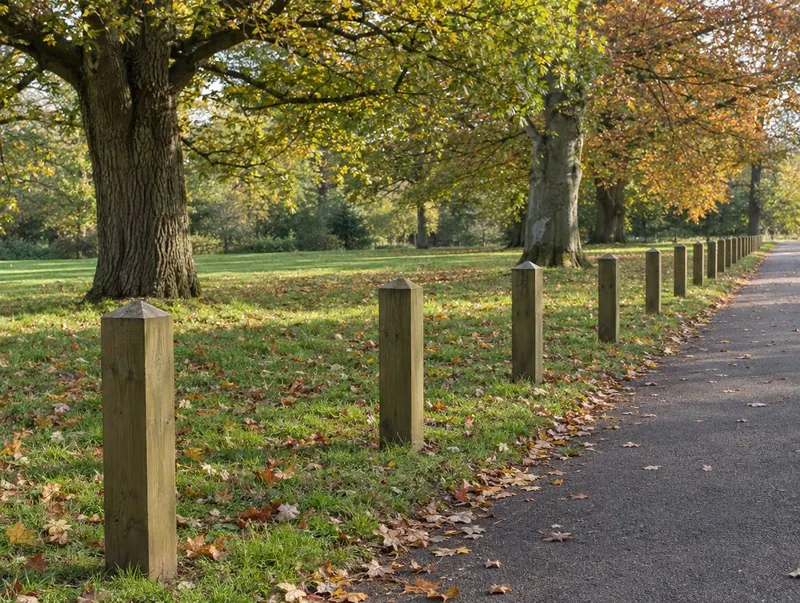 Computer-generated image
About timber bollards in Southampton
From multi-storey car parks, stadium approaches and university campuses, Southampton has plenty of places where timber bollards earn their keep. Oak, hardwood and treated softwood bollards for parks, verges, rural sites, car parks and school frontages.
We cover the SO14, SO15, SO17, SO19, SO18 and SO16 postcode districts in Southampton. Nearby, we also work in Hythe (3 miles), Totton (3.9 miles), Eastleigh (4.9 miles) and Fareham (10.5 miles), measured as the crow flies. Southampton is about 15 miles from Portsmouth.
Southampton at a glance
- Area
- Hampshire, England
- Highway authority
- Southampton City Council (local roads)
- Planning authority
- Southampton City Council
- Postcodes
- SO14, SO15, SO17, SO19, SO18 and SO16
- Guide price
- Typically £105–£365 per post + VAT (£125–£435 inc VAT for homes); minimum job £465
- Survey
- Free, with a fixed written quote
Where timber bollards go in around Southampton
Around Southampton, timber bollards usually solve one of these:
- Country parks, nature reserves and woodland car parks
- Verges on estates and rural lanes
- Landscaped car parks and picnic areas
Timber bollard prices in Southampton
| Specification | Guide price | Includes |
|---|---|---|
| Standard | £105–£215 + VAT · £125–£255 inc VAT | Standard post, foundation, reinstatement |
| Upgraded | £185–£295 + VAT · £215–£345 inc VAT | Upgraded finish or fittings, reflective band, matched keys |
| Premium | £265–£365 + VAT · £315–£435 inc VAT | Heavy-duty or architectural spec, premium finish |
Per post, supplied and installed; +6% for South East. Guide only — the fixed price follows a survey.
Consents, ground and services in Southampton
The highway authority for local roads in Southampton is Southampton City Council; motorways and trunk roads sit with National Highways. Timber bollards on the adopted footway are a matter for the highway authority, so we only install there with its written agreement.
Many private-land installations in Southampton need no planning application, but the rules don't clearly cover bollards, so listed buildings, conservation areas and prominent frontages are worth raising with the planning team at Southampton City Council before posts go in.
Verges on rural lanes and estates often carry water mains, telecoms cables and drainage, so services are checked before augering. Tree roots are common along verges and parks, and digging close to mature trees can harm them, so positions are adjusted to stay outside root areas where possible.
- Leave pedestrian gaps of typically at least 1,000–1,200 mm, and wider at path entrances used by cycles, buggies and mobility scooters, referring to Inclusive Mobility guidance.
- Use certified sustainable sources for hardwoods, which many public bodies require.
Installation, step by step
Survey the setting
A free site survey looks at the ground, drainage, tree roots, how vehicles currently get onto the land and how the site looks. You receive a fixed written quote with species, size and fixing.
Set the posts
Posts are set plumb and to a consistent height, backfilled with compacted stone or concreted with a shaped top. Cut softwood ends are re-treated.
Finish and tidy
Reflective bands are fitted, turf is reinstated around the posts and spoil is removed or spread as agreed.
Choosing the right spec
| Option | Detail |
|---|---|
| Treated softwood | Pressure-treated pine for ground contact, economical for long runs on verges and rural sites. |
| Oak | Naturally durable heartwood that weathers to silver-grey. Suits parks, heritage settings and visible frontages. |
| Sizes and profiles | Commonly 100–200 mm square or round, with chamfered, pyramid or domed tops to shed water. |
What affects the quote
When we price timber bollards in Southampton, these make the biggest difference:
- Species: treated softwood, oak or tropical hardwood
- Ground conditions, roots and services
- Number of posts and length of the line
Keeping them working
New oak can release tannin that stains nearby paving for the first season; this weathers away. Timber naturally moves, checks and splits along its length as it dries; surface cracks in oak and hardwood are normal and rarely affect strength.
For damaged or loose posts in Southampton, repairs and replacements are priced in writing first.
Timber bollards in Southampton: FAQs
Which parts of Southampton do you cover for timber bollards?
We cover all of Southampton (SO14, SO15, SO17, SO19, SO18 and SO16) and the rest of Hampshire. We also work in Hythe, Totton and Eastleigh.
Do I need consent for timber bollards on a public footway in Southampton?
The highway authority for local roads in Southampton is Southampton City Council; motorways and trunk roads sit with National Highways. Timber bollards on the adopted footway are a matter for the highway authority, so we only install there with its written agreement.
What's a typical price for timber bollards in Southampton?
In Southampton, typically £105–£365 per post, supplied and installed, plus VAT (£125–£435 including VAT for homeowners), with a minimum job of £465 plus VAT, using our South East guide prices. The fixed figure comes in writing after we've seen the site.
Do timber bollards stop vehicles?
They stop most drivers deliberately mounting a verge and resist low-speed knocks, especially in dense hardwood. They are not tested barriers and should not be relied on against a vehicle driven at them deliberately.
Why is my new oak bollard cracking?
Oak shrinks as it dries, and surface checks and splits are a normal part of that. They rarely affect the post's strength. Deep splits that run right through, or soft wood at the base, are a different matter.