Oxfordshire · England
Warehouse and loading-bay bollards in Oxford
Local installation of warehouse impact bollards in Oxford — free survey, fixed written price, and posts set to the right spacing for people and vehicles.
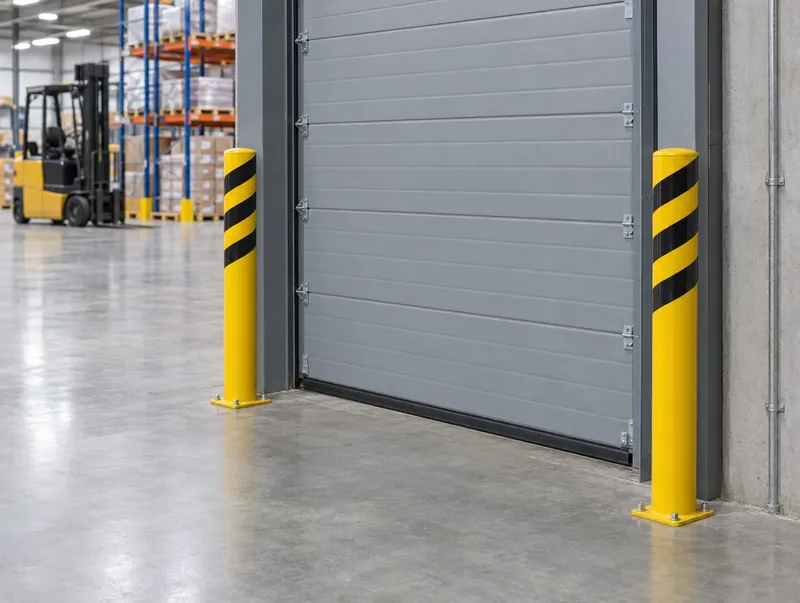 Computer-generated image
Warehouse bollards in Oxford
From distribution parks, city-centre plazas and stadium approaches, Oxford has plenty of places where warehouse impact bollards earn their keep. Yellow steel and polymer impact bollards for forklift zones, loading bays, doors, columns and racking inside warehouses.
We work across OX1, OX2, OX3 and OX4 — Oxford itself and places including Wolvercote and Sandford-on-Thames. Nearby, we also work in Abingdon (5.7 miles), Didcot (9.9 miles), Witney (10 miles) and Bicester (11.1 miles), measured as the crow flies. Oxford is about 24 miles from Reading.
Key facts for this area
- Area
- Oxfordshire, England
- Highway authority
- Oxfordshire County Council (local roads)
- Planning authority
- Oxfordshire County Council
- Postcodes
- OX1, OX2, OX3 and OX4
- Guide price
- Typically £185–£1,245 per bollard + VAT; minimum job £465
- Survey
- Free, with a fixed written quote
Where warehouse impact bollards go in around Oxford
Around Oxford, warehouse impact bollards usually solve one of these:
- Fire exit doors and emergency routes
- Loading dock doors, shutter guides and dock levellers
- Pedestrian crossings and the ends of walkways
What warehouse impact bollards cost in Oxford
| Specification | Guide price | Includes |
|---|---|---|
| Standard | £185–£635 + VAT | Standard post, foundation, reinstatement |
| Upgraded | £515–£965 + VAT | Upgraded finish or fittings, reflective band, matched keys |
| Premium | £835–£1,245 + VAT | Heavy-duty or architectural spec, premium finish |
Per bollard, supplied and fixed; +6% for South East. Guide only — the fixed price follows a survey.
Consents, ground and services in Oxford
Oxfordshire County Council is the highway authority covering Oxford's local roads. If any post would stand on adopted highway rather than your land, that consent is the first thing we sort out.
Bollards on private land often don't need planning permission, but it depends on the council's view, the height and the location; in a conservation area, next to a listed building or under an Article 4 direction, ask the local planning authority (Oxfordshire County Council) first — we flag this at survey.
The slab is the foundation, and it decides what can be fixed where. Where a slab is too thin or poor, the options include through-bolting, a larger base plate to spread load, a polymer bollard that reduces anchor forces, or breaking out and casting a new local foundation.
- Use your workplace transport risk assessment to decide where protection is needed, in line with HSE guidance on workplace transport.
- Check with the building owner before drilling into slabs with underfloor heating, guidance wires or post-tensioned reinforcement.
How the job runs
Walk the site with the vehicles running
At the free site survey we watch traffic routes, note the vehicles and loads, and look for existing damage that shows where impacts happen. You receive a fixed written quote with each position and product listed.
Check the slab
Slab thickness, joints, cracks and any underfloor services or heating are checked, and anchors are chosen for the floor rather than taken from a standard list.
Drill and anchor
Holes are drilled, cleaned and anchors installed to the maker's instructions. Chemical anchors are left to cure before the bollard is loaded.
Specification choices
| Option | Detail |
|---|---|
| Column and rack end guards | Wrap-around or corner protectors for columns and racking uprights where a single post will not fit. |
| Polymer impact bollards | Flex and recover on impact, reducing damage to anchors, floor and vehicle. Need clearance to deflect. |
| Steel bollards | Yellow-coated steel tube on a base plate, often concrete-filled. Robust and economical, but they pass impact loads straight into the slab. |
What affects the quote
Our South East guide prices are a starting point; the survey in Oxford firms them up. What tends to move them:
- Floor marking and associated signage
- Steel or polymer bollards and the impact performance needed
- Slab condition and the anchors or foundations it needs
After installation
Polymer bollards should return to their original shape; one that stays deformed or has split needs replacing. Repaint or recoat steel posts when the yellow is worn, because faded protection is easier to miss.
For damaged or loose posts in Oxford, repairs and replacements are priced in writing first.
Warehouse bollards in Oxford: FAQs
Do you install warehouse impact bollards in Oxford?
We cover all of Oxford (OX1, OX2, OX3 and OX4) and the rest of Oxfordshire. We also work in Abingdon, Didcot and Witney.
Who gives permission for bollards on the pavement in Oxford?
In Oxford, work on adopted pavements and verges needs consent from Oxfordshire County Council, the local highway authority. Car parks, forecourts and other private land only need the owner's permission.
What's a typical price for warehouse impact bollards in Oxford?
In Oxford, typically £185–£1,245 per bollard, supplied and fixed, plus VAT, with a minimum job of £465 plus VAT, using our South East guide prices. The fixed figure comes in writing after we've seen the site.
What size bollard do we need for forklifts?
That depends on the forklift's weight with load and how fast it travels near the asset, not just the post diameter. Tested products state their impact performance, which can be compared with your fleet. We size from your vehicles at the survey.
How close to a column should a bollard sit?
Close enough that a vehicle cannot reach the column around it, but with enough gap that the bollard does not hit the column when struck. Polymer bollards need more clearance than steel because they deflect. The gap is set from the product data.
Warehouse bollards near Oxford
- Abingdon (5.7 mi)
- Didcot (9.9 mi)
- Witney (10 mi)
- Bicester (11.1 mi)
- Aylesbury (19.4 mi)
- Banbury (21.8 mi)