Guide
Should you choose automatic bollards, a barrier or a gate?
How automatic rising bollards compare with rising-arm barriers and powered gates for cost, strength, safety, maintenance, power and groundworks.
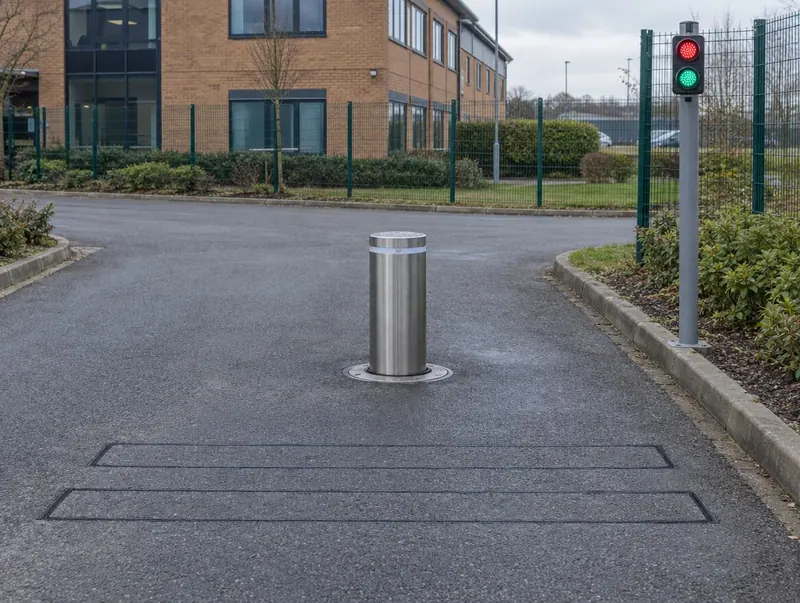 Computer-generated image
Automatic rising bollards close a road to vehicles while leaving it open to people on foot and on bikes, sit flush when lowered and can be crash-rated, but they need deeper groundworks, drainage and ducting than a rising-arm barrier. A barrier is a simple way to control cars but stops little by force, and a powered gate closes the whole boundary. All three move, so all three need safety devices, regular maintenance and a power supply.
What is the real difference between bollards, barriers and gates?
It comes down to what each one closes. Automatic bollards close the carriageway with a line of posts that sink into the ground, leaving gaps for pedestrians and cyclists. A rising-arm barrier closes a lane with a pivoting boom that signals a stop rather than physically forcing one. A powered gate closes the full width of an entrance, people included, and is the usual choice for a secure perimeter. Some entrances combine them, such as a barrier for routine traffic with bollards behind it for security.
How do they compare side by side?
The main differences are in strength, permeability and groundworks.
| Automatic bollards | Rising-arm barrier | Powered gate | |
|---|---|---|---|
| Stops a car driven at it | Depends on the unit; rated versions are tested | Unrated arms are a deterrent only | Depends on the gate and its posts |
| People on foot and bikes | Pass between the posts | Pass round the arm | Need a separate gate |
| When open | Flush with the road | Arm raised | Leaf open |
| Groundworks | Deep foundation box, drainage, ducts | Base and ducts | Post foundations and a track or hinge posts |
| Main safety risk | Rising under a vehicle or person | Arm striking people or vehicles | Crushing and trapping at edges |
| Maintenance | Planned servicing; drains and loops | Planned servicing | Planned servicing |
| Guide price | Typically £2,995–£14,995 per bollard + VAT | Not on our price list | Not on our price list |
Which option is strongest against a deliberate vehicle attack?
Only a crash-rated product, whatever its type. A rated vehicle security barrier has been tested to stop a stated vehicle at a stated speed, and the rating holds only on its tested foundation. Rated automatic bollards exist; whichever type you consider, check it in the NPSA Catalogue of Security Equipment. An unrated bollard, barrier or gate controls traffic but isn't a hostile vehicle mitigation measure. Our guide to crash-rated bollards explains the ratings.
What safety measures do automatic bollards need?
Signs, visibility, reliable detection and a safe way to fail. The Department of Transport's Traffic Advisory Leaflet 4/97 on rising bollards says:
- advance signs should show when the bollards operate and which vehicles may pass
- bollards should carry light-coloured retroreflective stripes
- detection loops may miss motorcycles, three-wheelers and vehicles towing trailers, so other detection may be needed
- bollards must never be able to rise beneath a vehicle
- systems should fail safe, ideally retracted
- emergency services may need to override the controls, for example with a special key or smart card
- standard traffic signals should not be used, and signal aspects on public roads need Secretary of State approval
TAL 4/97 dates from 1997 and we haven't confirmed it is still current, but it remains a useful checklist. The DHF published a bollard-specific best practice guide in 2024, Automated rising bollards. Its gate and barrier code of practice, TS 011, doesn't mention bollards, and whether BS EN 12453 formally applies to rising bollards isn't confirmed.
Do machinery regulations apply to automatic bollards?
Probably, although the official guidance doesn't say so in terms. In Great Britain, the Supply of Machinery (Safety) Regulations 2008 require the responsible person to carry out a risk assessment and conformity assessment, compile a technical file, issue a Declaration of Conformity, apply UKCA or CE marking and supply instructions, and a manufacturer includes someone who puts machinery into service. HSE says installers who assemble powered gates must comply, and that the responsible person is usually whoever does the final assembly. HSE's pages don't mention bollards, so applying this to rising bollards is a reasonable reading rather than settled law. In Northern Ireland, the EU Machinery Regulation 2023/1230 applies from 20 January 2027 under the Windsor Framework. We commission every automatic installation against a written risk assessment and hand over the manufacturer's documentation.
What power, ducting and loops do automatic bollards need?
Each bollard needs a power supply, ducts to a control cabinet, a drained foundation box and loops cut into the road.
- Power: a supply from the building or a feeder pillar, run by a qualified electrician; the route length affects cost.
- Ducting: ducts between each bollard, the cabinet and the access devices, laid before the foundation is poured.
- Drainage: a connection from the foundation box to a surface water drain or soakaway, because standing water damages the drive.
- Loops: a safety loop to stop the bollard rising under a vehicle, and often an exit loop to lower it for vehicles leaving.
- Drive: hydraulic, with a pump in the bollard or a remote power pack, or electro-mechanical, with a motor and gearbox and no fluid.
- Access control: ANPR, fob, keypad or intercom; see bollard access control.
Barriers need similar power and ducting but no deep drained box, which keeps their groundworks simpler.
What do automatic bollards cost compared with the alternatives?
Automatic rising bollards typically cost £2,995–£14,995 per bollard plus VAT installed with controls, loops and commissioning, with a minimum job value of around £2,995. Access control adds £595–£11,995 per entrance and planned servicing £95–£345 per visit. Public awards show what complete schemes cost: Cambridgeshire County Council's 2024 award for two non-rated rising bollards, including removing the old units, loops, a signal head, cabinet, paving reinstatement and three years' maintenance, was £30,969 (Bidstats), and Lichfield District Council's 2024 award for a rising bollard system was £112,646, bollard count not stated (UK Spending).
We don't price barriers or gates on this site, so ask for like-for-like quotes that cover groundworks, power, safety devices and maintenance. Where power is the obstacle, semi-automatic bollards at £1,095–£3,495 plus VAT need none.
Prepared by the Bollard Installers team · Last reviewed 01 November 2026 · Prices and rules change; check the rules pages and your written quote.
Questions
What happens to automatic bollards in a power cut?
That depends on how they are set up. TAL 4/97 says systems should fail safe, ideally retracted, and most units have a manual release; security sites may be set to stay raised, with an agreed way to open them.
Can emergency services get through automatic bollards?
They should be able to. TAL 4/97 suggests a special key or smart card override, and the London Fire Brigade asks for electric barriers to be referred to its Traffic Liaison Officer; agree the arrangement with your local fire and rescue service before handover.
Can automatic bollards work with number plate recognition?
Yes. ANPR cameras, fobs, keypads and intercoms all connect to the bollard controller, and an exit loop can lower the bollards for vehicles leaving.
Are automatic bollards suitable for a home driveway?
They can be, and smaller domestic units exist. HSE says health and safety law doesn't apply to privately owned domestic gates, though it still advises regular checks, and the same caution makes sense for bollards; a telescopic or semi-automatic post is the simpler option.
Related services
Automatic rising bollards
Hydraulic and electro-mechanical rising bollards installed with controls, safety loops, signals and power, for managed vehicle access.
Learn more →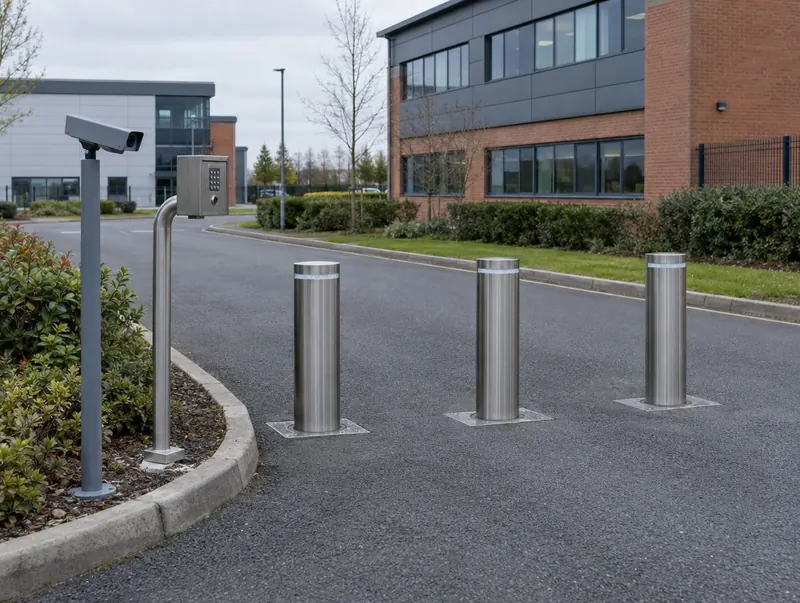
Bollard access control
ANPR, fob, keypad, intercom and remote control systems that decide who can lower an automatic bollard, and when.
Learn more →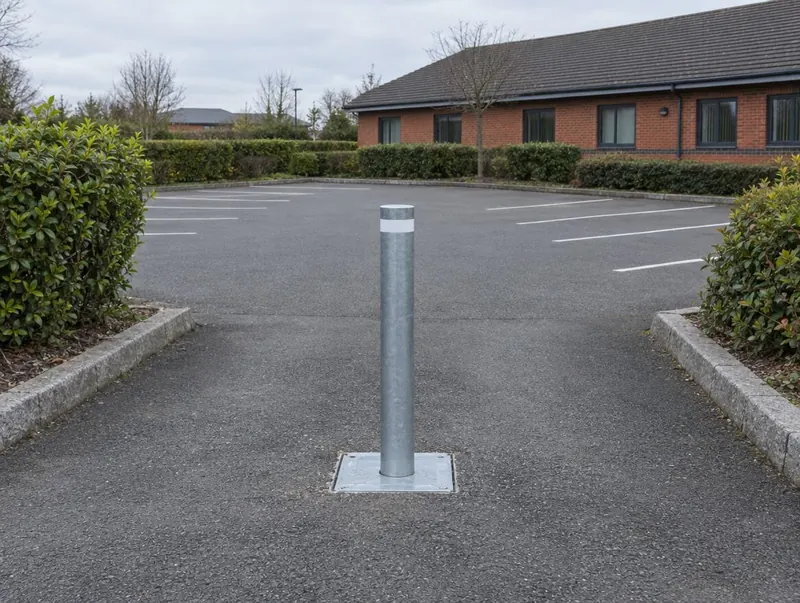
Semi-automatic bollards
Gas-strut assisted bollards that rise on their own when unlocked and lower by hand, with no mains power needed.
Learn more →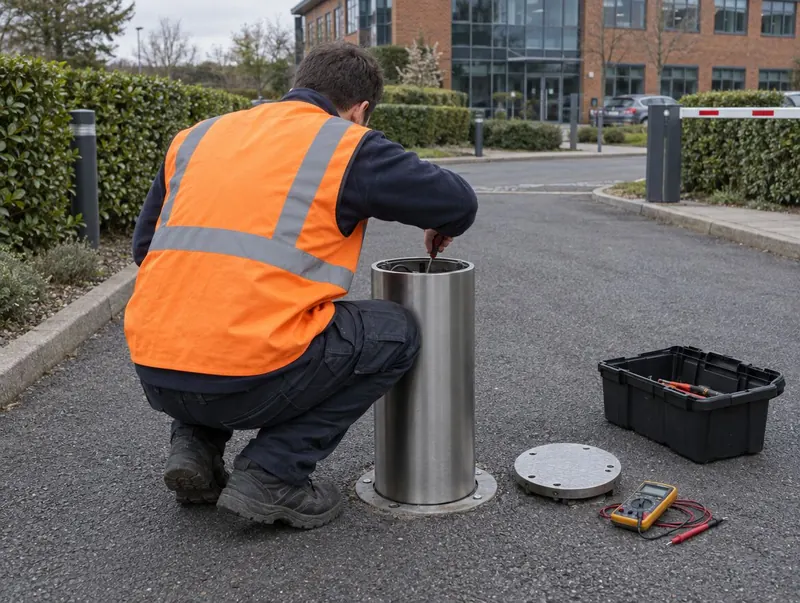
Automatic bollard servicing
Planned servicing visits and maintenance contracts for hydraulic and electro-mechanical rising bollards, priced in writing.
Learn more →