Guide
Removable, telescopic or fold-down bollards: which should you choose?
An honest comparison of the three manual bollard types: daily effort, security, ground depth, drainage and price, and the sites each one suits.
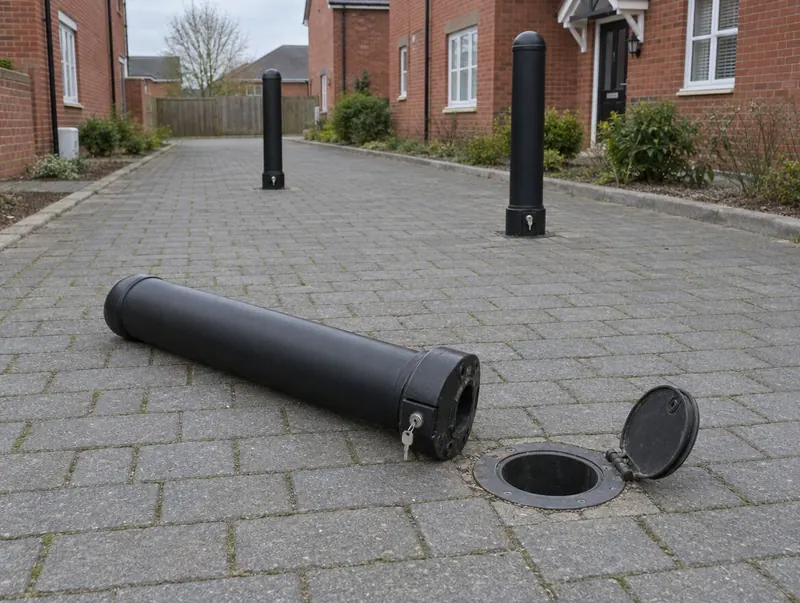 Computer-generated image
A removable bollard lifts out of a lockable ground socket, a telescopic bollard unlocks and lowers into a cassette in the ground, and a fold-down post is hinged at its base and folds flat. Telescopic posts are the easiest to use every day but need the deepest dig and good drainage; removable posts are simple and shallow but have to be lifted and stored; fold-down posts cost least and need no dig, but leave a low hinge on the surface. Semi-automatic posts suit heavier daily use without power.
How does each type work?
They differ in where the post goes when the way is open: out of the ground, into it, or flat on it.
- Removable. The post drops into a steel socket cast flush into a small concrete foundation and is held by a key, padlock or cylinder lock. Lifted out, the socket closes with a lid.
- Telescopic. The post sits in a cassette set around a metre into the ground, deeper for taller posts. Unlocked, it lowers into the cassette and a lid closes flush; it locks in both positions.
- Fold-down. The post is hinged on a base plate anchored to sound concrete and is padlocked or key-locked upright. Folded, it lies low enough to drive over on most models.
How do removable, telescopic and fold-down bollards compare?
Telescopic posts win on daily ease, removable posts on simplicity and fold-down posts on price and shallow fixing.
| Removable | Telescopic | Fold-down | |
|---|---|---|---|
| Daily effort | Unlock, lift out and store | Unlock and lower; no lifting | Unlock and fold; bend to ground level |
| Post when open | Stored elsewhere | Inside the cassette | Flat on its base plate |
| Ground depth | Socket usually 250–450 mm | Often around 1 m or more | None, unless a concrete pad is needed |
| Drainage | Small drain at the socket base | Soakaway or drain connection essential | Not needed |
| Surface when open | Flush lid | Flush lid | Low hinge and plate |
| Security | Good with a heavy post and lock | Good; the post can't be carried off | Lowest; hinge and anchors are weak points |
| Buried services | Rarely a problem | Can rule out a position | Rarely a problem |
| Typical price | £245–£845 per bollard + VAT | £345–£1,195 per bollard + VAT | £145–£445 per post + VAT |
Which type is easiest to use every day?
Telescopic, for most people. There is nothing to lift or store, which is why it is the usual choice for driveways used morning and evening. Removable posts suit gaps that open a few times a week or less, such as a fire route or delivery bay. If the post is heavy and the user is not, it tends to be left out permanently or laid on its side, where it becomes a trip hazard, so lighter aluminium posts, lifting handles and a wall bracket for storage all help. Fold-down posts are quick but mean bending to ground level twice a day. For frequent use without power, semi-automatic bollards rise on a gas strut once unlocked and are pushed down by foot.
Which type is the most secure?
A heavy telescopic or removable post in a well-made foundation is the most secure of the three, and a fold-down post the least. None is crash-rated as standard. A fold-down post relies on its anchors and hinge, so it suits parking control more than vehicle security. Telescopic posts can't be carried away, and heavy-duty versions are used for shopfronts and ram-raid protection. Removable posts depend on the lock and the socket's concrete surround, and crash-tested removable models with heavier sockets and tested foundations exist for security lines. Whatever the type, a cheap lock is the weak point; keyed-alike cylinders let one key open every post on a site.
What ground depth and drainage does each type need?
Telescopic posts need the most: a cassette pit often around a metre deep that must stay dry. On sandy or gravelly ground a soakaway beneath it usually copes, but on clay or where groundwater rises, the cassette needs a pipe to a surface water drain or its own soakaway, never the foul drain. The depth also means buried water, gas and electricity services can rule out a position, so we locate services and hand-dig first.
Removable sockets need a few hundred millimetres and a small drain at the base. Fold-down posts need no dig on sound concrete, but tarmac and block paving don't hold anchors well, so a small concrete pad is cut in beneath the post.
What does each type cost?
Of the three, fold-down posts cost least and telescopic posts most. Typical supplied-and-installed prices are:
- Fold-down parking posts: £145–£445 per post + VAT
- Removable bollards with socket: £245–£845 per bollard + VAT
- Telescopic bollards with cassette: £345–£1,195 per bollard + VAT
- Semi-automatic bollards: £1,095–£3,495 per bollard + VAT
- Homeowner driveway posts of any of these types: £385–£845 per post inc VAT
Block paving adds £40–£150 per post for lifting and relaying, core drilling concrete £60–£250, and small jobs carry a minimum charge. Try the price calculator or read how much bollards cost.
Which type suits which site?
Match the type to how often the gap opens and who opens it.
- Emergency and fire routes: removable or fold-down posts, secured as the fire service asks. The London Fire Brigade, for example, wants one-point locking with a fire brigade padlock or GERDA key.
- Home driveways used daily: telescopic, or semi-automatic for the least effort.
- Allocated parking bays: fold-down posts, on a concrete pad where needed.
- Delivery bays and market streets: removable posts with flush lids.
- Shopfronts needing occasional access: heavy-duty telescopic posts.
- Ground crowded with buried services: removable or fold-down posts, which need little depth.
Prepared by the Bollard Installers team · Last reviewed 01 November 2026 · Prices and rules change; check the rules pages and your written quote.
Questions
Can a telescopic bollard go in block paving?
Yes. The blocks around the position are lifted, the cassette is set in concrete, and the original blocks are relaid around the lid, so the finish usually matches well.
What happens if a telescopic bollard fills with water?
It becomes stiff, can freeze in winter and eventually seizes. The fix is a working drain from the cassette base to a soakaway or surface water drain, plus lifting the lid every few months to clear silt.
Can one key open all the posts on our site?
Yes, if you order keyed-alike locks. Removable, telescopic and fold-down posts are all available with matching cylinders or a common triangular or square key.
Are fold-down posts a trip hazard when folded?
They leave a low hinge and plate on the surface, which matters more on a footpath than in a parking bay. On a route people walk across, a removable post with a flush lid is the safer choice.
Related services
Removable bollards
Lift-out bollards in lockable ground sockets for driveways, delivery routes, access roads and emergency access points.
Learn more →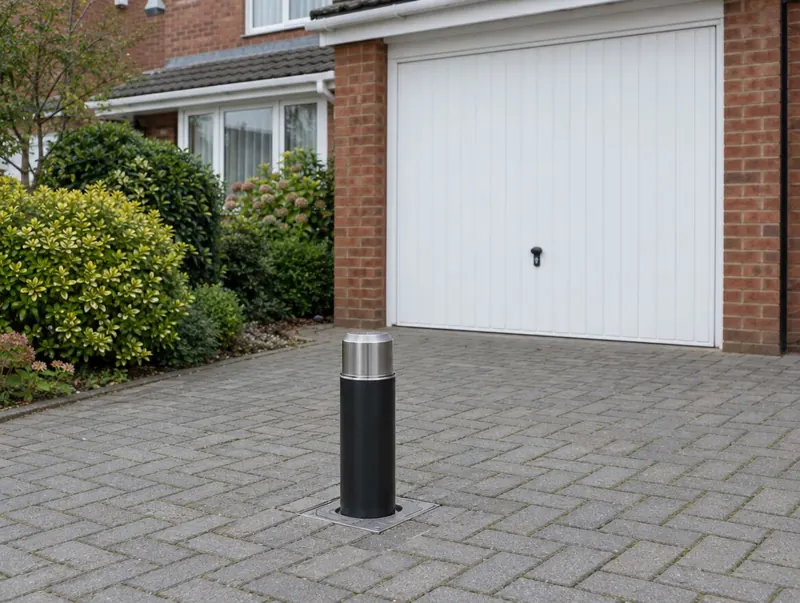
Telescopic bollards
Key-locked telescopic bollards that retract into a ground cassette, for driveways, private bays and access roads.
Learn more →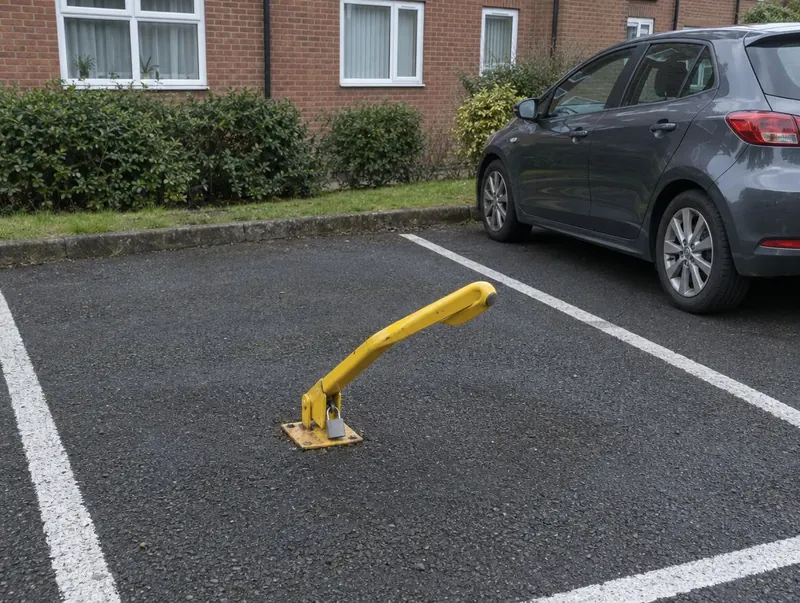
Fold-down parking posts
Hinged fold-down parking posts with padlock or integral key locks, bolted down to protect private and allocated bays.
Learn more →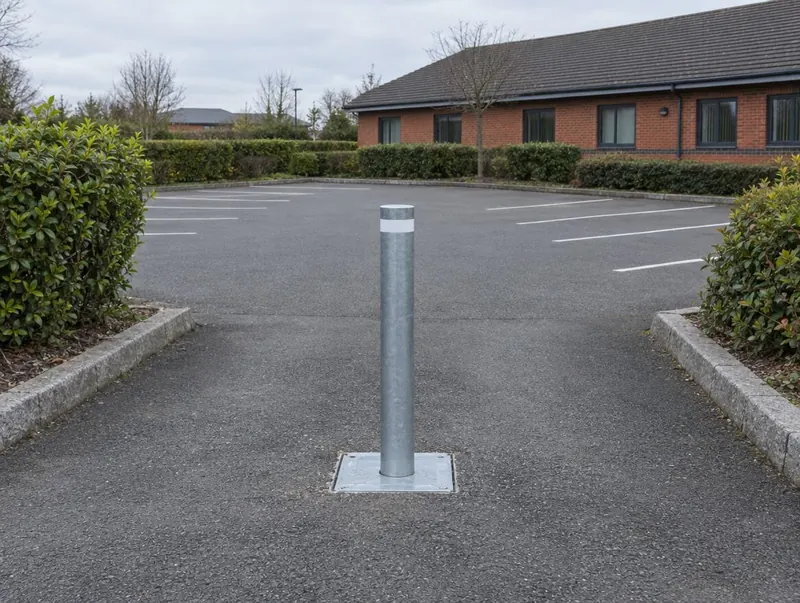
Semi-automatic bollards
Gas-strut assisted bollards that rise on their own when unlocked and lower by hand, with no mains power needed.
Learn more →