Fife · Scotland
Automatic bollard servicing in St Andrews
Automatic bollard service visits in St Andrews, Fife: the visit price confirmed in writing first, then a clear report and a fixed price for anything further.
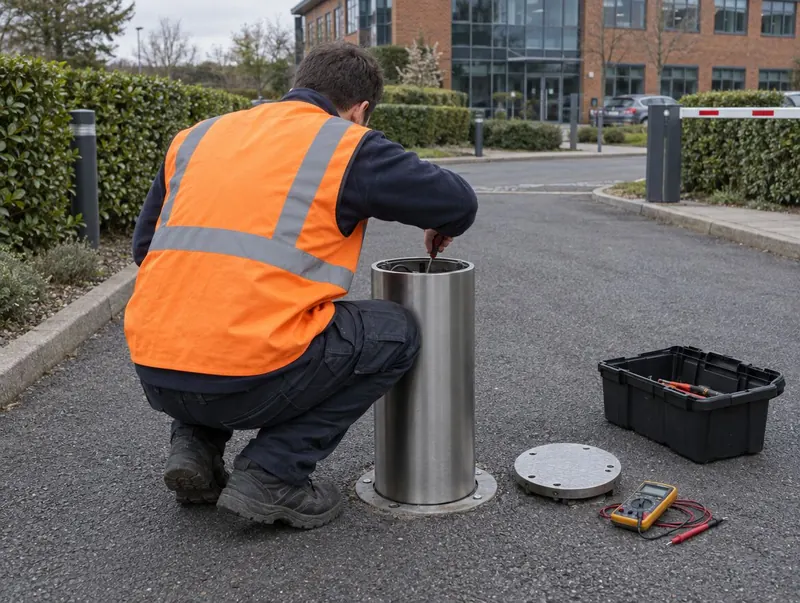 Computer-generated image
About automatic bollard service visits in St Andrews
In St Andrews, typical sites for automatic bollard service visits include schools, small industrial units and high street shopfronts. Each visit is recorded, giving a maintenance history for the installation.
Coverage in St Andrews takes in the KY16 postcode district and nearby places like Leuchars, Balmullo, Guardbridge and Kingsbarns. Nearby, we also work in Carnoustie (11.9 miles), Methil (13.6 miles), Glenrothes (17.4 miles) and Arbroath (17.5 miles), measured as the crow flies.
Key facts for this area
- Area
- Fife, Scotland
- Roads authority
- Fife Council (local roads)
- Planning authority
- Fife Council
- Postcodes
- KY16
- Guide price
- Typically £95–£345 per visit + VAT
- Survey
- Paid visit, price confirmed in writing first
- Nearby
- Carnoustie (11.9 mi), Methil (13.6 mi), Glenrothes (17.4 mi), Arbroath (17.5 mi)
Guide prices for St Andrews
| Specification | Guide price | Includes |
|---|---|---|
| Standard | £95–£205 + VAT | One bollard, planned service and safety checks |
| Upgraded | £175–£275 + VAT | Two bollards, full service and written report |
| Premium | £245–£345 + VAT | Larger or rated systems to manufacturer procedures |
Per planned service visit, first bollard; no regional adjustment. Guide only — the visit price is confirmed in writing first.
Common reasons for automatic bollard service visits in St Andrews
Why sites in St Andrews book automatic bollard service visits:
- Sites needing documented maintenance for insurers or audits
- Residential estates with shared automatic bollards
- Pedestrianised zones with rising bollards for deliveries
Permissions and groundwork in St Andrews
In Scotland the council is the roads authority for local roads, which in St Andrews means Fife Council. Bollards on an adopted footway need its consent; trunk roads sit with Transport Scotland.
Bollards on private land often need no planning application, but listed buildings and conservation areas are different; the planning service at Fife Council can confirm before anything is ordered.
Silt and grit washed in from the surrounding road are a steady source of wear, so where the road drains towards the bollard, a small change such as a channel or gully nearby can reduce how much debris reaches the pit. Drainage outlets are tested by running water into the pit; where they no longer drain, the cause may be a collapsed pipe or a soakaway that has silted up, which may need a separate drainage repair quoted in writing.
- Test emergency service access arrangements periodically and after any change to the controls.
- Keep written records of each service, including tests of safety devices and emergency functions.
What happens on site
Tell us about the installation
Send the make and model if known, the number of bollards, how busy the entrance is and any current problems, with photographs of the bollards and controller.
Agree the visit or contract
We price a one-off visit or a contract in writing, with the visit frequency suggested for your usage. Nothing is booked until you have agreed it.
Report and recommend
You receive a written report of what was checked and found. Any repair needed is quoted separately in writing for your approval.
Options to consider
| Option | Detail |
|---|---|
| Planned maintenance contract | Scheduled visits at agreed intervals, priced in writing, with a consistent record kept across visits. |
| Visit frequency | Set by how often the bollards cycle and the site's risk; busy or security sites usually need more frequent visits. |
| Safety and access testing | Loops, photocells, lights, manual release, emergency functions and access control inputs tested on every visit. |
Pricing automatic bollard service visits in St Andrews
Our Scotland guide prices are a starting point; the survey in St Andrews firms them up. What tends to move them:
- Number of bollards and controllers
- Access control equipment to be tested
- Hydraulic or electro-mechanical drive
Keeping them working
After snow, clear around the head before use. Between service visits, site staff can do a lot to keep bollards reliable: keep the head and surrounding road clear of leaves and grit, report any change in speed, noise or behaviour, keep a note of faults with the date and time, and never bypass or disconnect safety devices to keep an entrance open.
We can also service, repair or replace existing posts anywhere in St Andrews.
Bollard servicing in St Andrews: FAQs
Which parts of St Andrews do you cover for automatic bollard service visits?
We cover all of St Andrews (KY16) and the rest of Fife. We also work in Carnoustie, Methil and Glenrothes.
Do I need consent for bollards on a public footway in St Andrews?
St Andrews falls under Fife Council as roads authority. If the line of posts crosses onto adopted road or pavement, permission comes before excavation; on private land it does not.
What's a typical price for automatic bollard service visits in St Andrews?
In St Andrews, typically £95–£345 per planned service visit, first bollard, plus VAT, using our Scotland guide prices. We confirm the visit price in writing before attending.
Will the entrance be closed during a service?
Usually only partly. We service one bollard or lane at a time where possible, with cones and staff managing traffic. On single-bollard entrances, a short closure is agreed in advance.
How often should automatic bollards be serviced?
It depends on how often they cycle and the risk at the site. Commonly that means every three to six months, with busier or security entrances at the more frequent end. We suggest a frequency once we know your usage.