Fife · Scotland
Concrete bollard installation in St Andrews
Concrete bollards supplied and fitted in St Andrews, Fife: surveyed, scanned for services, set in proper foundations and finished to match the ground.
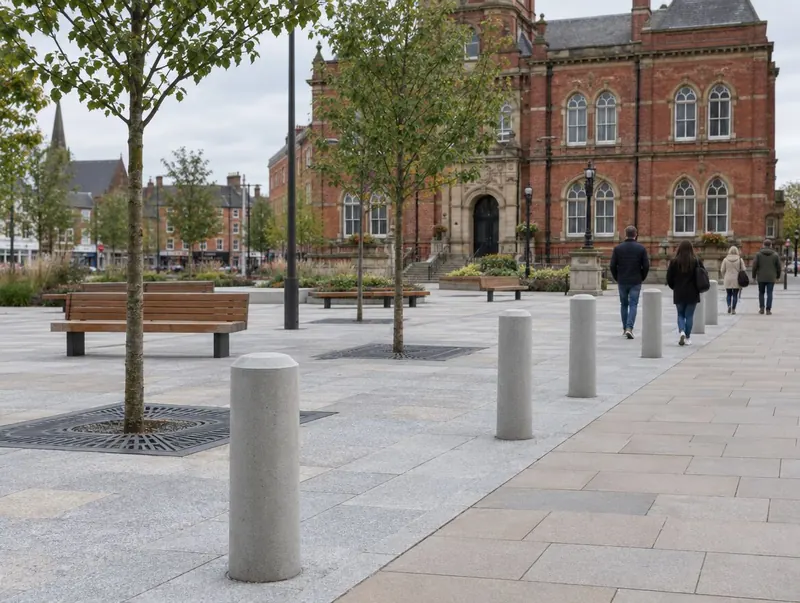 Computer-generated image
St Andrews concrete bollards
In the town of St Andrews, concrete bollards tend to go in at schools, high street shopfronts and small industrial units. Precast concrete and reconstituted stone bollards for public realm, parks, boundaries and estates, dowelled or bedded in place.
Coverage in St Andrews takes in the KY16 postcode district and nearby places like Leuchars, Balmullo, Guardbridge and Kingsbarns. Nearby, we also work in Carnoustie (11.9 miles), Methil (13.6 miles), Glenrothes (17.4 miles) and Arbroath (17.5 miles), measured as the crow flies.
Key facts for this area
- Area
- Fife, Scotland
- Roads authority
- Fife Council (local roads)
- Planning authority
- Fife Council
- Postcodes
- KY16
- Guide price
- Typically £175–£595 per bollard + VAT; minimum job £595
- Survey
- Free, with a fixed written quote
- Nearby
- Carnoustie (11.9 mi), Methil (13.6 mi), Glenrothes (17.4 mi), Arbroath (17.5 mi)
Concrete bollard prices in St Andrews
| Specification | Guide price | Includes |
|---|---|---|
| Standard | £175–£355 + VAT | Standard post, foundation, reinstatement |
| Upgraded | £305–£475 + VAT | Upgraded finish or fittings, reflective band, matched keys |
| Premium | £425–£595 + VAT | Heavy-duty or architectural spec, premium finish |
Per bollard, supplied and installed; no regional adjustment. Guide only — the fixed price follows a survey.
What St Andrews sites use concrete bollards for
Typical reasons St Andrews sites choose concrete bollards:
- Retail parks and landscaped car parks
- Park entrances and greens where vehicles should not drive
- Edges of open land and verges subject to unauthorised vehicle access
Permissions and groundwork in St Andrews
St Andrews falls under Fife Council as roads authority. If the line of posts crosses onto adopted road or pavement, permission comes before excavation; on private land it does not.
Many private-land installations in St Andrews need no planning application, but the rules don't clearly cover bollards, so listed buildings, conservation areas and prominent frontages are worth raising with the planning team at Fife Council before posts go in.
Each post sits on a concrete base on firm ground, and on soft verges or made ground the base is deepened or widened to suit. Because concrete bollards are heavy, a weak foundation shows itself quickly as a tilt.
- On public highway or council land, agree positions and specification with the roads authority or landowner.
- Plan lifts with an exclusion zone and suitable lifting equipment, and record the method for the site.
From survey to handover
Survey and choose
A free site survey looks at the setting, ground, delivery access and where a lifting vehicle can stand. You receive a fixed written quote with the product, finish and fixing.
Set the bollards
Each bollard is lowered onto a mortar bed with its dowel grouted in, checked plumb and aligned with its neighbours.
Protect while the grout cures
Bollards are left undisturbed until the grout and foundation have gained strength, with temporary barriers if vehicles use the area. Lines that need to open to traffic quickly can use faster-setting grouts where the product allows.
Finishes and options
| Option | Detail |
|---|---|
| Planters and blocks | Concrete planters and seating blocks used in place of bollards where a softer look is wanted. |
| Precast concrete | Grey or coloured concrete in round, square, tapered or domed shapes, the economical public realm option. |
| Surface finishes | Smooth, exposed aggregate, acid-etched or shot-blasted, chosen to suit paving and resist visible weathering. |
What affects the quote
Our Scotland guide prices are a starting point; the survey in St Andrews firms them up. What tends to move them:
- Size, shape and surface finish
- Lifting equipment and access for delivery
- Foundation depth and ground conditions
Keeping them working
In areas salted heavily in winter, check for surface spalling. Small chips can be repaired with a colour-matched mortar, but a bollard that has cracked through or sheared at the dowel needs replacing.
We can also service, repair or replace existing posts anywhere in St Andrews.
Common questions
Which parts of St Andrews do you cover for concrete bollards?
We cover all of St Andrews (KY16) and the rest of Fife. We also work in Carnoustie, Methil and Glenrothes.
Do I need consent for concrete bollards on a public footway in St Andrews?
St Andrews falls under Fife Council as roads authority. If the line of posts crosses onto adopted road or pavement, permission comes before excavation; on private land it does not.
What's a typical price for concrete bollards in St Andrews?
In St Andrews, typically £175–£595 per bollard, supplied and installed, plus VAT, with a minimum job of £595 plus VAT, using our Scotland guide prices. The fixed figure comes in writing after we've seen the site.
Can a chipped concrete bollard be repaired?
Small chips and edge damage can be filled with colour-matched mortar. A bollard cracked through or broken at its base needs replacing. Matching finishes is easier if the original product is still made.
Should we use concrete or steel bollards?
Concrete suits landscaped and public spaces where appearance and low maintenance matter and where impacts are rare. Steel suits car parks and yards where knocks are frequent, because it bends rather than shatters. Many schemes use both in different places.