Fife · Scotland
Flexible bollard installation in St Andrews
Flexible bollards supplied and fitted in St Andrews, Fife: surveyed, scanned for services, set in proper foundations and finished to match the ground.
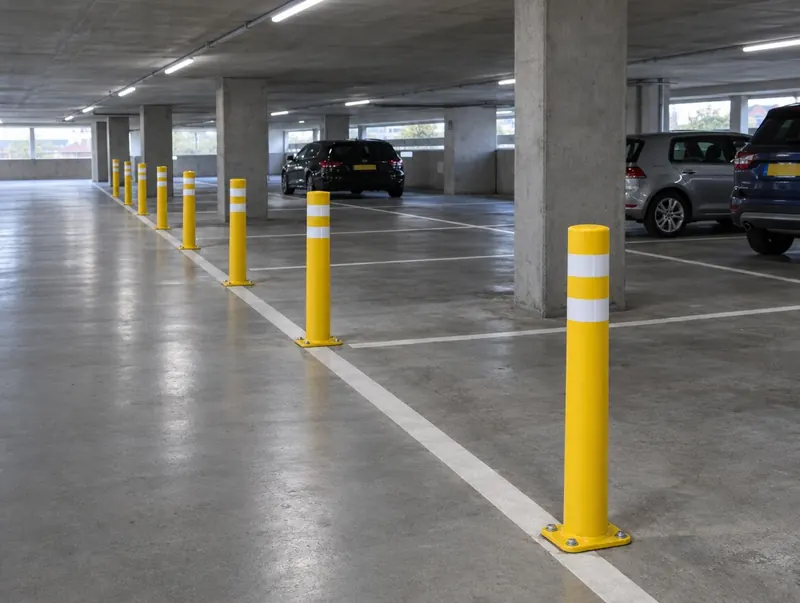 Computer-generated image
About flexible bollards in St Andrews
In the town of St Andrews, flexible bollards tend to go in at community buildings, schools and small industrial units. Flexible bollards are traffic management products, not barriers, and will not stop a vehicle that is driven at them.
We work across KY16 — St Andrews itself and places including Leuchars, Balmullo, Guardbridge and Kingsbarns. Nearby, we also work in Carnoustie (11.9 miles), Methil (13.6 miles), Glenrothes (17.4 miles) and Arbroath (17.5 miles), measured as the crow flies.
Local details
- Area
- Fife, Scotland
- Roads authority
- Fife Council (local roads)
- Planning authority
- Fife Council
- Postcodes
- KY16
- Guide price
- Typically £195–£595 per bollard + VAT; minimum job £445
- Survey
- Free, with a fixed written quote
- Nearby
- Carnoustie (11.9 mi), Methil (13.6 mi), Glenrothes (17.4 mi), Arbroath (17.5 mi)
Typical flexible bollards jobs in St Andrews
Around St Andrews, flexible bollards usually solve one of these:
- Drive-thru lanes and fuel forecourts
- Temporary or trial layouts before permanent kerbs
- Bus stations and coach parks
Guide prices for St Andrews
| Specification | Guide price | Includes |
|---|---|---|
| Standard | £195–£365 + VAT | Standard post, foundation, reinstatement |
| Upgraded | £315–£485 + VAT | Upgraded finish or fittings, reflective band, matched keys |
| Premium | £435–£595 + VAT | Heavy-duty or architectural spec, premium finish |
Per bollard, supplied and fixed; no regional adjustment. Guide only — the fixed price follows a survey.
Before we dig in St Andrews
For anything on the public footway in St Andrews we check with the roads authority first — Fife Council for local roads, Transport Scotland on trunk routes. Private ground such as a car park or forecourt only needs the owner's go-ahead.
Many private-land installations in St Andrews need no planning application, but the rules don't clearly cover bollards, so listed buildings, conservation areas and prominent frontages are worth raising with the planning team at Fife Council before posts go in.
Where posts go in a line across a drainage fall, positions avoid channels and gullies. On tarmac, a small concrete pad or a socket base cast in concrete is the reliable option.
- Check drilling into car park decks or podium slabs with the building owner before fixing.
- Do not use flexible bollards where a physical barrier is needed to protect people or buildings; they guide rather than stop.
Installation, step by step
Check the surface
Slabs and decks are checked for thickness, reinforcement and waterproofing before drilling. Weak tarmac may need a concrete pad or socket base.
Fix the bases
Holes are drilled and cleaned, resin anchors or bolts are set and the bases fixed and torqued once cured. Socket bases are set flush in concrete.
Hand over spares and records
Post and base details are recorded so replacements match, and spare posts can be left on site for busy locations. Staff are shown how a post is swapped on its base.
Specification choices
| Option | Detail |
|---|---|
| Polyurethane posts | Flex along their length and return to shape. Gentle on vehicles and common in car parks and on forecourts. |
| Low-profile deck bases | Shallow fixings for multi-storey decks where deep drilling is not permitted. |
| Sprung-base bollards | A rigid post on a heavy spring or elastomer base that tilts and returns. Looks like a conventional bollard. |
What affects the quote
Two St Andrews jobs with the same number of posts can price quite differently. The usual reasons:
- Number of posts and length of line
- Deck scanning and restrictions on drilling
- Bolt-down or socket base
After installation
Posts exposed to strong sunlight slowly lose flexibility and colour, and eventually crack; replacing the post on its existing base is usually quick. Check flexible bollards for splits, permanent bends and loose bases, and tighten or replace fixings that have worked loose.
If posts in St Andrews are later hit or damaged, we can repair or replace them — see bollard repairs.
Questions about flexible bollards in St Andrews
Can you install flexible bollards anywhere in St Andrews?
We cover all of St Andrews (KY16) and the rest of Fife. We also work in Carnoustie, Methil and Glenrothes.
Who gives permission for bollards on the pavement in St Andrews?
In Scotland the council is the roads authority for local roads, which in St Andrews means Fife Council. Flexible bollards on an adopted footway need its consent; trunk roads sit with Transport Scotland.
How much do flexible bollards cost in St Andrews?
In St Andrews, typically £195–£595 per bollard, supplied and fixed, plus VAT, with a minimum job of £445 plus VAT, using our Scotland guide prices. The fixed figure comes in writing after we've seen the site.
Do flexible bollards work in cold weather?
They do, but polymers become stiffer in cold conditions and recover more slowly after a knock. Sprung-base designs are less affected. Neither type is damaged by normal UK winter temperatures.
Can flexible bollards go in a multi-storey car park?
Yes, often with low-profile bases. The deck has to be checked first, as some slabs contain tendons or waterproofing that must not be drilled. The building owner usually needs to agree the fixing method.