West Dunbartonshire · Scotland
Automatic bollard servicing in Clydebank
Automatic bollard service visits for sites in Clydebank and the rest of West Dunbartonshire, by crews working under our management.
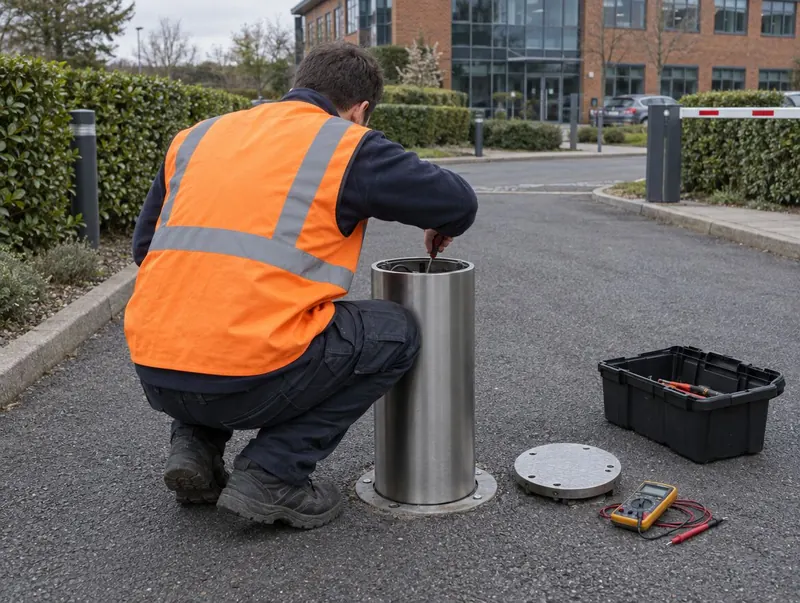 Computer-generated image
Clydebank automatic bollard service visits
We carry out automatic bollard service visits throughout Clydebank, typically for small industrial units, schools and high street shopfronts. Each visit is recorded, giving a maintenance history for the installation.
We work across G81 and G60 — Clydebank itself and places including Bowling. We also cover neighbouring Erskine (1.7 miles), Renfrew (2.1 miles), Bearsden (3 miles) and Milngavie (4.2 miles) — distances are straight-line. It sits roughly 6 miles from Glasgow as the crow flies.
Local details
- Area
- West Dunbartonshire, Scotland
- Roads authority
- West Dunbartonshire Council (local roads)
- Planning authority
- West Dunbartonshire Council
- Postcodes
- G81 and G60
- Guide price
- Typically £95–£345 per visit + VAT
- Survey
- Paid visit, price confirmed in writing first
Common reasons for automatic bollard service visits in Clydebank
Typical reasons for automatic bollard service visits in Clydebank:
- Bollards inherited with a building and no service history
- Systems that have started to run slowly or noisily
- Business parks and campuses with busy automatic entrances
Guide prices for Clydebank
| Specification | Guide price | Includes |
|---|---|---|
| Standard | £95–£205 + VAT | One bollard, planned service and safety checks |
| Upgraded | £175–£275 + VAT | Two bollards, full service and written report |
| Premium | £245–£345 + VAT | Larger or rated systems to manufacturer procedures |
Per planned service visit, first bollard; no regional adjustment. Guide only — the visit price is confirmed in writing first.
What we check first in Clydebank
Clydebank falls under West Dunbartonshire Council as roads authority. If the line of posts crosses onto adopted road or pavement, permission comes before excavation; on private land it does not.
Bollards on private land often need no planning application, but listed buildings and conservation areas are different; the planning service at West Dunbartonshire Council can confirm before anything is ordered.
Cracked or sunken surfacing around a cassette can indicate a failing foundation or water washing out the sub-base. Servicing rarely needs excavation, but the condition of the ground around the bollard tells a lot about its health.
- Have electrical faults and modifications handled by a qualified electrician, to BS 7671.
- Keep safety devices tested and working; a bollard with disabled or faulty safety loops or photocells should not stay in service.
How the job runs
Plan around the entrance
Visits are planned to keep the entrance usable, usually servicing one lane or bollard at a time, with cones and staff on hand while a bollard is out of service.
Service and test
The pit, drainage, drive, electrics, safety devices and access inputs are serviced and tested, and the controller log is read.
Report and recommend
You receive a written report of what was checked and found. Any repair needed is quoted separately in writing for your approval.
Specification choices
| Option | Detail |
|---|---|
| Hydraulic servicing | Fluid, hoses, seals, pump and valve checks, with fluid topped up or changed as needed. |
| Visit frequency | Set by how often the bollards cycle and the site's risk; busy or security sites usually need more frequent visits. |
| Electro-mechanical servicing | Motor, gearbox, couplings and sensor checks, with adjustment of limits and positions. |
What affects the quote
When we price automatic bollard service visits in Clydebank, these make the biggest difference:
- Access control equipment to be tested
- Traffic management needed on live roads
- Hydraulic or electro-mechanical drive
Looking after them
If the road around the bollard is being resurfaced, tell us beforehand so loops and ducts can be protected or reinstated. Between service visits, site staff can do a lot to keep bollards reliable: keep the head and surrounding road clear of leaves and grit, report any change in speed, noise or behaviour, keep a note of faults with the date and time, and never bypass or disconnect safety devices to keep an entrance open.
If posts in Clydebank are later hit or damaged, we can repair or replace them — see bollard repairs.
Common questions
Can you carry out automatic bollard service visits anywhere in Clydebank?
We cover all of Clydebank (G81 and G60) and the rest of West Dunbartonshire. We also work in Erskine, Renfrew and Bearsden.
Do I need consent for bollards on a public footway in Clydebank?
In Scotland the council is the roads authority for local roads, which in Clydebank means West Dunbartonshire Council. Bollards on an adopted footway need its consent; trunk roads sit with Transport Scotland.
What's a typical price for automatic bollard service visits in Clydebank?
In Clydebank, typically £95–£345 per planned service visit, first bollard, plus VAT, using our Scotland guide prices. We confirm the visit price in writing before attending.
Do you service bollards you did not install?
Yes, for common makes of hydraulic and electro-mechanical bollard. Proprietary parts are sourced through the manufacturer or their distributor where available. Photographs of the bollard and controller help us prepare.
Is a maintenance contract necessary?
It is not compulsory, but planned visits catch wear before it becomes a breakdown and give you a maintenance record. One-off visits suit lightly used bollards or as a starting point.