West Dunbartonshire · Scotland
Timber bollard installation in Clydebank
Local installation of timber bollards in Clydebank — free survey, fixed written price, and posts set to the right spacing for people and vehicles.
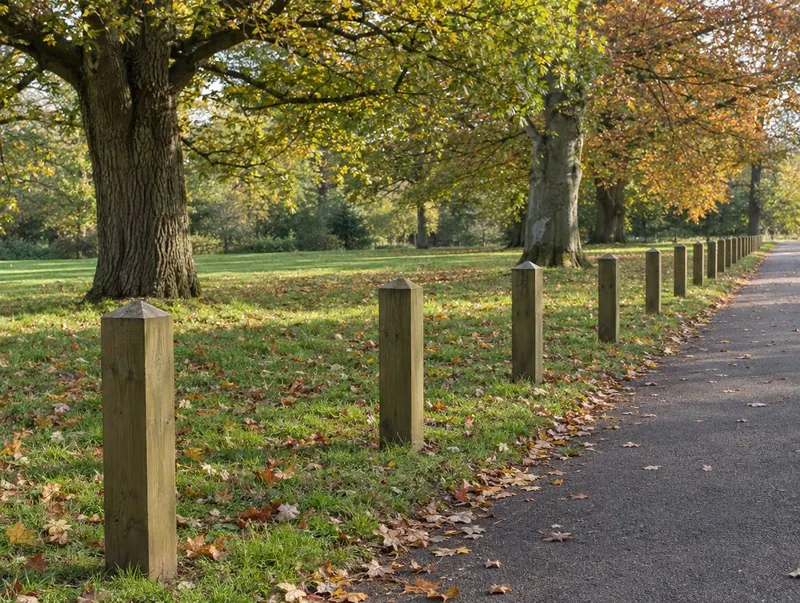 Computer-generated image
Clydebank timber bollards
Timber bollards suit plenty of Clydebank sites, residential driveways, community buildings and filling-station forecourts among them. Timber bollards deter and guide vehicles; they are not tested barriers.
We cover Clydebank's G81 and G60 postcode districts, including places such as Bowling. Nearby, we also work in Erskine (1.7 miles), Renfrew (2.1 miles), Bearsden (3 miles) and Milngavie (4.2 miles), measured as the crow flies. It sits roughly 6 miles from Glasgow as the crow flies.
Local details
- Area
- West Dunbartonshire, Scotland
- Roads authority
- West Dunbartonshire Council (local roads)
- Planning authority
- West Dunbartonshire Council
- Postcodes
- G81 and G60
- Guide price
- Typically £95–£345 per post + VAT (£105–£405 inc VAT for homes); minimum job £445
- Survey
- Free, with a fixed written quote
Timber bollard prices in Clydebank
| Specification | Guide price | Includes |
|---|---|---|
| Standard | £95–£205 + VAT · £105–£245 inc VAT | Standard post, foundation, reinstatement |
| Upgraded | £175–£275 + VAT · £205–£325 inc VAT | Upgraded finish or fittings, reflective band, matched keys |
| Premium | £245–£345 + VAT · £285–£405 inc VAT | Heavy-duty or architectural spec, premium finish |
Per post, supplied and installed; no regional adjustment. Guide only — the fixed price follows a survey.
Typical timber bollards jobs in Clydebank
Around Clydebank, timber bollards usually solve one of these:
- Country parks, nature reserves and woodland car parks
- Verges on estates and rural lanes
- Village greens and recreation grounds
What we check first in Clydebank
For anything on the public footway in Clydebank we check with the roads authority first — West Dunbartonshire Council for local roads, Transport Scotland on trunk routes. Private ground such as a car park or forecourt only needs the owner's go-ahead.
Bollards on private land often need no planning application, but listed buildings and conservation areas are different; the planning service at West Dunbartonshire Council can confirm before anything is ordered.
Clay holds water against the timber and benefits from a free-draining stone base; sandy ground may need a concrete surround to stop posts loosening. Tree roots are common along verges and parks, and digging close to mature trees can harm them, so positions are adjusted to stay outside root areas where possible.
- Use certified sustainable sources for hardwoods, which many public bodies require.
- Fit reflective bands or white tops where posts stand beside roads or in unlit car parks.
What happens on site
Dig the holes
Holes are dug by hand or auger to the required depth, avoiding roots and checking for services along verges and footpaths.
Set the posts
Posts are set plumb and to a consistent height, backfilled with compacted stone or concreted with a shaped top. Cut softwood ends are re-treated.
Finish and tidy
Reflective bands are fitted, turf is reinstated around the posts and spoil is removed or spread as agreed.
Finishes and options
| Option | Detail |
|---|---|
| Sizes and profiles | Commonly 100–200 mm square or round, with chamfered, pyramid or domed tops to shed water. |
| Oak | Naturally durable heartwood that weathers to silver-grey. Suits parks, heritage settings and visible frontages. |
| Reflective bands and studs | Reflective bands, white painted tops or inset studs so posts are visible on unlit sites. |
What moves the price in Clydebank
Two Clydebank jobs with the same number of posts can price quite differently. The usual reasons:
- Number of posts and length of the line
- Fixing method: stone, concrete or steel shoe
- Post size and length
Keeping them working
Replacing individual damaged posts is straightforward if the original size and species are recorded. Timber naturally moves, checks and splits along its length as it dries; surface cracks in oak and hardwood are normal and rarely affect strength.
If posts in Clydebank are later hit or damaged, we can repair or replace them — see bollard repairs.
Common questions
Can you install timber bollards anywhere in Clydebank?
We cover all of Clydebank (G81 and G60) and the rest of West Dunbartonshire. We also work in Erskine, Renfrew and Bearsden.
Do I need consent for timber bollards on a public footway in Clydebank?
In Scotland the council is the roads authority for local roads, which in Clydebank means West Dunbartonshire Council. Timber bollards on an adopted footway need its consent; trunk roads sit with Transport Scotland.
How much do timber bollards cost in Clydebank?
In Clydebank, typically £95–£345 per post, supplied and installed, plus VAT (£105–£405 including VAT for homeowners), with a minimum job of £445 plus VAT, using our Scotland guide prices. The fixed figure comes in writing after we've seen the site.
Can timber bollards be removable?
Yes. Timber posts can be fitted into steel ground sockets with a lock, or mounted on a hinged base. That allows maintenance vehicles or emergency services through without a permanent gap.
Do timber bollards stop vehicles?
They stop most drivers deliberately mounting a verge and resist low-speed knocks, especially in dense hardwood. They are not tested barriers and should not be relied on against a vehicle driven at them deliberately.