West Dunbartonshire · Scotland
Steel security bollard installation in Clydebank
Planning steel security bollards in Clydebank? We check ownership, consents and buried services first, then quote a fixed price.
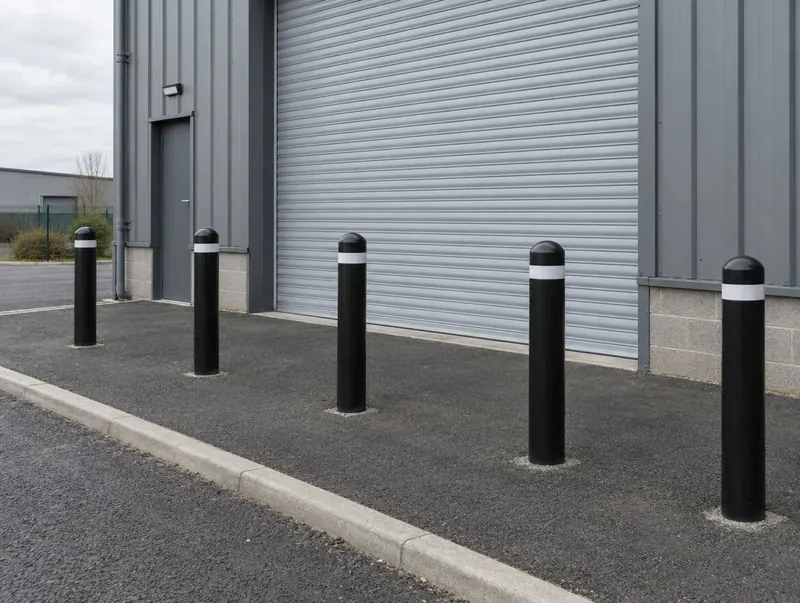 Computer-generated image
Steel security bollards in Clydebank
We supply and fit steel security bollards throughout Clydebank, typically for sites such as community car parks, town-centre squares and filling-station forecourts. Unrated steel bollards have not been crash-tested, so they deter vehicles and stop low-speed knocks and casual misuse rather than a determined attack.
We work across G81 and G60 — Clydebank itself and places including Bowling. Nearby, we also work in Erskine (1.7 miles), Renfrew (2.1 miles), Bearsden (3 miles) and Milngavie (4.2 miles), measured as the crow flies. Glasgow is around 6 miles away.
Clydebank at a glance
- Area
- West Dunbartonshire, Scotland
- Roads authority
- West Dunbartonshire Council (local roads)
- Planning authority
- West Dunbartonshire Council
- Postcodes
- G81 and G60
- Guide price
- Typically £195–£895 per bollard + VAT (£225–£1,045 inc VAT for homes); minimum job £595
- Survey
- Free, with a fixed written quote
Where steel security bollards go in around Clydebank
Typical reasons Clydebank sites choose steel security bollards:
- Social housing estates with nuisance parking
- Protecting meter boxes, gas kiosks, pillars and corners
- Stopping cut-through traffic on private roads and estates
Clydebank: typical steel security bollard prices
| Specification | Guide price | Includes |
|---|---|---|
| Standard | £195–£485 + VAT · £225–£575 inc VAT | Standard post, foundation, reinstatement |
| Upgraded | £405–£695 + VAT · £485–£825 inc VAT | Upgraded finish or fittings, reflective band, matched keys |
| Premium | £615–£895 + VAT · £735–£1,045 inc VAT | Heavy-duty or architectural spec, premium finish |
Per bollard, supplied and installed; no regional adjustment. Guide only — the fixed price follows a survey.
Permissions and groundwork in Clydebank
In Scotland the council is the roads authority for local roads, which in Clydebank means West Dunbartonshire Council. Steel security bollards on an adopted footway need its consent; trunk roads sit with Transport Scotland.
Many private-land installations in Clydebank need no planning application, but the rules don't clearly cover bollards, so listed buildings, conservation areas and prominent frontages are worth raising with the planning team at West Dunbartonshire Council before posts go in.
Root-fixed posts need firm ground and enough depth to carry the post's root plus a concrete surround. Service runs commonly follow kerb lines and verges, which is exactly where steel posts tend to go, so positions are checked with records and scanning before digging.
- Avoid linking posts with chains across pedestrian routes, which can be a trip hazard for blind and partially sighted people.
- Fit contrasting or reflective bands near the top so posts are visible, as Inclusive Mobility guidance recommends.
How the job runs
Break out and excavate
For root-fixed posts, the surface is cut neatly and each hole is dug to depth, by hand near known services. For base plates, the slab is checked for thickness and soundness.
Set the posts
Posts are set plumb and to a consistent height along the line, and concreted in. Base-plated posts are drilled, anchored with resin and torqued once cured.
Fill and cap
Where specified, posts are filled with concrete and capped so water cannot collect inside the tube.
Choosing the right spec
| Option | Detail |
|---|---|
| Concrete infill | Adds mass and stiffness and makes the post harder to cut or dent. Usually specified for security and impact positions. |
| Finishes | Hot-dip galvanised, then powder-coated in a RAL colour if wanted. Black, grey, yellow and green are common. |
| Tube size and wall thickness | Common diameters include 76, 114, 140, 168 and 219 mm, with heavier walls for service yards and vehicle routes. |
What affects the quote
Our Scotland guide prices are a starting point; the survey in Clydebank firms them up. What tends to move them:
- Tube diameter, wall thickness and concrete infill
- Finish: galvanised only or powder-coated
- Surface reinstatement such as block paving or tarmac
After installation
Galvanised steel posts need little attention for years at a time. Reflective bands fade and peel and are easy to renew.
For damaged or loose posts in Clydebank, repairs and replacements are priced in writing first.
Steel security bollards in Clydebank: FAQs
Do you install steel security bollards in Clydebank?
We cover all of Clydebank (G81 and G60) and the rest of West Dunbartonshire. We also work in Erskine, Renfrew and Bearsden.
Who gives permission for bollards on the pavement in Clydebank?
Clydebank falls under West Dunbartonshire Council as roads authority. If the line of posts crosses onto adopted road or pavement, permission comes before excavation; on private land it does not.
What's a typical price for steel security bollards in Clydebank?
In Clydebank, typically £195–£895 per bollard, supplied and installed, plus VAT (£225–£1,045 including VAT for homeowners), with a minimum job of £595 plus VAT, using our Scotland guide prices. The fixed figure comes in writing after we've seen the site.
Will galvanised posts rust?
Hot-dip galvanising protects steel for a long time in normal outdoor conditions. Powder coat over the galvanising adds colour and extra protection. Touch up chips promptly in coastal or heavily salted locations.
What diameter of steel bollard do I need?
Match it to the job. Around 114 mm suits car park walkways and verges; 168 or 219 mm with a heavier wall suits service yards and corners that lorries pass. The survey looks at what is likely to hit the posts.