Mid and East Antrim · Northern Ireland
Automatic rising bollard installation in Carrickfergus
Automatic bollards supplied and fitted in Carrickfergus, Mid and East Antrim: surveyed, scanned for services, set in proper foundations and finished to match the ground.
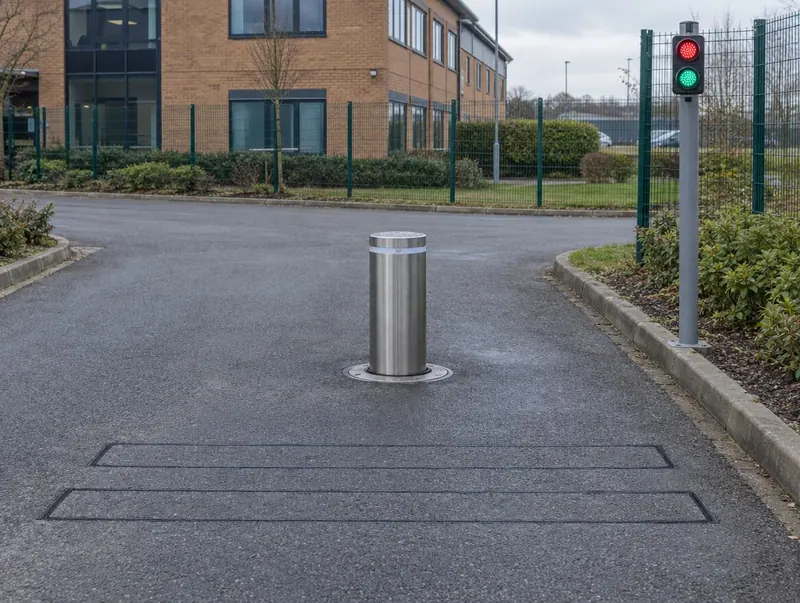 Computer-generated image
About automatic bollards in Carrickfergus
Automatic bollards suit plenty of Carrickfergus sites, high street shopfronts, schools and small industrial units among them. Hydraulic and electro-mechanical rising bollards installed with controls, safety loops, signals and power, for managed vehicle access.
Coverage in Carrickfergus takes in the BT38 postcode district. We also cover neighbouring Newtownabbey (5.6 miles), Larne (9.3 miles), Antrim (16.2 miles) and Lisburn (16.2 miles) — distances are straight-line.
Carrickfergus at a glance
- Area
- Mid and East Antrim, Northern Ireland
- Roads authority
- the Department for Infrastructure (DfI Roads)
- Planning authority
- Mid and East Antrim Borough Council
- Postcodes
- BT38
- Guide price
- Typically £2,945–£14,695 per bollard + VAT
- Survey
- Free, with a fixed written quote
- Nearby
- Newtownabbey (5.6 mi), Larne (9.3 mi), Antrim (16.2 mi), Lisburn (16.2 mi)
Guide prices for Carrickfergus
| Specification | Guide price | Includes |
|---|---|---|
| Standard | £2,945–£7,895 + VAT | Electro-mechanical or entry hydraulic, controls, loops and photocell |
| Upgraded | £6,445–£11,395 + VAT | Heavy-duty hydraulic, traffic light, signs and LED head |
| Premium | £9,995–£14,695 + VAT | High-cycle or crash-rated automatic bollard |
Per bollard, installed with controls, loops and commissioning; -2% for Northern Ireland. Guide only — the fixed price follows a survey.
Typical automatic bollards jobs in Carrickfergus
Around Carrickfergus, automatic bollards usually solve one of these:
- Secure loading yards where rated automatic posts are specified
- Entrances where a gate would block pedestrian desire lines
- Private estates and gated developments without a full gate
Consents, ground and services in Carrickfergus
Across Northern Ireland the Department for Infrastructure's DfI Roads is the roads authority, so automatic bollards on a public footway or road in Carrickfergus need its agreement before anything is dug. Posts on your own land do not.
If your site in Carrickfergus is listed or inside a conservation area, check with the local planning authority (Mid and East Antrim Borough Council) before choosing a finish — heritage settings often favour cast iron or painted steel over stainless.
Reinstatement around each cassette is made flush so vehicles pass smoothly over the lowered head. Automatic bollards need a deep pit for the cassette and a reliable way for water to leave it.
- Prepare a written risk assessment covering pedestrians, cyclists, following vehicles and children, and choose safety devices to match.
- For rated units, keep the test certificate and confirm the foundation matches the tested design.
How the job runs
Survey and risk assessment
A free site survey covers traffic patterns, who uses the entrance, power, drainage routes and buried services. We draft the safety arrangement from that, and you receive a fixed written quote.
Power and controls
A qualified electrician installs the supply and isolation, and the controller, traffic lights, photocells and access devices are mounted and wired.
Commission and test
Rise and fall times, loop detection, photocells, lights and the manual release are tested with vehicles present. Safety settings are recorded against the risk assessment.
Options to consider
| Option | Detail |
|---|---|
| Paired or multi-bollard lanes | Several bollards can run from one controller to close a wider entrance, with lane-by-lane control where needed. |
| Unrated or crash-rated | Unrated units control traffic; rated units are tested to IWA 14-1, ISO 22343-1 or PAS 68 for security entrances, with deeper, heavier foundations. |
| Fail-safe behaviour | Configured to lower or stay raised on power loss, with a manual release, depending on whether access or security takes priority. |
Pricing automatic bollards in Carrickfergus
Our Northern Ireland guide prices are a starting point; the survey in Carrickfergus firms them up. What tends to move them:
- Number of bollards and lanes controlled
- Surface condition for loops and the extent of reinstatement
- Access control devices, traffic lights and signage
Looking after them
Typical visits clean and inspect the cassette and drain, check hydraulic fluid or gearbox condition, test loops, photocells, lights and the manual release, and read the controller's fault log. Frequency depends on how often the bollard cycles; a busy entrance needs more visits than a rarely used one.
For damaged or loose posts in Carrickfergus, repairs and replacements are priced in writing first.
Questions about automatic bollards in Carrickfergus
Can you install automatic bollards anywhere in Carrickfergus?
We cover all of Carrickfergus (BT38) and the rest of Mid and East Antrim. We also work in Newtownabbey, Larne and Antrim.
Who gives permission for bollards on the pavement in Carrickfergus?
Kerbside work in Carrickfergus is a DfI Roads question: the Department for Infrastructure is the roads authority for Northern Ireland, and its permission is needed for anything placed in the public road or footway.
How much do automatic bollards cost in Carrickfergus?
In Carrickfergus, typically £2,945–£14,695 per bollard, installed with controls, loops and commissioning, plus VAT, using our Northern Ireland guide prices. The fixed figure comes in writing after we've seen the site.
Should I choose hydraulic or electro-mechanical bollards?
Choose by how often the bollard will move and how you want it maintained. Hydraulic units suit busy entrances and heavier rated posts but need fluid and seal checks. Electro-mechanical units avoid fluid and are often simpler to look after at moderate traffic levels.
Can rising bollards be installed on a public road?
Only with DfI Roads' approval, and they will set requirements for signs, signals and operation. On private land the decision is yours, but the same safety principles apply.