Dundee City · Scotland
Cast iron and heritage bollards in Dundee
Cast iron bollards for sites across Dundee and the rest of Dundee City, from the first measurement to the last relaid paving block.
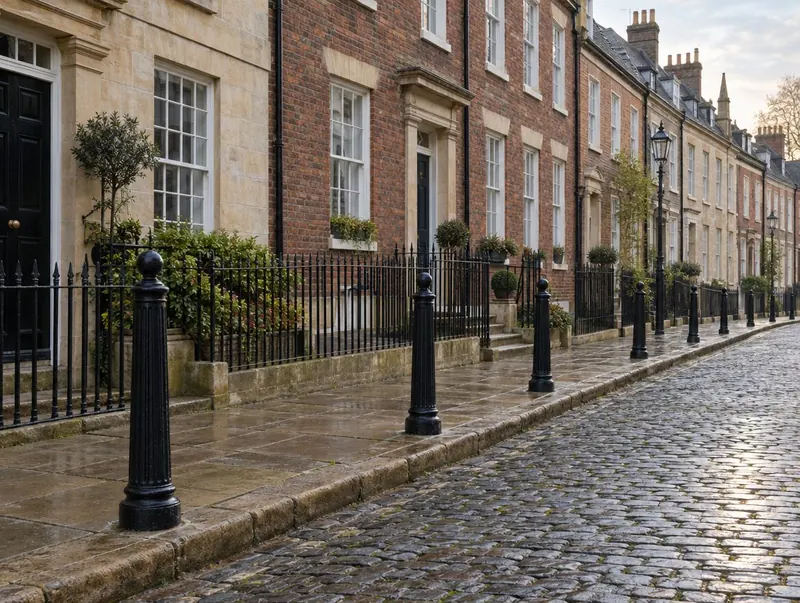 Computer-generated image
Dundee cast iron bollards
From retail parks, housing association car parks and high streets, Dundee has plenty of places where cast iron bollards earn their keep. Traditional grey cast iron is hard but brittle, while modern ductile iron castings are tougher and bend before they break.
Coverage in Dundee takes in the DD1, DD3, DD4, DD2 and DD5 postcode districts and nearby places like Barns of Claverhouse, Broughty Ferry, Invergowrie and Liff. Nearby, we also work in Carnoustie (10.5 miles), Forfar (12.5 miles), Arbroath (16.1 miles) and Blairgowrie (16.3 miles), measured as the crow flies.
Local details
- Area
- Dundee City, Scotland
- Roads authority
- Dundee City Council (local roads)
- Planning authority
- Dundee City Council
- Postcodes
- DD1, DD3, DD4, DD2 and DD5
- Guide price
- Typically £445–£1,695 per bollard + VAT (£525–£2,045 inc VAT for homes); minimum job £745
- Survey
- Free, with a fixed written quote
- Nearby
- Carnoustie (10.5 mi), Forfar (12.5 mi), Arbroath (16.1 mi), Blairgowrie (16.3 mi)
Cast iron bollard prices in Dundee
| Specification | Guide price | Includes |
|---|---|---|
| Standard | £445–£975 + VAT · £525–£1,145 inc VAT | Standard post, foundation, reinstatement |
| Upgraded | £825–£1,345 + VAT · £985–£1,595 inc VAT | Upgraded finish or fittings, reflective band, matched keys |
| Premium | £1,195–£1,695 + VAT · £1,445–£2,045 inc VAT | Heavy-duty or architectural spec, premium finish |
Per bollard, supplied and installed; no regional adjustment. Guide only — the fixed price follows a survey.
Cast iron bollards in Dundee: common uses
Typical reasons Dundee sites choose cast iron bollards:
- Cathedral closes, college courts and historic estates
- Period residential streets and mews
- Replacing lost or broken posts in an existing heritage line
Consents, ground and services in Dundee
Dundee falls under Dundee City Council as roads authority. If the line of posts crosses onto adopted road or pavement, permission comes before excavation; on private land it does not.
If your site in Dundee is listed or inside a conservation area, check with the local planning authority (Dundee City Council) before choosing a finish — heritage settings often favour cast iron or painted steel over stainless.
Original stone flags and setts are reused wherever possible, because new stone rarely matches weathered material. Excavation is by hand, positions are checked against service records and scanning, and anything unexpected is recorded rather than broken through.
- Avoid chains between posts on pedestrian routes, which can trip blind and partially sighted people.
- Check whether existing bollards are of historic interest or listed before removing them; repair and resetting may be expected.
Installation, step by step
Agree pattern and approvals
We source a matching pattern or close equivalent and, where needed, provide details for the conservation officer or planning authority before ordering.
Set the post
Each bollard is set plumb in concrete with its root, flange or core, at a height that matches its neighbours. Original posts being reset are cleaned and checked for cracks first.
Relay and finish
Stone is relaid in its original pattern with suitable mortar, and the bollard is painted or touched up after fixing.
Specification choices
| Option | Detail |
|---|---|
| Contrast details | Painted bands or contrasting caps agreed with the conservation officer so posts are visible to partially sighted people. |
| Grey cast iron | Traditional material with crisp detail and good corrosion resistance. Brittle under heavy impact, so suited to low-risk positions. |
| Paint finishes | Primed and painted, commonly black, with traditional highlights in gold or white on bands and crests where appropriate. |
What affects the quote
When we price cast iron bollards in Dundee, these make the biggest difference:
- Steel cores, concrete fill or tested cores beneath covers
- Lifting and relaying natural stone paving
- Pattern complexity and whether a special casting is needed
After installation
Touch up damaged paint promptly and repaint fully when the finish has dulled or worn through. Keep a record of patterns and suppliers so that future replacements match; some patterns are made in small runs and can take time to source.
For damaged or loose posts in Dundee, repairs and replacements are priced in writing first.
Questions about cast iron bollards in Dundee
Which parts of Dundee do you cover for cast iron bollards?
We cover all of Dundee (DD1, DD3, DD4, DD2 and DD5) and the rest of Dundee City. We also work in Carnoustie, Forfar and Arbroath.
Do I need consent for cast iron bollards on a public footway in Dundee?
For anything on the public footway in Dundee we check with the roads authority first — Dundee City Council for local roads, Transport Scotland on trunk routes. Private ground such as a car park or forecourt only needs the owner's go-ahead.
How much do cast iron bollards cost in Dundee?
In Dundee, typically £445–£1,695 per bollard, supplied and installed, plus VAT (£525–£2,045 including VAT for homeowners), with a minimum job of £745 plus VAT, using our Scotland guide prices. The fixed figure comes in writing after we've seen the site.
Grey cast iron or ductile iron for new heritage bollards?
Ductile iron for any position that vehicles might strike, because it bends rather than shatters. Grey cast iron suits low-risk positions or matching existing grey iron posts exactly. Both take the same traditional patterns.
Can you match the old bollards on our street?
Often, yes. Many traditional patterns are still cast, and close equivalents exist for others. For rare patterns, a casting can sometimes be made from an existing post, though that takes longer.