Dundee City · Scotland
Crash-rated bollard installation in Dundee
Crash-rated bollards for sites across Dundee and the rest of Dundee City, from the first measurement to the last relaid paving block.
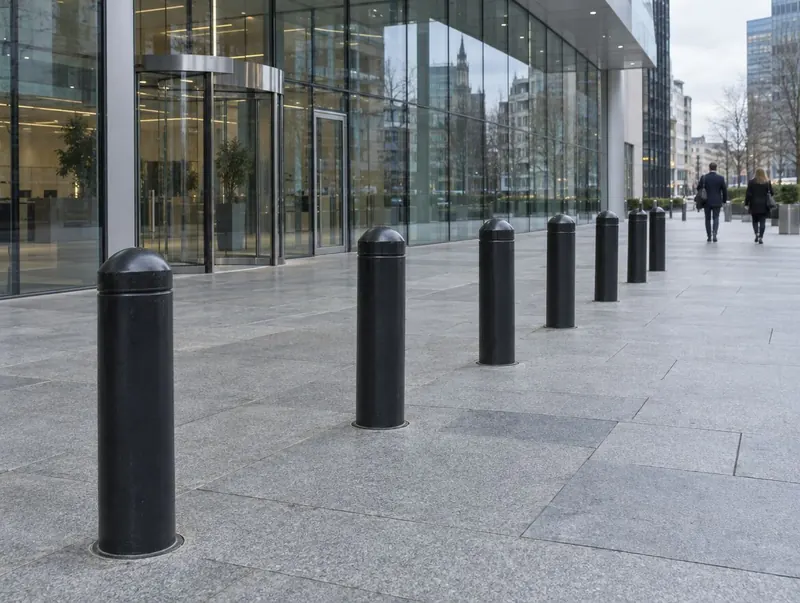 Computer-generated image
Crash-rated bollards in Dundee
Across Dundee, typical sites for crash-rated bollards include town-centre streets, business parks and college campuses. Installation of impact-tested HVM bollards rated to ISO 22343-1 (or the superseded, still-accepted PAS 68 / IWA 14-1) on the tested foundation.
We work across DD1, DD3, DD4, DD2 and DD5 — Dundee itself and places including Barns of Claverhouse, Broughty Ferry, Invergowrie and Liff. Jobs in Dundee can be combined with work in Carnoustie (10.5 miles), Forfar (12.5 miles), Arbroath (16.1 miles) and Blairgowrie (16.3 miles) (straight-line distances).
Dundee at a glance
- Area
- Dundee City, Scotland
- Roads authority
- Dundee City Council (local roads)
- Planning authority
- Dundee City Council
- Postcodes
- DD1, DD3, DD4, DD2 and DD5
- Guide price
- Typically £1,995–£9,995 per bollard + VAT; minimum job £3,995
- Survey
- Free, with a fixed written quote
- Nearby
- Carnoustie (10.5 mi), Forfar (12.5 mi), Arbroath (16.1 mi), Blairgowrie (16.3 mi)
Typical crash-rated bollards jobs in Dundee
Around Dundee, crash-rated bollards usually solve one of these:
- Transport interchanges, taxi ranks and drop-off zones
- Building entrances and forecourts flagged in a security risk assessment
- Sites where a vehicle dynamics assessment shows a long straight run-up
Guide prices for Dundee
| Specification | Guide price | Includes |
|---|---|---|
| Standard | £1,995–£5,345 + VAT | Rated for a 7.5 t vehicle at 30 mph (48 km/h), tested foundation |
| Upgraded | £4,395–£7,745 + VAT | Rated for 7.5 t at 40 mph (64 km/h), tested foundation |
| Premium | £6,795–£9,995 + VAT | Rated for 7.5 t at 50 mph (80 km/h), or a specialist foundation |
Per bollard, supplied and installed on a standard tested foundation; no regional adjustment. Guide only — the fixed price follows a survey.
What we check first in Dundee
In Scotland the council is the roads authority for local roads, which in Dundee means Dundee City Council. Crash-rated bollards on an adopted footway need its consent; trunk roads sit with Transport Scotland.
Many private-land installations in Dundee need no planning application, but the rules don't clearly cover bollards, so listed buildings, conservation areas and prominent frontages are worth raising with the planning team at Dundee City Council before posts go in.
Footways and forecourts in towns are usually crowded with cables, gas mains, water pipes and old drainage, and a single unexpected duct can stop a bollard position. Reinstatement matches paving, tactile surfaces and kerbs.
- Confirm who owns the land: works on public highway usually need the roads authority's agreement, and permanent street furniture there may need a licence.
- Agree how emergency vehicles will get through, and refer to guidance on selecting and installing vehicle security barriers such as PAS 69 or ISO 22343-2.
From survey to handover
Free site survey and ground checks
A free site survey looks at access, surfaces and likely services, followed by utility searches, radar scanning and trial holes where needed. You then receive a fixed written quote based on what the survey found.
Fix reinforcement and set the posts
The reinforcement cage is built to the drawing and the bollards are held to line and level in templates. Concrete is poured to the specified grade, with samples taken for testing if the specification calls for them.
Cure, protect and reinstate
The posts are protected while the concrete gains strength, and the surface is reinstated to match. The line should not be treated as fully effective until the specified curing period has passed.
Options to consider
| Option | Detail |
|---|---|
| Deep or standard foundation designs | Deep foundations suit open ground where excavation is unrestricted. Where services or slabs get in the way, shallow-mount tested designs may be a better fit. |
| Rated removable or automatic posts | Where an entrance must open for deliveries or emergency vehicles, rated removable, retractable or automatic models are available. Check that the rating stated is for the exact model and position you are buying. |
| Static rated bollards | Fixed posts for permanent lines where vehicles never need to pass. They are a straightforward rated option to install and maintain. |
What affects the quote
Two Dundee jobs with the same number of posts can price quite differently. The usual reasons:
- Reinstatement of natural stone, tactile paving or specialist surfaces
- Number of posts and whether a linked beam system is needed
- Buried services, diversions and ground investigation
After installation
Look for cracked surfacing at the base, movement, damaged covers and faded bands. Movable rated bollards need a planned servicing schedule.
For damaged or loose posts in Dundee, repairs and replacements are priced in writing first.
Crash-rated bollards in Dundee: FAQs
Can you install crash-rated bollards anywhere in Dundee?
We cover all of Dundee (DD1, DD3, DD4, DD2 and DD5) and the rest of Dundee City. We also work in Carnoustie, Forfar and Arbroath.
Do I need consent for crash-rated bollards on a public footway in Dundee?
In Scotland the council is the roads authority for local roads, which in Dundee means Dundee City Council. Crash-rated bollards on an adopted footway need its consent; trunk roads sit with Transport Scotland.
What's a typical price for crash-rated bollards in Dundee?
In Dundee, typically £1,995–£9,995 per bollard, supplied and installed on a standard tested foundation, plus VAT, with a minimum job of £3,995 plus VAT, using our Scotland guide prices. The fixed figure comes in writing after we've seen the site.
What happens if a rated bollard is struck?
Make the area safe and have the post assessed before relying on it again. A rated bollard that has absorbed a serious impact is usually replaced, and the manufacturer may need to check the foundation or insert. We can install the replacement to the original tested detail.
Why can't the foundation be adjusted to suit our ground?
Because the rating belongs to the bollard and foundation as tested together. Making the hole shallower, narrower or lighter on steel changes how the system behaves on impact. If site conditions force a change, the manufacturer has to approve it in writing, and some changes mean choosing a different product such as a shallow-mount system.