Dundee City · Scotland
Automatic rising bollard installation in Dundee
Automatic bollards supplied and fitted in Dundee, Dundee City: surveyed, scanned for services, set in proper foundations and finished to match the ground.
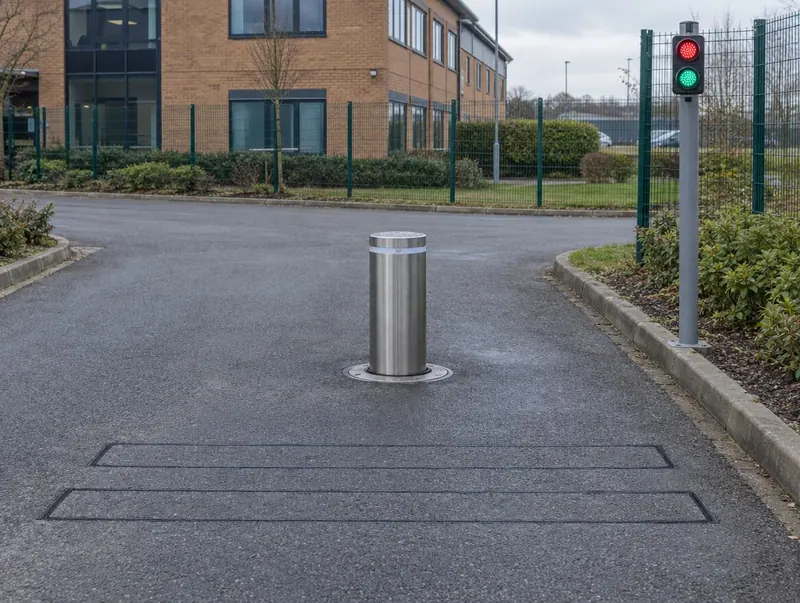 Computer-generated image
Dundee automatic bollards
We supply and fit automatic bollards throughout Dundee, typically for sites such as retail parks, leisure centres and business parks. Automatic bollards are available unrated for traffic control or crash-tested for security entrances.
Coverage in Dundee takes in the DD1, DD3, DD4, DD2 and DD5 postcode districts and nearby places like Barns of Claverhouse, Broughty Ferry, Invergowrie and Liff. Nearby, we also work in Carnoustie (10.5 miles), Forfar (12.5 miles), Arbroath (16.1 miles) and Blairgowrie (16.3 miles), measured as the crow flies.
Dundee at a glance
- Area
- Dundee City, Scotland
- Roads authority
- Dundee City Council (local roads)
- Planning authority
- Dundee City Council
- Postcodes
- DD1, DD3, DD4, DD2 and DD5
- Guide price
- Typically £2,995–£14,995 per bollard + VAT
- Survey
- Free, with a fixed written quote
- Nearby
- Carnoustie (10.5 mi), Forfar (12.5 mi), Arbroath (16.1 mi), Blairgowrie (16.3 mi)
What Dundee sites use automatic bollards for
Common uses in a place like Dundee:
- Secure loading yards where rated automatic posts are specified
- Business parks and campus roads with controlled vehicle access
- Bus gates and access-only routes where the highway authority agrees
Dundee: typical automatic bollard prices
| Specification | Guide price | Includes |
|---|---|---|
| Standard | £2,995–£8,045 + VAT | Electro-mechanical or entry hydraulic, controls, loops and photocell |
| Upgraded | £6,595–£11,595 + VAT | Heavy-duty hydraulic, traffic light, signs and LED head |
| Premium | £10,195–£14,995 + VAT | High-cycle or crash-rated automatic bollard |
Per bollard, installed with controls, loops and commissioning; no regional adjustment. Guide only — the fixed price follows a survey.
Permissions and groundwork in Dundee
For anything on the public footway in Dundee we check with the roads authority first — Dundee City Council for local roads, Transport Scotland on trunk routes. Private ground such as a car park or forecourt only needs the owner's go-ahead.
Bollards on private land often need no planning application, but listed buildings and conservation areas are different; the planning service at Dundee City Council can confirm before anything is ordered.
Automatic bollards need a deep pit for the cassette and a reliable way for water to leave it. Reinstatement around each cassette is made flush so vehicles pass smoothly over the lowered head.
- Have the electrical installation carried out and certified by a qualified electrician to BS 7671.
- Prepare a written risk assessment covering pedestrians, cyclists, following vehicles and children, and choose safety devices to match.
How the job runs
Survey and risk assessment
A free site survey covers traffic patterns, who uses the entrance, power, drainage routes and buried services. We draft the safety arrangement from that, and you receive a fixed written quote.
Excavate and set cassettes
Each cassette pit is excavated to the manufacturer's depth, with the base prepared to drain. Cassettes are set to finished road level and fall, then concreted in.
Commission and test
Rise and fall times, loop detection, photocells, lights and the manual release are tested with vehicles present. Safety settings are recorded against the risk assessment.
Specification choices
| Option | Detail |
|---|---|
| Hydraulic drive | Integral or remote power pack. Suits high-frequency entrances and heavier rated units, with periodic checks on fluid, seals and hoses. |
| Heights and diameters | Raised heights are commonly around 500–800 mm for traffic control and taller for security models, with diameters varying by drive and rating. |
| Paired or multi-bollard lanes | Several bollards can run from one controller to close a wider entrance, with lane-by-lane control where needed. |
What moves the price in Dundee
When we price automatic bollards in Dundee, these make the biggest difference:
- Hydraulic or electro-mechanical drive and the duty cycle needed
- Access control devices, traffic lights and signage
- Traffic management during installation on live roads
Keeping them working
Automatic bollards need planned servicing, not just repair when they fail. Between visits, site staff should keep the head clear of grit and leaves, report slow or noisy movement early and never override safety devices to keep an entrance open.
For damaged or loose posts in Dundee, repairs and replacements are priced in writing first.
Automatic bollards in Dundee: FAQs
Can you install automatic bollards anywhere in Dundee?
We cover all of Dundee (DD1, DD3, DD4, DD2 and DD5) and the rest of Dundee City. We also work in Carnoustie, Forfar and Arbroath.
Do I need consent for automatic bollards on a public footway in Dundee?
In Scotland the council is the roads authority for local roads, which in Dundee means Dundee City Council. Automatic bollards on an adopted footway need its consent; trunk roads sit with Transport Scotland.
What's a typical price for automatic bollards in Dundee?
In Dundee, typically £2,995–£14,995 per bollard, installed with controls, loops and commissioning, plus VAT, using our Scotland guide prices. The fixed figure comes in writing after we've seen the site.
Why do automatic bollards need drainage?
The bollard sits in a pit that collects rain and silt. Without a drain, water corrodes the mechanism, short-circuits electrics and can freeze the post in place. A drain connection is part of every automatic installation we carry out.
What stops a rising bollard hitting a car?
A safety loop in the road detects a vehicle above or close to the bollard and blocks the rise, backed up by photocells. Traffic lights and head lights tell drivers when to stop. The settings are tested on site with vehicles before handover.