Angus · Scotland
Automatic rising bollard installation in Forfar
Local installation of automatic bollards in Forfar — free survey, fixed written price, and posts set to the right spacing for people and vehicles.
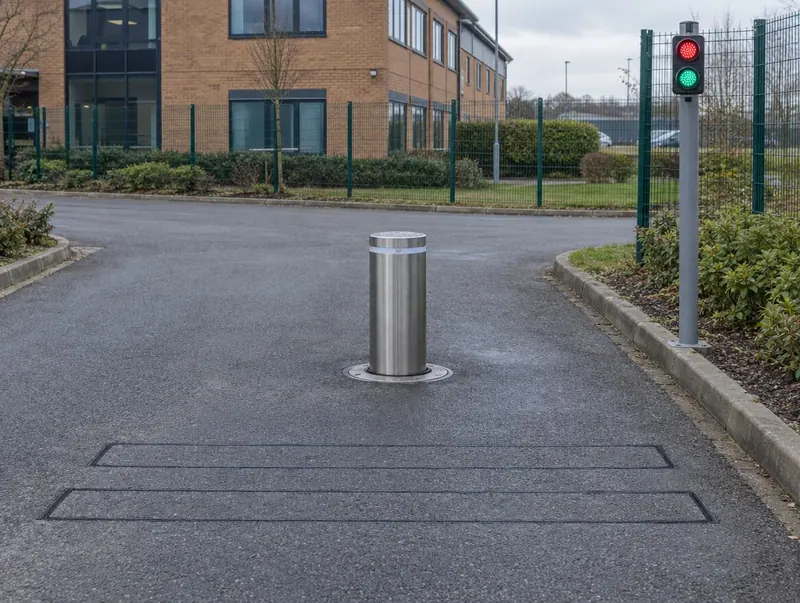 Computer-generated image
About automatic bollards in Forfar
From small industrial units, town-centre squares and filling-station forecourts, Forfar has plenty of places where automatic bollards earn their keep. Hydraulic and electro-mechanical rising bollards installed with controls, safety loops, signals and power, for managed vehicle access.
Coverage in Forfar takes in the DD8 postcode district and nearby places like Kirriemuir, Letham, Glamis and Westmuir. We also cover neighbouring Carnoustie (12 miles), Dundee (12.5 miles), Arbroath (12.8 miles) and Montrose (16.8 miles) — distances are straight-line.
Local details
- Area
- Angus, Scotland
- Roads authority
- Angus Council (local roads)
- Planning authority
- Angus Council
- Postcodes
- DD8
- Guide price
- Typically £2,995–£14,995 per bollard + VAT
- Survey
- Free, with a fixed written quote
- Nearby
- Carnoustie (12 mi), Dundee (12.5 mi), Arbroath (12.8 mi), Montrose (16.8 mi)
What automatic bollards cost in Forfar
| Specification | Guide price | Includes |
|---|---|---|
| Standard | £2,995–£8,045 + VAT | Electro-mechanical or entry hydraulic, controls, loops and photocell |
| Upgraded | £6,595–£11,595 + VAT | Heavy-duty hydraulic, traffic light, signs and LED head |
| Premium | £10,195–£14,995 + VAT | High-cycle or crash-rated automatic bollard |
Per bollard, installed with controls, loops and commissioning; no regional adjustment. Guide only — the fixed price follows a survey.
Where automatic bollards go in around Forfar
Around Forfar, automatic bollards usually solve one of these:
- Secure loading yards where rated automatic posts are specified
- Entrances where a gate would block pedestrian desire lines
- Pedestrianised streets with permitted delivery windows
Permissions and groundwork in Forfar
In Scotland the council is the roads authority for local roads, which in Forfar means Angus Council. Automatic bollards on an adopted footway need its consent; trunk roads sit with Transport Scotland.
Many private-land installations in Forfar need no planning application, but the rules don't clearly cover bollards, so listed buildings, conservation areas and prominent frontages are worth raising with the planning team at Angus Council before posts go in.
Duct routes cross the carriageway and often the footway, so buried services along those routes must be traced first. Without drainage, rainwater and silt collect in the cassette, corrode the mechanism and can freeze around the post in winter.
- Have the electrical installation carried out and certified by a qualified electrician to BS 7671.
- On public highway, rising bollards normally need roads authority approval, with signs and signals to their requirements.
How the job runs
Excavate and set cassettes
Each cassette pit is excavated to the manufacturer's depth, with the base prepared to drain. Cassettes are set to finished road level and fall, then concreted in.
Ducts, drainage and loops
Ducts are laid between the bollards, the controller cabinet and access devices, with draw pits where runs change direction. The drain is connected and the safety and exit loops are cut into the surface and sealed.
Commission and test
Rise and fall times, loop detection, photocells, lights and the manual release are tested with vehicles present. Safety settings are recorded against the risk assessment.
Specification choices
| Option | Detail |
|---|---|
| Electro-mechanical drive | Motor and gearbox inside the bollard with no hydraulic fluid. Often simpler to service, with duty cycles that suit moderate traffic. |
| Head lighting and finishes | LED rings or lights in the head, reflective bands, and powder-coated or stainless finishes. Lit heads help drivers see the post when it is raised. |
| Heights and diameters | Raised heights are commonly around 500–800 mm for traffic control and taller for security models, with diameters varying by drive and rating. |
What moves the price in Forfar
When we price automatic bollards in Forfar, these make the biggest difference:
- Length of duct runs, drainage connections and power supply distance
- Access control devices, traffic lights and signage
- Number of bollards and lanes controlled
Looking after them
Between visits, site staff should keep the head clear of grit and leaves, report slow or noisy movement early and never override safety devices to keep an entrance open. Automatic bollards need planned servicing, not just repair when they fail.
If posts in Forfar are later hit or damaged, we can repair or replace them — see bollard repairs.
Common questions
Do you install automatic bollards in Forfar?
We cover all of Forfar (DD8) and the rest of Angus. We also work in Carnoustie, Dundee and Arbroath.
Do I need consent for automatic bollards on a public footway in Forfar?
Forfar falls under Angus Council as roads authority. If the line of posts crosses onto adopted road or pavement, permission comes before excavation; on private land it does not.
What's a typical price for automatic bollards in Forfar?
In Forfar, typically £2,995–£14,995 per bollard, installed with controls, loops and commissioning, plus VAT, using our Scotland guide prices. The fixed figure comes in writing after we've seen the site.
Can rising bollards be installed on a public road?
Only with the roads authority's approval, and they will set requirements for signs, signals and operation. On private land the decision is yours, but the same safety principles apply.
Should I choose hydraulic or electro-mechanical bollards?
Choose by how often the bollard will move and how you want it maintained. Hydraulic units suit busy entrances and heavier rated posts but need fluid and seal checks. Electro-mechanical units avoid fluid and are often simpler to look after at moderate traffic levels.