Angus · Scotland
Lighting bollard installation in Forfar
Lighting bollards for sites across Forfar and the rest of Angus, from the first measurement to the last relaid paving block.
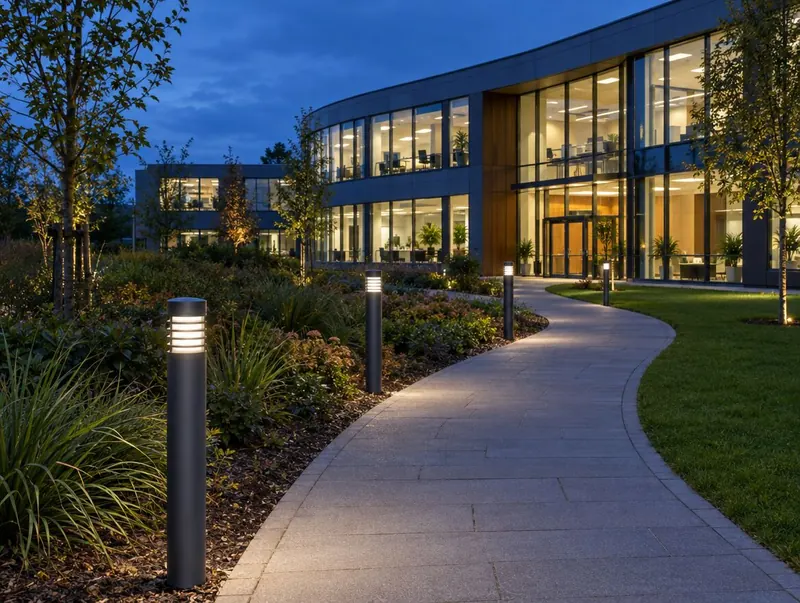 Computer-generated image
Forfar lighting bollards
We supply and fit lighting bollards throughout Forfar, typically for sites such as small industrial units, filling-station forecourts and residential driveways. Outdoor lighting bollards need weatherproof and impact-resistant construction and must be connected and tested by a qualified electrician.
We cover Forfar's DD8 postcode district, including places such as Kirriemuir, Letham, Glamis and Westmuir. Nearby, we also work in Carnoustie (12 miles), Dundee (12.5 miles), Arbroath (12.8 miles) and Montrose (16.8 miles), measured as the crow flies.
Forfar at a glance
- Area
- Angus, Scotland
- Roads authority
- Angus Council (local roads)
- Planning authority
- Angus Council
- Postcodes
- DD8
- Guide price
- Typically £345–£1,195 per bollard + VAT (£405–£1,445 inc VAT for homes); minimum job £845
- Survey
- Free, with a fixed written quote
- Nearby
- Carnoustie (12 mi), Dundee (12.5 mi), Arbroath (12.8 mi), Montrose (16.8 mi)
Where lighting bollards go in around Forfar
Typical reasons Forfar sites choose lighting bollards:
- Building entrances and approach routes
- Car park walkways and pedestrian crossings
- Steps, ramps and changes in level
Lighting bollard prices in Forfar
| Specification | Guide price | Includes |
|---|---|---|
| Standard | £345–£705 + VAT · £405–£845 inc VAT | Standard post, foundation, reinstatement |
| Upgraded | £605–£955 + VAT · £725–£1,145 inc VAT | Upgraded finish or fittings, reflective band, matched keys |
| Premium | £855–£1,195 + VAT · £1,045–£1,445 inc VAT | Heavy-duty or architectural spec, premium finish |
Per bollard, installed with a qualified electrician (supply run extra); no regional adjustment. Guide only — the fixed price follows a survey.
What we check first in Forfar
Forfar falls under Angus Council as roads authority. If the line of posts crosses onto adopted road or pavement, permission comes before excavation; on private land it does not.
Bollards on private land often need no planning application, but listed buildings and conservation areas are different; the planning service at Angus Council can confirm before anything is ordered.
Cable trenches run between every position and back to the supply, often crossing paths, drives and planting, so the routes are planned to minimise cuts through hard surfaces and to avoid existing gas, water and telecoms services. Bases are set in firm ground with the cable entry facing the right way, and on paved routes the bollards are positioned so cables can be pulled through ducts rather than requiring surfaces to be lifted again later.
- Choose IP and IK ratings that suit the location, and do not rely on lighting bollards as vehicle barriers.
- In homes, new outdoor circuits are often notifiable building work; a registered electrician can usually self-certify it.
From survey to handover
Dig cable routes
Trenches are dug between bollard positions and the supply point, avoiding existing services, with cable or duct laid at a suitable depth and warning tape above.
Set the bases
Anchor cages or foundations are cast at each position with the cable entry in the right place, set level so each bollard stands plumb.
Test, aim and certify
The circuit is tested and certified, bollards are checked at night for coverage and glare, and asymmetric heads are turned to face the path.
Options to consider
| Option | Detail |
|---|---|
| Fixings | Anchor cages cast in concrete, base plates on existing slabs, or ground spikes for garden models. |
| Mains LED bollards | Wired from a dedicated circuit for reliable lighting of paths and car parks. Needs cable routes and electrical certification. |
| Colour temperature | Warm white for residential and amenity areas; warmer or amber options near sensitive wildlife habitats. |
What affects the quote
Two Forfar jobs with the same number of posts can price quite differently. The usual reasons:
- Length of cable routes and surfaces to be cut
- Reinstatement of paving, tarmac or planting
- Distance from the supply and circuit requirements
After installation
Photocells and timers need resetting when the clocks change unless they adjust automatically. A periodic electrical inspection checks that connections and protection are still sound.
We can also service, repair or replace existing posts anywhere in Forfar.
Questions about lighting bollards in Forfar
Can you install lighting bollards anywhere in Forfar?
We cover all of Forfar (DD8) and the rest of Angus. We also work in Carnoustie, Dundee and Arbroath.
Do I need consent for lighting bollards on a public footway in Forfar?
For anything on the public footway in Forfar we check with the roads authority first — Angus Council for local roads, Transport Scotland on trunk routes. Private ground such as a car park or forecourt only needs the owner's go-ahead.
How much do lighting bollards cost in Forfar?
In Forfar, typically £345–£1,195 per bollard, installed with a qualified electrician (supply run extra), plus VAT (£405–£1,445 including VAT for homeowners), with a minimum job of £845 plus VAT, using our Scotland guide prices. The fixed figure comes in writing after we've seen the site.
How far apart should lighting bollards be?
That depends on the light output, beam pattern and how evenly the path needs to be lit. Spacing is worked out from the product's light data rather than a fixed distance. Too far apart leaves dark patches between pools of light.
Do lighting bollards need an electrician to install?
Yes, mains lighting bollards must be connected by a qualified electrician, who tests and certifies the circuit. We arrange that as part of the job. Solar bollards avoid mains work but provide less light.