Angus · Scotland
Lighting bollard installation in Carnoustie
Lighting bollards for sites across Carnoustie and the rest of Angus, from the first measurement to the last relaid paving block.
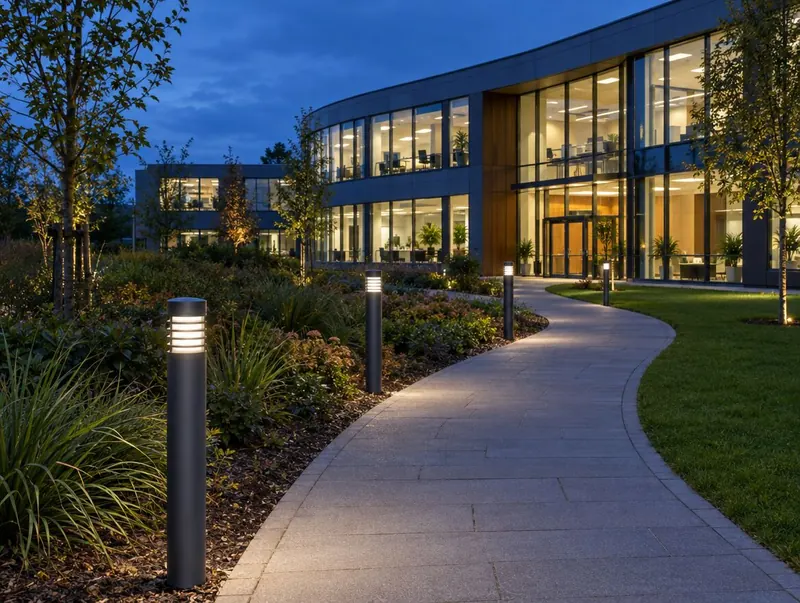 Computer-generated image
Carnoustie lighting bollards
We supply and fit lighting bollards throughout Carnoustie, typically for sites such as high street shopfronts, community buildings and residential driveways. Outdoor lighting bollards need weatherproof and impact-resistant construction and must be connected and tested by a qualified electrician.
Coverage in Carnoustie takes in the DD7 postcode district and nearby places like East Haven. We also cover neighbouring Arbroath (6.1 miles), Dundee (10.5 miles), St Andrews (11.9 miles) and Forfar (12 miles) — distances are straight-line.
Local details
- Area
- Angus, Scotland
- Roads authority
- Angus Council (local roads)
- Planning authority
- Angus Council
- Postcodes
- DD7
- Guide price
- Typically £345–£1,195 per bollard + VAT (£405–£1,445 inc VAT for homes); minimum job £845
- Survey
- Free, with a fixed written quote
- Nearby
- Arbroath (6.1 mi), Dundee (10.5 mi), St Andrews (11.9 mi), Forfar (12 mi)
Lighting bollards in Carnoustie: common uses
Common uses in a place like Carnoustie:
- Steps, ramps and changes in level
- Hotel, restaurant and pub frontages
- Car park walkways and pedestrian crossings
Guide prices for Carnoustie
| Specification | Guide price | Includes |
|---|---|---|
| Standard | £345–£705 + VAT · £405–£845 inc VAT | Standard post, foundation, reinstatement |
| Upgraded | £605–£955 + VAT · £725–£1,145 inc VAT | Upgraded finish or fittings, reflective band, matched keys |
| Premium | £855–£1,195 + VAT · £1,045–£1,445 inc VAT | Heavy-duty or architectural spec, premium finish |
Per bollard, installed with a qualified electrician (supply run extra); no regional adjustment. Guide only — the fixed price follows a survey.
What we check first in Carnoustie
In Scotland the council is the roads authority for local roads, which in Carnoustie means Angus Council. Lighting bollards on an adopted footway need its consent; trunk roads sit with Transport Scotland.
Bollards on private land often need no planning application, but listed buildings and conservation areas are different; the planning service at Angus Council can confirm before anything is ordered.
Cable is protected by armour or duct, buried deep enough to avoid garden tools and future paving works, and marked with warning tape. Bases are set in firm ground with the cable entry facing the right way, and on paved routes the bollards are positioned so cables can be pulled through ducts rather than requiring surfaces to be lifted again later.
- Choose IP and IK ratings that suit the location, and do not rely on lighting bollards as vehicle barriers.
- Where bollards light a public route, check the lighting levels the site owner or designer requires.
What happens on site
Survey and lighting layout
A free site survey looks at the routes to be lit, where power can come from, surfaces and buried services. Bollard spacing is set from the product's light data, and you receive a fixed written quote.
Dig cable routes
Trenches are dug between bollard positions and the supply point, avoiding existing services, with cable or duct laid at a suitable depth and warning tape above.
Reinstate
Trenches are backfilled and surfaces made good, whether paving, tarmac, gravel or turf.
Choosing the right spec
| Option | Detail |
|---|---|
| Fixings | Anchor cages cast in concrete, base plates on existing slabs, or ground spikes for garden models. |
| Colour temperature | Warm white for residential and amenity areas; warmer or amber options near sensitive wildlife habitats. |
| Mains LED bollards | Wired from a dedicated circuit for reliable lighting of paths and car parks. Needs cable routes and electrical certification. |
What moves the price in Carnoustie
Our Scotland guide prices are a starting point; the survey in Carnoustie firms them up. What tends to move them:
- Mains or solar bollards
- Controls such as photocells, timers or sensors
- Number of bollards and their specification
After installation
If a run of bollards trips the circuit after rain, water ingress at a connection is the usual cause and needs an electrician. A periodic electrical inspection checks that connections and protection are still sound.
For damaged or loose posts in Carnoustie, repairs and replacements are priced in writing first.
Questions about lighting bollards in Carnoustie
Do you install lighting bollards in Carnoustie?
We cover all of Carnoustie (DD7) and the rest of Angus. We also work in Arbroath, Dundee and St Andrews.
Who gives permission for bollards on the pavement in Carnoustie?
Carnoustie falls under Angus Council as roads authority. If the line of posts crosses onto adopted road or pavement, permission comes before excavation; on private land it does not.
How much do lighting bollards cost in Carnoustie?
In Carnoustie, typically £345–£1,195 per bollard, installed with a qualified electrician (supply run extra), plus VAT (£405–£1,445 including VAT for homeowners), with a minimum job of £845 plus VAT, using our Scotland guide prices. The fixed figure comes in writing after we've seen the site.
Are solar bollard lights worth it?
For marking edges and low-use paths, they can be, because there is no cabling to install. They give less light than mains bollards and perform poorly in shaded spots and short winter days. For lighting a route properly, mains bollards are more dependable.
Will lighting bollards survive in a car park?
Choose robust bodies with a high impact rating and place them where vehicles are unlikely to hit them, such as behind kerbs or alongside protective posts. A lighting bollard is not designed to stop a car.