Dundee City · Scotland
Shallow-mount security bollard installation in Dundee
Local installation of shallow-mount bollards in Dundee — free survey, fixed written price, and posts set to the right spacing for people and vehicles.
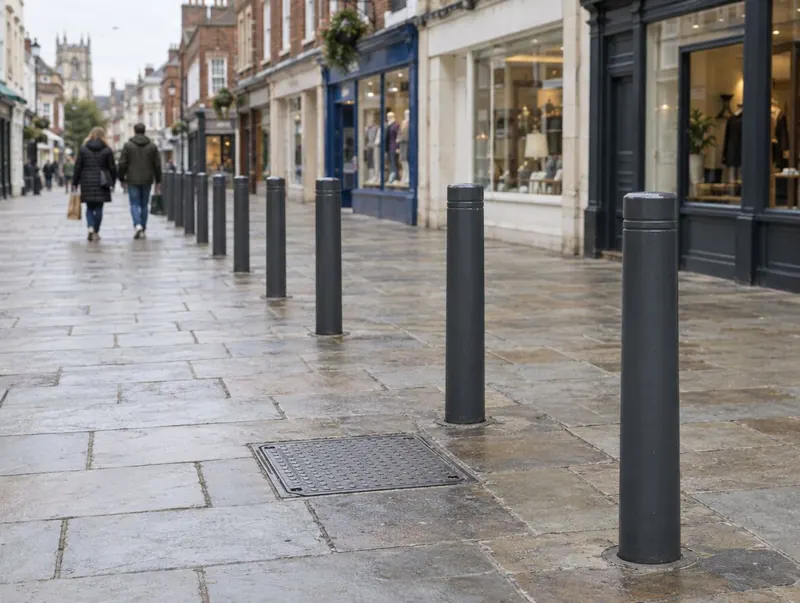 Computer-generated image
About shallow-mount bollards in Dundee
In the city of Dundee, shallow-mount bollards tend to go in at retail parks, town-centre streets and leisure centres. Rated shallow-foundation bollard systems installed where buried services, basements or slabs rule out deep excavation.
We work across DD1, DD3, DD4, DD2 and DD5 — Dundee itself and places including Barns of Claverhouse, Broughty Ferry, Invergowrie and Liff. Jobs in Dundee can be combined with work in Carnoustie (10.5 miles), Forfar (12.5 miles), Arbroath (16.1 miles) and Blairgowrie (16.3 miles) (straight-line distances).
Key facts for this area
- Area
- Dundee City, Scotland
- Roads authority
- Dundee City Council (local roads)
- Planning authority
- Dundee City Council
- Postcodes
- DD1, DD3, DD4, DD2 and DD5
- Guide price
- Typically £1,995–£8,995 per bollard + VAT; minimum job £4,995
- Survey
- Free, with a fixed written quote
- Nearby
- Carnoustie (10.5 mi), Forfar (12.5 mi), Arbroath (16.1 mi), Blairgowrie (16.3 mi)
Guide prices for Dundee
| Specification | Guide price | Includes |
|---|---|---|
| Standard | £1,995–£4,945 + VAT | Rated for a 7.5 t vehicle at 30 mph (48 km/h), tested foundation |
| Upgraded | £4,095–£7,045 + VAT | Rated for 7.5 t at 40 mph (64 km/h), tested foundation |
| Premium | £6,195–£8,995 + VAT | Rated for 7.5 t at 50 mph (80 km/h), or a specialist foundation |
Per bollard position, supplied and installed; no regional adjustment. Guide only — the fixed price follows a survey.
Shallow-mount bollards in Dundee: common uses
Typical reasons Dundee sites choose shallow-mount bollards:
- Listed or historic streets where deep digging is unwelcome
- Sites where service diversions would be slow or impractical
- Podium decks, car park roofs and basement slabs
Permissions and groundwork in Dundee
For anything on the public footway in Dundee we check with the roads authority first — Dundee City Council for local roads, Transport Scotland on trunk routes. Private ground such as a car park or forecourt only needs the owner's go-ahead.
If your site in Dundee is listed or inside a conservation area, check with the local planning authority (Dundee City Council) before choosing a finish — heritage settings often favour cast iron or painted steel over stainless.
Shallow does not mean simple. On decks and roofs, the waterproofing and drainage layers must be protected or rebuilt, and fixings must not puncture membranes unless the structural and waterproofing designers have agreed a detail.
- Get written confirmation from a structural engineer before installing on slabs, decks, basements or over voids.
- Keep the test certificate for the exact system and configuration, including the minimum run length and end details.
Installation, step by step
Map what is underground
Utility records, radar scanning and trial holes establish exactly how much depth is available along the line. This is the survey that decides whether a shallow system will fit at all.
Assemble and level the frame
Frame sections are placed, joined and set to line and level, with posts fixed as the drawing shows. Joints and fixings are photographed before any concrete goes in.
Pour, cure and reinstate
Concrete is placed to the specified grade and finish depth, then the surface is rebuilt to match. The line is protected until the specified curing period has passed.
Choosing the right spec
| Option | Detail |
|---|---|
| Removable posts within a run | Some systems include removable or retractable positions for maintenance or emergency access. Check how these affect the rating. |
| Covers and sleeves | Stainless, cast or powder-coated covers fitted over the cores to match surrounding street furniture, supplied or approved by the manufacturer. |
| Surface-mounted rated units | Some tested products sit on or very close to the surface with minimal digging. These are often used for temporary or semi-permanent protection and need careful checking of the surface they bear on. |
Pricing shallow-mount bollards in Dundee
Our Scotland guide prices are a starting point; the survey in Dundee firms them up. What tends to move them:
- Structural engineering checks on slabs or decks
- Lifting, storing and relaying natural stone paving
- Changes of direction, end details and removable positions
Keeping them working
Pay attention to the surface around the posts, because settlement or loose paving can indicate movement in the bearing layer. Once cured, a shallow-mount line needs much the same care as any static rated barrier: periodic visual checks, cleaning of covers and renewal of visibility bands.
For damaged or loose posts in Dundee, repairs and replacements are priced in writing first.
Shallow-mount bollards in Dundee: FAQs
Can you install shallow-mount bollards anywhere in Dundee?
We cover all of Dundee (DD1, DD3, DD4, DD2 and DD5) and the rest of Dundee City. We also work in Carnoustie, Forfar and Arbroath.
Do I need consent for shallow-mount bollards on a public footway in Dundee?
Dundee falls under Dundee City Council as roads authority. If the line of posts crosses onto adopted road or pavement, permission comes before excavation; on private land it does not.
How much do shallow-mount bollards cost in Dundee?
In Dundee, typically £1,995–£8,995 per bollard position, supplied and installed, plus VAT, with a minimum job of £4,995 plus VAT, using our Scotland guide prices. The fixed figure comes in writing after we've seen the site.
Can I install a single shallow-mount bollard on its own?
Usually not. Most shallow systems rely on several posts working together, and the rating applies to a tested run with a stated minimum number of posts. A single position generally needs a different solution.
How much shallower is a shallow-mount bollard foundation?
Often a fraction of the depth of a conventional rated foundation, commonly a few hundred millimetres. The exact depth depends on the system and rating chosen. What you gain in depth is usually traded for width, because the load is spread along a linked frame.