Angus · Scotland
Crash-rated bollard installation in Arbroath
Local installation of crash-rated bollards in Arbroath — free survey, fixed written price, and posts set to the right spacing for people and vehicles.
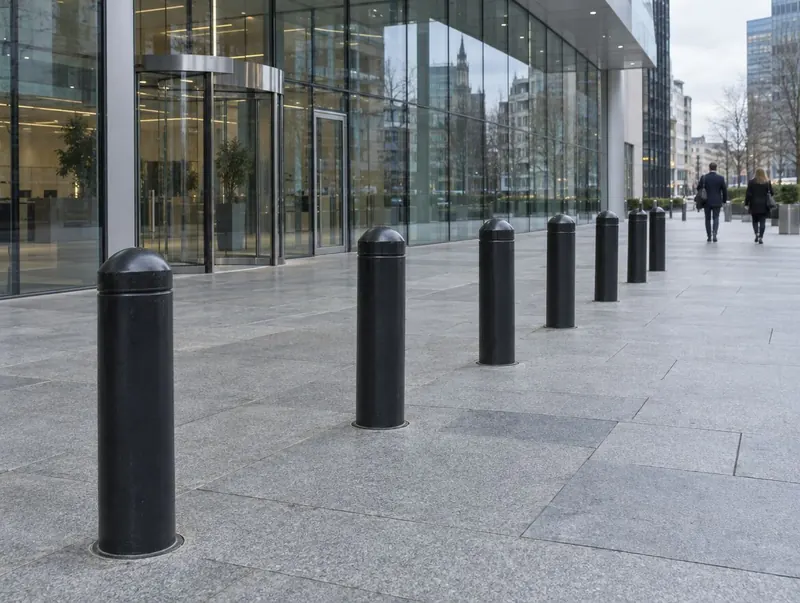 Computer-generated image
About crash-rated bollards in Arbroath
Crash-rated bollards suit plenty of Arbroath sites, filling-station forecourts, schools and small industrial units among them. Installation of impact-tested HVM bollards rated to ISO 22343-1 (or the superseded, still-accepted PAS 68 / IWA 14-1) on the tested foundation.
We work across DD11 — Arbroath itself and places including Friockheim, Inverkeilor, St Vigeans and Auchmithie. Nearby, we also work in Carnoustie (6.1 miles), Montrose (11.6 miles), Forfar (12.8 miles) and Dundee (16.1 miles), measured as the crow flies.
Key facts for this area
- Area
- Angus, Scotland
- Roads authority
- Angus Council (local roads)
- Planning authority
- Angus Council
- Postcodes
- DD11
- Guide price
- Typically £1,995–£9,995 per bollard + VAT; minimum job £3,995
- Survey
- Free, with a fixed written quote
- Nearby
- Carnoustie (6.1 mi), Montrose (11.6 mi), Forfar (12.8 mi), Dundee (16.1 mi)
What crash-rated bollards cost in Arbroath
| Specification | Guide price | Includes |
|---|---|---|
| Standard | £1,995–£5,345 + VAT | Rated for a 7.5 t vehicle at 30 mph (48 km/h), tested foundation |
| Upgraded | £4,395–£7,745 + VAT | Rated for 7.5 t at 40 mph (64 km/h), tested foundation |
| Premium | £6,795–£9,995 + VAT | Rated for 7.5 t at 50 mph (80 km/h), or a specialist foundation |
Per bollard, supplied and installed on a standard tested foundation; no regional adjustment. Guide only — the fixed price follows a survey.
What Arbroath sites use crash-rated bollards for
Typical reasons Arbroath sites choose crash-rated bollards:
- Data centres, utilities and critical infrastructure perimeters
- Sites where a vehicle dynamics assessment shows a long straight run-up
- Building entrances and forecourts flagged in a security risk assessment
Before we dig in Arbroath
In Scotland the council is the roads authority for local roads, which in Arbroath means Angus Council. Crash-rated bollards on an adopted footway need its consent; trunk roads sit with Transport Scotland.
If your site in Arbroath is listed or inside a conservation area, check with the local planning authority (Angus Council) before choosing a finish — heritage settings often favour cast iron or painted steel over stainless.
Reinstatement matches paving, tactile surfaces and kerbs. Made ground, a high water table or soft clay may need an engineer to confirm the tested design suits the site; any change to depth, width or reinforcement must be agreed in writing by the manufacturer, or the rating may no longer apply.
- Confirm who owns the land: works on public highway usually need the roads authority's agreement, and permanent street furniture there may need a licence.
- Agree how emergency vehicles will get through, and refer to guidance on selecting and installing vehicle security barriers such as PAS 69 or ISO 22343-2.
From survey to handover
Set out and excavate
Positions are set out to the drawing and excavated to the tested depth and width, with shoring where the ground needs it. Spoil is removed as work progresses.
Fix reinforcement and set the posts
The reinforcement cage is built to the drawing and the bollards are held to line and level in templates. Concrete is poured to the specified grade, with samples taken for testing if the specification calls for them.
Cure, protect and reinstate
The posts are protected while the concrete gains strength, and the surface is reinstated to match. The line should not be treated as fully effective until the specified curing period has passed.
Options to consider
| Option | Detail |
|---|---|
| Decorative covers | Stainless steel, cast or polymer sleeves can be fitted over the steel core to suit a streetscape. Use covers supplied or approved by the manufacturer so the tested product is not altered. |
| Heights and diameters | Exposed heights are commonly around 800 to 1,000 mm, with core diameters varying by model and rating. Larger diameters are not always needed to achieve a given rating. |
| Deep or standard foundation designs | Deep foundations suit open ground where excavation is unrestricted. Where services or slabs get in the way, shallow-mount tested designs may be a better fit. |
What moves the price in Arbroath
Our Scotland guide prices are a starting point; the survey in Arbroath firms them up. What tends to move them:
- The rating required and the product range that achieves it
- Number of posts and whether a linked beam system is needed
- Reinstatement of natural stone, tactile paving or specialist surfaces
Looking after them
Look for cracked surfacing at the base, movement, damaged covers and faded bands. A rated bollard that has stopped a vehicle has done its job and should be assessed with the manufacturer; in most cases the post, and sometimes the foundation insert, is replaced rather than straightened.
For damaged or loose posts in Arbroath, repairs and replacements are priced in writing first.
Crash-rated bollards in Arbroath: FAQs
Which parts of Arbroath do you cover for crash-rated bollards?
We cover all of Arbroath (DD11) and the rest of Angus. We also work in Carnoustie, Montrose and Forfar.
Who gives permission for bollards on the pavement in Arbroath?
In Scotland the council is the roads authority for local roads, which in Arbroath means Angus Council. Crash-rated bollards on an adopted footway need its consent; trunk roads sit with Transport Scotland.
What's a typical price for crash-rated bollards in Arbroath?
In Arbroath, typically £1,995–£9,995 per bollard, supplied and installed on a standard tested foundation, plus VAT, with a minimum job of £3,995 plus VAT, using our Scotland guide prices. The fixed figure comes in writing after we've seen the site.
What does a crash rating code actually tell me?
It tells you the vehicle used in the test, how fast it was travelling, the angle it hit at and how far it got past the bollard line. Your security adviser compares those figures with the vehicle and speed achievable on your approach. A rating that does not match the site's real risk is either more than you need or not enough.
Will you design our HVM layout?
No. Scheme design and threat assessment belong with your security adviser, a specialist consultant or the manufacturer's technical team. We install the products they specify, to the tested foundation, and work alongside them on site so the build matches the design.