Isle of Anglesey · Wales
Concrete bollard installation in Holyhead
Planning concrete bollards in Holyhead? We check ownership, consents and buried services first, then quote a fixed price.
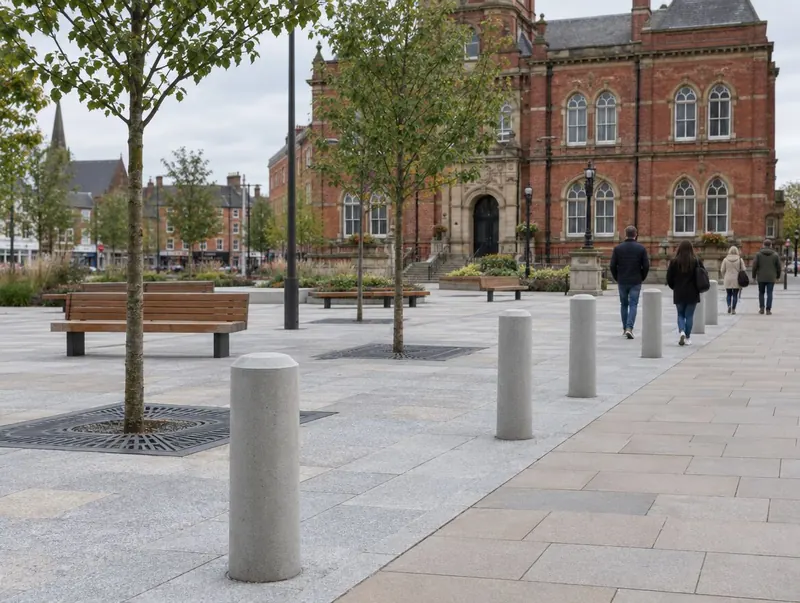 Computer-generated image
Holyhead concrete bollards
Across Holyhead, typical sites for concrete bollards include community buildings, high street shopfronts and local parades. Precast concrete and reconstituted stone bollards for public realm, parks, boundaries and estates, dowelled or bedded in place.
We work across LL65 — Holyhead itself and places including Trearddur, Bodedern, Bryngwran and Llanfihangel yn Nhowyn. Holyhead is fairly self-contained, with no other large town within about 20 miles.
Local details
- Area
- Isle of Anglesey, Wales
- Highway authority
- Isle of Anglesey County Council (local roads)
- Planning authority
- Isle of Anglesey County Council
- Postcodes
- LL65
- Guide price
- Typically £165–£575 per bollard + VAT; minimum job £575
- Survey
- Free, with a fixed written quote
Typical concrete bollards jobs in Holyhead
Common uses in a place like Holyhead:
- School, library and civic building forecourts
- Park entrances and greens where vehicles should not drive
- Rural and coastal sites where steel would corrode
Guide prices for Holyhead
| Specification | Guide price | Includes |
|---|---|---|
| Standard | £165–£345 + VAT | Standard post, foundation, reinstatement |
| Upgraded | £295–£465 + VAT | Upgraded finish or fittings, reflective band, matched keys |
| Premium | £415–£575 + VAT | Heavy-duty or architectural spec, premium finish |
Per bollard, supplied and installed; -3% for Wales. Guide only — the fixed price follows a survey.
What we check first in Holyhead
Before digging near the kerb in Holyhead we establish who owns the ground: adopted footways are Isle of Anglesey County Council's responsibility, trunk roads the Welsh Government's, and everything else belongs to the site owner.
Bollards on private land often don't need planning permission, but it depends on the council's view, the height and the location; in a conservation area, next to a listed building or under an Article 4 direction, ask the local planning authority (Isle of Anglesey County Council) first — we flag this at survey.
Access for the lifting vehicle matters: soft grass, paving and kerbs can be damaged by an outrigger, so ground protection mats are often laid before lifting begins. Park and verge locations often have tree roots nearby, which need protecting and can push bollards over time if set too close.
- Use contrasting colours or bands so grey bollards stand out against grey paving.
- On public highway or council land, agree positions and specification with the highway authority or landowner.
From survey to handover
Plan lifting
Each bollard's weight is checked, and a lifting method is chosen, such as a vacuum lifter or crane arm, with an exclusion zone set during lifts.
Excavate and cast foundations
Small foundations are excavated, checked for services and cast with a dowel hole or sleeve at the right position and level.
Reinstate and clean
Paving is made good around each base and the bollards are cleaned of mortar and handling marks.
Specification choices
| Option | Detail |
|---|---|
| Reflective and contrasting details | Inset reflective bands, contrasting tops or rings for visibility to drivers and partially sighted pedestrians. |
| Dowel-fixed or root-set | Dowels grouted into a foundation for most installations; root-set posts buried in the ground on softer sites. |
| Reconstituted stone | Crushed natural stone in a concrete mix, giving a Portland, buff or granite-like appearance for civic and heritage settings. |
What affects the quote
Two Holyhead jobs with the same number of posts can price quite differently. The usual reasons:
- Lifting equipment and access for delivery
- Precast concrete or reconstituted stone
- Size, shape and surface finish
Keeping them working
Small chips can be repaired with a colour-matched mortar, but a bollard that has cracked through or sheared at the dowel needs replacing. If a line is regularly struck by vehicles, consider whether steel cores, a tested product or a different layout would suit better.
For damaged or loose posts in Holyhead, repairs and replacements are priced in writing first.
Questions about concrete bollards in Holyhead
Do you install concrete bollards in Holyhead?
We cover all of Holyhead (LL65) and the rest of Isle of Anglesey.
Do I need consent for concrete bollards on a public footway in Holyhead?
Local roads and pavements in Holyhead are the responsibility of Isle of Anglesey County Council as highway authority, with the Welsh Government's trunk road agents handling trunk roads. Posts on the public highway need that authority's consent; private land does not.
What's a typical price for concrete bollards in Holyhead?
In Holyhead, typically £165–£575 per bollard, supplied and installed, plus VAT, with a minimum job of £575 plus VAT, using our Wales guide prices. The fixed figure comes in writing after we've seen the site.
Can concrete bollards be moved later?
Yes, though it takes lifting equipment. Dowel-fixed bollards can be lifted off once the grout is broken out, and the foundation removed or reused. Plan for it if you think the layout may change.
How heavy are concrete bollards?
Often well over a hundred kilograms each, and larger designs several times that. The exact weight depends on size and shape. It means they are delivered and set using lifting equipment rather than by hand.