Kent · England
Concrete bollard installation in Chatham
Concrete bollards supplied and fitted in Chatham, Kent: surveyed, scanned for services, set in proper foundations and finished to match the ground.
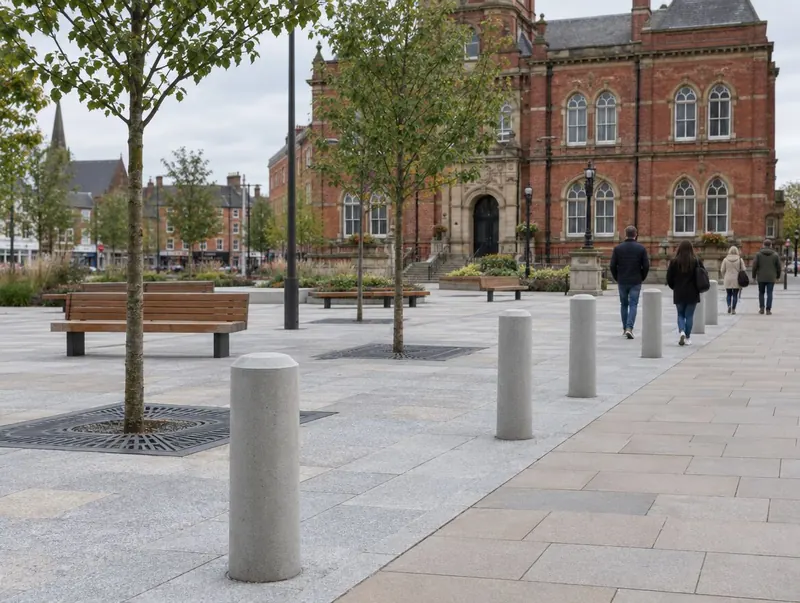 Computer-generated image
Concrete bollards in Chatham
In the town of Chatham, concrete bollards tend to go in at housing association car parks, college campuses and leisure centres. Finishes range from plain grey concrete to exposed aggregate and stone-effect surfaces that suit civic and landscaped settings.
We cover every part of Chatham in the ME4 and ME5 postcode districts. Nearby, we also work in Gillingham (1.1 miles), Rochester (1.1 miles), Strood (2.4 miles) and Maidstone (7.8 miles), measured as the crow flies.
Local details
- Area
- Kent, England
- Highway authority
- Medway Council (local roads)
- Planning authority
- Medway Council
- Postcodes
- ME4 and ME5
- Guide price
- Typically £185–£635 per bollard + VAT; minimum job £625
- Survey
- Free, with a fixed written quote
- Nearby
- Gillingham (1.1 mi), Rochester (1.1 mi), Strood (2.4 mi), Maidstone (7.8 mi)
Guide prices for Chatham
| Specification | Guide price | Includes |
|---|---|---|
| Standard | £185–£375 + VAT | Standard post, foundation, reinstatement |
| Upgraded | £315–£505 + VAT | Upgraded finish or fittings, reflective band, matched keys |
| Premium | £455–£635 + VAT | Heavy-duty or architectural spec, premium finish |
Per bollard, supplied and installed; +6% for South East. Guide only — the fixed price follows a survey.
Concrete bollards in Chatham: common uses
Typical reasons Chatham sites choose concrete bollards:
- Park entrances and greens where vehicles should not drive
- Edges of open land and verges subject to unauthorised vehicle access
- Rural and coastal sites where steel would corrode
Consents, ground and services in Chatham
Medway Council is the highway authority covering Chatham's local roads. If any post would stand on adopted highway rather than your land, that consent is the first thing we sort out.
Bollards on private land often don't need planning permission, but it depends on the council's view, the height and the location; in a conservation area, next to a listed building or under an Article 4 direction, ask the local planning authority (Medway Council) first — we flag this at survey.
Access for the lifting vehicle matters: soft grass, paving and kerbs can be damaged by an outrigger, so ground protection mats are often laid before lifting begins. Park and verge locations often have tree roots nearby, which need protecting and can push bollards over time if set too close.
- Keep clear gaps of typically at least 1,000–1,200 mm where pedestrians pass, checking against Inclusive Mobility guidance.
- Plan lifts with an exclusion zone and suitable lifting equipment, and record the method for the site.
What happens on site
Survey and choose
A free site survey looks at the setting, ground, delivery access and where a lifting vehicle can stand. You receive a fixed written quote with the product, finish and fixing.
Excavate and cast foundations
Small foundations are excavated, checked for services and cast with a dowel hole or sleeve at the right position and level.
Protect while the grout cures
Bollards are left undisturbed until the grout and foundation have gained strength, with temporary barriers if vehicles use the area. Lines that need to open to traffic quickly can use faster-setting grouts where the product allows.
Choosing the right spec
| Option | Detail |
|---|---|
| Precast concrete | Grey or coloured concrete in round, square, tapered or domed shapes, the economical public realm option. |
| Reflective and contrasting details | Inset reflective bands, contrasting tops or rings for visibility to drivers and partially sighted pedestrians. |
| Reconstituted stone | Crushed natural stone in a concrete mix, giving a Portland, buff or granite-like appearance for civic and heritage settings. |
What moves the price in Chatham
Two Chatham jobs with the same number of posts can price quite differently. The usual reasons:
- Lifting equipment and access for delivery
- Precast concrete or reconstituted stone
- Foundation depth and ground conditions
Looking after them
If a line is regularly struck by vehicles, consider whether steel cores, a tested product or a different layout would suit better. In areas salted heavily in winter, check for surface spalling.
If posts in Chatham are later hit or damaged, we can repair or replace them — see bollard repairs.
Common questions
Which parts of Chatham do you cover for concrete bollards?
We cover all of Chatham (ME4 and ME5) and the rest of Kent. We also work in Gillingham, Rochester and Strood.
Who gives permission for bollards on the pavement in Chatham?
The highway authority for local roads in Chatham is Medway Council; motorways and trunk roads sit with National Highways. Concrete bollards on the adopted footway are a matter for the highway authority, so we only install there with its written agreement.
What's a typical price for concrete bollards in Chatham?
In Chatham, typically £185–£635 per bollard, supplied and installed, plus VAT, with a minimum job of £625 plus VAT, using our South East guide prices. The fixed figure comes in writing after we've seen the site.
Can a chipped concrete bollard be repaired?
Small chips and edge damage can be filled with colour-matched mortar. A bollard cracked through or broken at its base needs replacing. Matching finishes is easier if the original product is still made.
How heavy are concrete bollards?
Often well over a hundred kilograms each, and larger designs several times that. The exact weight depends on size and shape. It means they are delivered and set using lifting equipment rather than by hand.
Concrete bollards in nearby towns
- Gillingham (1.1 mi)
- Rochester (1.1 mi)
- Strood (2.4 mi)
- Maidstone (7.8 mi)
- Gravesend (8 mi)
- Sittingbourne (9.2 mi)