Merseyside · England
Concrete bollard installation in Liverpool
Local installation of concrete bollards in Liverpool — free survey, fixed written price, and posts set to the right spacing for people and vehicles.
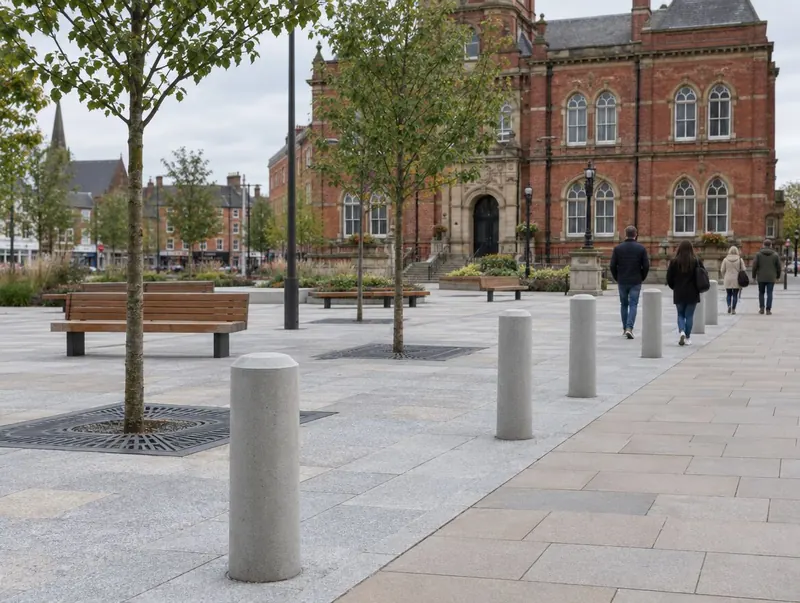 Computer-generated image
Liverpool concrete bollards
Finishes range from plain grey concrete to exposed aggregate and stone-effect surfaces that suit civic and landscaped settings. In Liverpool, that tends to mean sites such as distribution parks, retail parks and stadium approaches.
Coverage in Liverpool takes in the L3, L2, L1, L5, L7 and L6 postcode districts. Nearby, we also work in Birkenhead (1.9 miles), Wallasey (3.7 miles), Bootle (4.2 miles) and Litherland (4.2 miles), measured as the crow flies. Preston is around 27 miles away.
Liverpool at a glance
- Area
- Merseyside, England
- Highway authority
- Liverpool City Council (local roads)
- Planning authority
- Liverpool City Council
- Postcodes
- L3, L2, L1, L5, L7, L6, L8 and L4
- Guide price
- Typically £175–£585 per bollard + VAT; minimum job £575
- Survey
- Free, with a fixed written quote
- Nearby
- Birkenhead (1.9 mi), Wallasey (3.7 mi), Bootle (4.2 mi), Litherland (4.2 mi)
Liverpool: typical concrete bollard prices
| Specification | Guide price | Includes |
|---|---|---|
| Standard | £175–£345 + VAT | Standard post, foundation, reinstatement |
| Upgraded | £295–£465 + VAT | Upgraded finish or fittings, reflective band, matched keys |
| Premium | £415–£585 + VAT | Heavy-duty or architectural spec, premium finish |
Per bollard, supplied and installed; -2% for North West. Guide only — the fixed price follows a survey.
What Liverpool sites use concrete bollards for
Around Liverpool, concrete bollards usually solve one of these:
- Rural and coastal sites where steel would corrode
- School, library and civic building forecourts
- Retail parks and landscaped car parks
Consents, ground and services in Liverpool
The highway authority for local roads in Liverpool is Liverpool City Council; motorways and trunk roads sit with National Highways. Concrete bollards on the adopted footway are a matter for the highway authority, so we only install there with its written agreement.
If your site in Liverpool is listed or inside a conservation area, check with the local planning authority (Liverpool City Council) before choosing a finish — heritage settings often favour cast iron or painted steel over stainless.
Access for the lifting vehicle matters: soft grass, paving and kerbs can be damaged by an outrigger, so ground protection mats are often laid before lifting begins. Because concrete bollards are heavy, a weak foundation shows itself quickly as a tilt.
- Keep clear gaps of typically at least 1,000–1,200 mm where pedestrians pass, checking against Inclusive Mobility guidance.
- On public highway or council land, agree positions and specification with the highway authority or landowner.
From survey to handover
Plan lifting
Each bollard's weight is checked, and a lifting method is chosen, such as a vacuum lifter or crane arm, with an exclusion zone set during lifts.
Set the bollards
Each bollard is lowered onto a mortar bed with its dowel grouted in, checked plumb and aligned with its neighbours.
Reinstate and clean
Paving is made good around each base and the bollards are cleaned of mortar and handling marks.
Specification choices
| Option | Detail |
|---|---|
| Precast concrete | Grey or coloured concrete in round, square, tapered or domed shapes, the economical public realm option. |
| Surface finishes | Smooth, exposed aggregate, acid-etched or shot-blasted, chosen to suit paving and resist visible weathering. |
| Dowel-fixed or root-set | Dowels grouted into a foundation for most installations; root-set posts buried in the ground on softer sites. |
What affects the quote
Our North West guide prices are a starting point; the survey in Liverpool firms them up. What tends to move them:
- Precast concrete or reconstituted stone
- Lifting equipment and access for delivery
- Size, shape and surface finish
Looking after them
Keep a note of the product name, finish and supplier, because matching a single damaged bollard years later is much easier when the original specification is known. If a line is regularly struck by vehicles, consider whether steel cores, a tested product or a different layout would suit better.
For damaged or loose posts in Liverpool, repairs and replacements are priced in writing first.
Common questions
Do you install concrete bollards in Liverpool?
We cover all of Liverpool (L3, L2, L1, L5, L7 and L6) and the rest of Merseyside. We also work in Birkenhead, Wallasey and Bootle.
Do I need consent for concrete bollards on a public footway in Liverpool?
In Liverpool, work on adopted pavements and verges needs consent from Liverpool City Council, the local highway authority. Car parks, forecourts and other private land only need the owner's permission.
What's a typical price for concrete bollards in Liverpool?
In Liverpool, typically £175–£585 per bollard, supplied and installed, plus VAT, with a minimum job of £575 plus VAT, using our North West guide prices. The fixed figure comes in writing after we've seen the site.
Are concrete bollards anti-ram?
Only if that specific product has been crash-tested. Weight alone does not make a bollard crash-rated, and an untested concrete post can crack or shear when hit hard. Tested concrete-clad products exist for security use.
How heavy are concrete bollards?
Often well over a hundred kilograms each, and larger designs several times that. The exact weight depends on size and shape. It means they are delivered and set using lifting equipment rather than by hand.
Concrete bollards near Liverpool
- Birkenhead (1.9 mi)
- Wallasey (3.7 mi)
- Bootle (4.2 mi)
- Litherland (4.2 mi)
- Bebington (4.5 mi)
- Huyton (5.7 mi)