Mid Ulster · Northern Ireland
Concrete bollard installation in Dungannon
Local installation of concrete bollards in Dungannon — free survey, fixed written price, and posts set to the right spacing for people and vehicles.
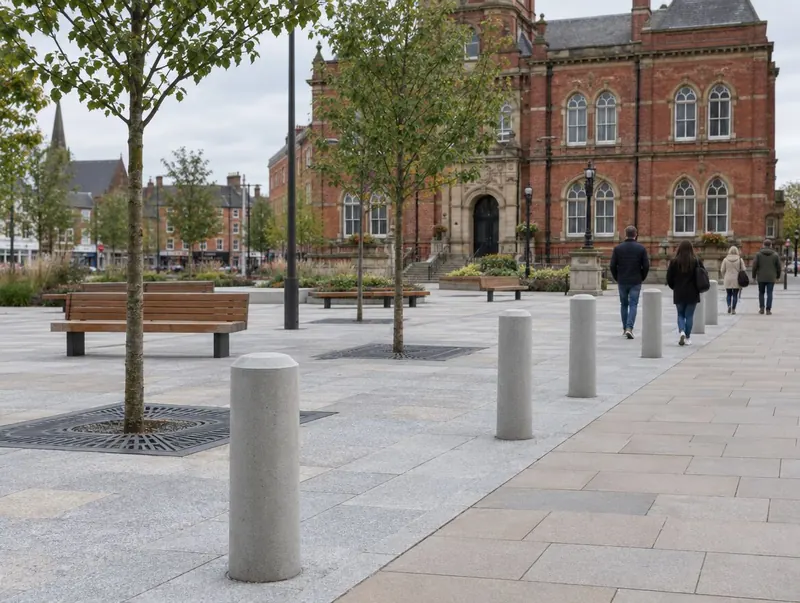 Computer-generated image
Concrete bollards in Dungannon
We supply and fit concrete bollards throughout Dungannon, typically for sites such as schools, local parades and small industrial units. Finishes range from plain grey concrete to exposed aggregate and stone-effect surfaces that suit civic and landscaped settings.
Coverage in Dungannon takes in the BT71 and BT70 postcode districts. Jobs in Dungannon can be combined with work in Cookstown (9.7 miles), Armagh (11.3 miles), Portadown (14.1 miles) and Craigavon (15.8 miles) (straight-line distances). Dungannon is about 34 miles from Belfast.
Dungannon at a glance
- Area
- Mid Ulster, Northern Ireland
- Roads authority
- the Department for Infrastructure (DfI Roads)
- Planning authority
- Mid Ulster District Council
- Postcodes
- BT71 and BT70
- Guide price
- Typically £175–£585 per bollard + VAT; minimum job £575
- Survey
- Free, with a fixed written quote
Guide prices for Dungannon
| Specification | Guide price | Includes |
|---|---|---|
| Standard | £175–£345 + VAT | Standard post, foundation, reinstatement |
| Upgraded | £295–£465 + VAT | Upgraded finish or fittings, reflective band, matched keys |
| Premium | £415–£585 + VAT | Heavy-duty or architectural spec, premium finish |
Per bollard, supplied and installed; -2% for Northern Ireland. Guide only — the fixed price follows a survey.
Typical concrete bollards jobs in Dungannon
Common uses in a place like Dungannon:
- Rural and coastal sites where steel would corrode
- Housing estates and communal areas
- Park entrances and greens where vehicles should not drive
Permissions and groundwork in Dungannon
Kerbside work in Dungannon is a DfI Roads question: the Department for Infrastructure is the roads authority for Northern Ireland, and its permission is needed for anything placed in the public road or footway.
Planning in Northern Ireland sits with the councils, so for a listed building or conservation area in Dungannon the planning team at Mid Ulster District Council is the one to ask before posts go in.
Because concrete bollards are heavy, a weak foundation shows itself quickly as a tilt. Services under footways are traced before excavation.
- Use contrasting colours or bands so grey bollards stand out against grey paving.
- Keep clear gaps of typically at least 1,000–1,200 mm where pedestrians pass, checking against Inclusive Mobility guidance.
Installation, step by step
Excavate and cast foundations
Small foundations are excavated, checked for services and cast with a dowel hole or sleeve at the right position and level.
Set the bollards
Each bollard is lowered onto a mortar bed with its dowel grouted in, checked plumb and aligned with its neighbours.
Protect while the grout cures
Bollards are left undisturbed until the grout and foundation have gained strength, with temporary barriers if vehicles use the area. Lines that need to open to traffic quickly can use faster-setting grouts where the product allows.
Choosing the right spec
| Option | Detail |
|---|---|
| Surface finishes | Smooth, exposed aggregate, acid-etched or shot-blasted, chosen to suit paving and resist visible weathering. |
| Reconstituted stone | Crushed natural stone in a concrete mix, giving a Portland, buff or granite-like appearance for civic and heritage settings. |
| Planters and blocks | Concrete planters and seating blocks used in place of bollards where a softer look is wanted. |
What affects the quote
Our Northern Ireland guide prices are a starting point; the survey in Dungannon firms them up. What tends to move them:
- Size, shape and surface finish
- Foundation depth and ground conditions
- Lifting equipment and access for delivery
After installation
Keep a note of the product name, finish and supplier, because matching a single damaged bollard years later is much easier when the original specification is known. If a line is regularly struck by vehicles, consider whether steel cores, a tested product or a different layout would suit better.
If posts in Dungannon are later hit or damaged, we can repair or replace them — see bollard repairs.
Concrete bollards in Dungannon: FAQs
Which parts of Dungannon do you cover for concrete bollards?
We cover all of Dungannon (BT71 and BT70) and the rest of Mid Ulster. We also work in Cookstown, Armagh and Portadown.
Who gives permission for bollards on the pavement in Dungannon?
Across Northern Ireland the Department for Infrastructure's DfI Roads is the roads authority, so concrete bollards on a public footway or road in Dungannon need its agreement before anything is dug. Posts on your own land do not.
How much do concrete bollards cost in Dungannon?
In Dungannon, typically £175–£585 per bollard, supplied and installed, plus VAT, with a minimum job of £575 plus VAT, using our Northern Ireland guide prices. The fixed figure comes in writing after we've seen the site.
Can a chipped concrete bollard be repaired?
Small chips and edge damage can be filled with colour-matched mortar. A bollard cracked through or broken at its base needs replacing. Matching finishes is easier if the original product is still made.
Are concrete bollards anti-ram?
Only if that specific product has been crash-tested. Weight alone does not make a bollard crash-rated, and an untested concrete post can crack or shear when hit hard. Tested concrete-clad products exist for security use.