Mid Ulster · Northern Ireland
Timber bollard installation in Dungannon
Timber bollards supplied and fitted in Dungannon, Mid Ulster: surveyed, scanned for services, set in proper foundations and finished to match the ground.
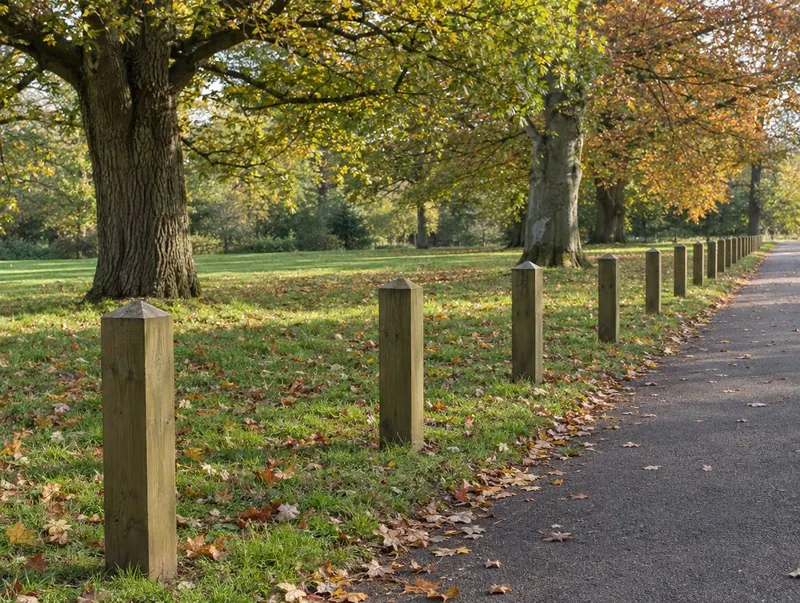 Computer-generated image
Timber bollards in Dungannon
We supply and fit timber bollards throughout Dungannon, typically for sites such as community buildings, small industrial units and filling-station forecourts. Timber bollards deter and guide vehicles; they are not tested barriers.
Coverage in Dungannon takes in the BT71 and BT70 postcode districts. Nearby, we also work in Cookstown (9.7 miles), Armagh (11.3 miles), Portadown (14.1 miles) and Craigavon (15.8 miles), measured as the crow flies. Dungannon is about 34 miles from Belfast.
Dungannon at a glance
- Area
- Mid Ulster, Northern Ireland
- Roads authority
- the Department for Infrastructure (DfI Roads)
- Planning authority
- Mid Ulster District Council
- Postcodes
- BT71 and BT70
- Guide price
- Typically £100–£335 per post + VAT (£115–£395 inc VAT for homes); minimum job £435
- Survey
- Free, with a fixed written quote
Dungannon: typical timber bollard prices
| Specification | Guide price | Includes |
|---|---|---|
| Standard | £100–£195 + VAT · £115–£225 inc VAT | Standard post, foundation, reinstatement |
| Upgraded | £165–£265 + VAT · £195–£315 inc VAT | Upgraded finish or fittings, reflective band, matched keys |
| Premium | £245–£335 + VAT · £285–£395 inc VAT | Heavy-duty or architectural spec, premium finish |
Per post, supplied and installed; -2% for Northern Ireland. Guide only — the fixed price follows a survey.
Timber bollards in Dungannon: common uses
Common uses in a place like Dungannon:
- Village greens and recreation grounds
- Landscaped car parks and picnic areas
- School frontages and nursery entrances
Before we dig in Dungannon
Kerbside work in Dungannon is a DfI Roads question: the Department for Infrastructure is the roads authority for Northern Ireland, and its permission is needed for anything placed in the public road or footway.
Many private-land installations in Dungannon need no planning application, but the rules don't clearly cover bollards, so listed buildings, conservation areas and prominent frontages are worth raising with the planning team at Mid Ulster District Council before posts go in.
Clay holds water against the timber and benefits from a free-draining stone base; sandy ground may need a concrete surround to stop posts loosening. Tree roots are common along verges and parks, and digging close to mature trees can harm them, so positions are adjusted to stay outside root areas where possible.
- Keep emergency vehicle access available, using a removable or hinged post where a route must open.
- Use certified sustainable sources for hardwoods, which many public bodies require.
What happens on site
Survey the setting
A free site survey looks at the ground, drainage, tree roots, how vehicles currently get onto the land and how the site looks. You receive a fixed written quote with species, size and fixing.
Set out the line
Posts are set out at spacings that stop cars passing between them while leaving gaps for walkers, buggies and wheelchairs.
Dig the holes
Holes are dug by hand or auger to the required depth, avoiding roots and checking for services along verges and footpaths.
Choosing the right spec
| Option | Detail |
|---|---|
| Oak | Naturally durable heartwood that weathers to silver-grey. Suits parks, heritage settings and visible frontages. |
| Sizes and profiles | Commonly 100–200 mm square or round, with chamfered, pyramid or domed tops to shed water. |
| Tropical hardwood | Very dense and long-lasting in ground contact. Specify certified sustainable sources. |
What affects the quote
Our Northern Ireland guide prices are a starting point; the survey in Dungannon firms them up. What tends to move them:
- Number of posts and length of the line
- Species: treated softwood, oak or tropical hardwood
- Ground conditions, roots and services
Looking after them
Re-treat cut or damaged softwood, keep grass and soil from building up around the base, and replace posts that are soft at the ground line before they snap. Inspect posts at ground level, where rot starts, by probing for soft wood.
For damaged or loose posts in Dungannon, repairs and replacements are priced in writing first.
Common questions
Which parts of Dungannon do you cover for timber bollards?
We cover all of Dungannon (BT71 and BT70) and the rest of Mid Ulster. We also work in Cookstown, Armagh and Portadown.
Who gives permission for bollards on the pavement in Dungannon?
Kerbside work in Dungannon is a DfI Roads question: the Department for Infrastructure is the roads authority for Northern Ireland, and its permission is needed for anything placed in the public road or footway.
What's a typical price for timber bollards in Dungannon?
In Dungannon, typically £100–£335 per post, supplied and installed, plus VAT (£115–£395 including VAT for homeowners), with a minimum job of £435 plus VAT, using our Northern Ireland guide prices. The fixed figure comes in writing after we've seen the site.
Should timber posts be set in concrete?
Only with care. Concrete holds the post firmly but can trap water around it at ground level, where rot starts. A free-draining base and a concrete collar shaped to shed water help, and compacted stone backfill is often better in clay.
Do timber bollards stop vehicles?
They stop most drivers deliberately mounting a verge and resist low-speed knocks, especially in dense hardwood. They are not tested barriers and should not be relied on against a vehicle driven at them deliberately.