Stirling · Scotland
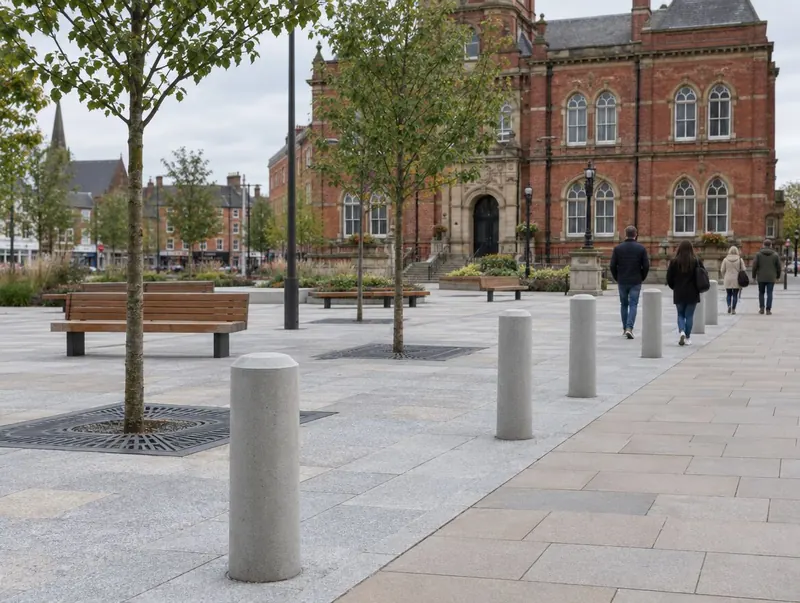
Concrete bollard installation in Dunblane
Local installation of concrete bollards in Dunblane — free survey, fixed written price, and posts set to the right spacing for people and vehicles.
 Computer-generated image
Concrete bollards in Dunblane
Across Dunblane, typical sites for concrete bollards include high street shopfronts, local parades and schools. Finishes range from plain grey concrete to exposed aggregate and stone-effect surfaces that suit civic and landscaped settings.
We cover Dunblane's FK15 and FK16 postcode districts, including places such as Doune and Deanston. Jobs in Dunblane can be combined with work in Stirling (4.9 miles), Tullibody (6.1 miles), Alloa (8.4 miles) and Falkirk (14.6 miles) (straight-line distances). It sits roughly 25 miles from Glasgow as the crow flies.
Key facts for this area
- Area
- Stirling, Scotland
- Roads authority
- Stirling Council (local roads)
- Planning authority
- Stirling Council
- Postcodes
- FK15 and FK16
- Guide price
- Typically £175–£595 per bollard + VAT; minimum job £595
- Survey
- Free, with a fixed written quote
Concrete bollards in Dunblane: common uses
Common uses in a place like Dunblane:
- Retail parks and landscaped car parks
- Park entrances and greens where vehicles should not drive
- School, library and civic building forecourts
Guide prices for Dunblane
| Specification | Guide price | Includes |
|---|---|---|
| Standard | £175–£355 + VAT | Standard post, foundation, reinstatement |
| Upgraded | £305–£475 + VAT | Upgraded finish or fittings, reflective band, matched keys |
| Premium | £425–£595 + VAT | Heavy-duty or architectural spec, premium finish |
Per bollard, supplied and installed; no regional adjustment. Guide only — the fixed price follows a survey.
Consents, ground and services in Dunblane
In Scotland the council is the roads authority for local roads, which in Dunblane means Stirling Council. Concrete bollards on an adopted footway need its consent; trunk roads sit with Transport Scotland.
Many private-land installations in Dunblane need no planning application, but the rules don't clearly cover bollards, so listed buildings, conservation areas and prominent frontages are worth raising with the planning team at Stirling Council before posts go in.
Each post sits on a concrete base on firm ground, and on soft verges or made ground the base is deepened or widened to suit. Park and verge locations often have tree roots nearby, which need protecting and can push bollards over time if set too close.
- Plan lifts with an exclusion zone and suitable lifting equipment, and record the method for the site.
- Do not present untested concrete bollards as crash-rated protection.
Installation, step by step
Survey and choose
A free site survey looks at the setting, ground, delivery access and where a lifting vehicle can stand. You receive a fixed written quote with the product, finish and fixing.
Plan lifting
Each bollard's weight is checked, and a lifting method is chosen, such as a vacuum lifter or crane arm, with an exclusion zone set during lifts.
Excavate and cast foundations
Small foundations are excavated, checked for services and cast with a dowel hole or sleeve at the right position and level.
Specification choices
| Option | Detail |
|---|---|
| Planters and blocks | Concrete planters and seating blocks used in place of bollards where a softer look is wanted. |
| Dowel-fixed or root-set | Dowels grouted into a foundation for most installations; root-set posts buried in the ground on softer sites. |
| Reflective and contrasting details | Inset reflective bands, contrasting tops or rings for visibility to drivers and partially sighted pedestrians. |
Pricing concrete bollards in Dunblane
Two Dunblane jobs with the same number of posts can price quite differently. The usual reasons:
- Number of bollards
- Lifting equipment and access for delivery
- Precast concrete or reconstituted stone
Looking after them
Small chips can be repaired with a colour-matched mortar, but a bollard that has cracked through or sheared at the dowel needs replacing. Concrete bollards need very little: occasional washing, removal of graffiti with suitable cleaners, and checks for chips, cracks and lean.
If posts in Dunblane are later hit or damaged, we can repair or replace them — see bollard repairs.
Concrete bollards in Dunblane: FAQs
Do you install concrete bollards in Dunblane?
We cover all of Dunblane (FK15 and FK16) and the rest of Stirling. We also work in Stirling, Tullibody and Alloa.
Who gives permission for bollards on the pavement in Dunblane?
In Scotland the council is the roads authority for local roads, which in Dunblane means Stirling Council. Concrete bollards on an adopted footway need its consent; trunk roads sit with Transport Scotland.
What's a typical price for concrete bollards in Dunblane?
In Dunblane, typically £175–£595 per bollard, supplied and installed, plus VAT, with a minimum job of £595 plus VAT, using our Scotland guide prices. The fixed figure comes in writing after we've seen the site.
How heavy are concrete bollards?
Often well over a hundred kilograms each, and larger designs several times that. The exact weight depends on size and shape. It means they are delivered and set using lifting equipment rather than by hand.
Are concrete bollards anti-ram?
Only if that specific product has been crash-tested. Weight alone does not make a bollard crash-rated, and an untested concrete post can crack or shear when hit hard. Tested concrete-clad products exist for security use.
Concrete bollards near Dunblane
- Stirling (4.9 mi)
- Tullibody (6.1 mi)
- Alloa (8.4 mi)
- Falkirk (14.6 mi)
- Cumbernauld (16.7 mi)
- Kirkintilloch (18.7 mi)