Suffolk · England
Concrete bollard installation in Newmarket
Concrete bollards for sites across Newmarket and the rest of Suffolk, from the first measurement to the last relaid paving block.
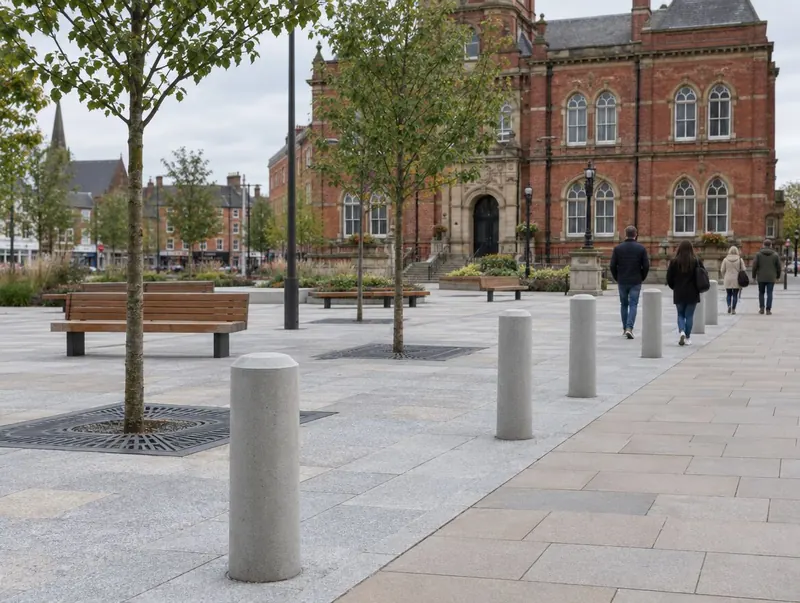 Computer-generated image
Concrete bollards in Newmarket
Across Newmarket, typical sites for concrete bollards include community car parks, filling-station forecourts and local parades. Finishes range from plain grey concrete to exposed aggregate and stone-effect surfaces that suit civic and landscaped settings.
We cover Newmarket's CB8 postcode district, including places such as Exning, Kentford and Gazeley. Nearby, we also work in Haverhill (11.3 miles), Ely (12.3 miles), Cambridge (12.6 miles) and Bury St Edmunds (13 miles), measured as the crow flies.
Key facts for this area
- Area
- Suffolk, England
- Highway authority
- Suffolk County Council (local roads)
- Planning authority
- the council for West Suffolk
- Postcodes
- CB8
- Guide price
- Typically £185–£615 per bollard + VAT; minimum job £605
- Survey
- Free, with a fixed written quote
- Nearby
- Haverhill (11.3 mi), Ely (12.3 mi), Cambridge (12.6 mi), Bury St Edmunds (13 mi)
What Newmarket sites use concrete bollards for
Common uses in a place like Newmarket:
- Park entrances and greens where vehicles should not drive
- Housing estates and communal areas
- Town centre squares and pedestrianised streets
What concrete bollards cost in Newmarket
| Specification | Guide price | Includes |
|---|---|---|
| Standard | £185–£365 + VAT | Standard post, foundation, reinstatement |
| Upgraded | £315–£495 + VAT | Upgraded finish or fittings, reflective band, matched keys |
| Premium | £435–£615 + VAT | Heavy-duty or architectural spec, premium finish |
Per bollard, supplied and installed; +3% for East of England. Guide only — the fixed price follows a survey.
What we check first in Newmarket
Suffolk County Council is the highway authority covering Newmarket's local roads. If any post would stand on adopted highway rather than your land, that consent is the first thing we sort out.
Many private-land installations in Newmarket need no planning application, but the rules don't clearly cover bollards, so listed buildings, conservation areas and prominent frontages are worth raising with the planning team at the council for West Suffolk before posts go in.
Park and verge locations often have tree roots nearby, which need protecting and can push bollards over time if set too close. Each post sits on a concrete base on firm ground, and on soft verges or made ground the base is deepened or widened to suit.
- On public highway or council land, agree positions and specification with the highway authority or landowner.
- Keep clear gaps of typically at least 1,000–1,200 mm where pedestrians pass, checking against Inclusive Mobility guidance.
Installation, step by step
Excavate and cast foundations
Small foundations are excavated, checked for services and cast with a dowel hole or sleeve at the right position and level.
Set the bollards
Each bollard is lowered onto a mortar bed with its dowel grouted in, checked plumb and aligned with its neighbours.
Reinstate and clean
Paving is made good around each base and the bollards are cleaned of mortar and handling marks.
Options to consider
| Option | Detail |
|---|---|
| Planters and blocks | Concrete planters and seating blocks used in place of bollards where a softer look is wanted. |
| Dowel-fixed or root-set | Dowels grouted into a foundation for most installations; root-set posts buried in the ground on softer sites. |
| Reconstituted stone | Crushed natural stone in a concrete mix, giving a Portland, buff or granite-like appearance for civic and heritage settings. |
Pricing concrete bollards in Newmarket
Two Newmarket jobs with the same number of posts can price quite differently. The usual reasons:
- Lifting equipment and access for delivery
- Number of bollards
- Precast concrete or reconstituted stone
After installation
In areas salted heavily in winter, check for surface spalling. Concrete bollards need very little: occasional washing, removal of graffiti with suitable cleaners, and checks for chips, cracks and lean.
For damaged or loose posts in Newmarket, repairs and replacements are priced in writing first.
Concrete bollards in Newmarket: FAQs
Do you install concrete bollards in Newmarket?
We cover all of Newmarket (CB8) and the rest of Suffolk. We also work in Haverhill, Ely and Cambridge.
Who gives permission for bollards on the pavement in Newmarket?
The highway authority for local roads in Newmarket is Suffolk County Council; motorways and trunk roads sit with National Highways. Concrete bollards on the adopted footway are a matter for the highway authority, so we only install there with its written agreement.
What's a typical price for concrete bollards in Newmarket?
In Newmarket, typically £185–£615 per bollard, supplied and installed, plus VAT, with a minimum job of £605 plus VAT, using our East of England guide prices. The fixed figure comes in writing after we've seen the site.
Should we use concrete or steel bollards?
Concrete suits landscaped and public spaces where appearance and low maintenance matter and where impacts are rare. Steel suits car parks and yards where knocks are frequent, because it bends rather than shatters. Many schemes use both in different places.
Can a chipped concrete bollard be repaired?
Small chips and edge damage can be filled with colour-matched mortar. A bollard cracked through or broken at its base needs replacing. Matching finishes is easier if the original product is still made.
Concrete bollards in nearby towns
- Haverhill (11.3 mi)
- Ely (12.3 mi)
- Cambridge (12.6 mi)
- Bury St Edmunds (13 mi)
- Thetford (18.8 mi)
- Sudbury (19.9 mi)