Cornwall · England
Crash-rated bollard installation in Redruth
Planning crash-rated bollards in Redruth? We check ownership, consents and buried services first, then quote a fixed price.
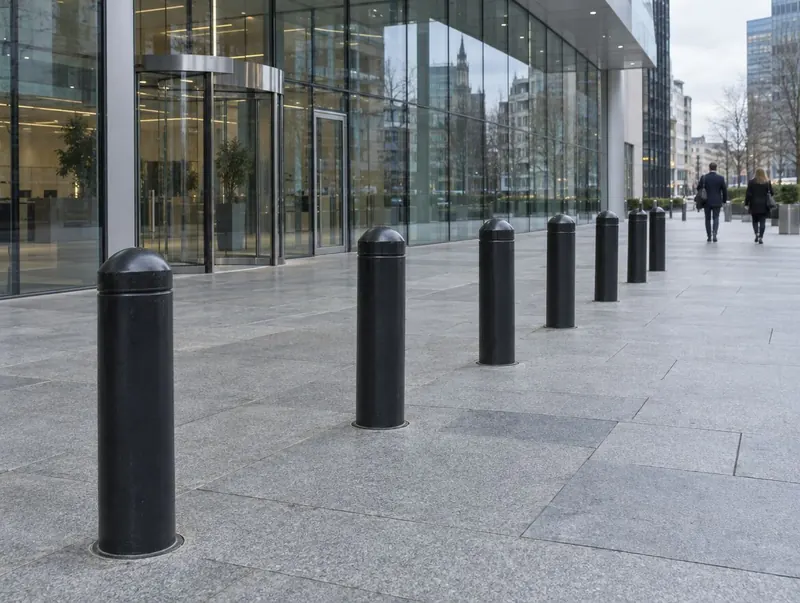 Computer-generated image
Crash-rated bollards in Redruth
Across Redruth, typical sites for crash-rated bollards include community car parks, high street shopfronts and small industrial units. Installation of impact-tested HVM bollards rated to ISO 22343-1 (or the superseded, still-accepted PAS 68 / IWA 14-1) on the tested foundation.
We work across TR15, TR16 and TR5 — Redruth itself and places including Pool, Illogan, Illogan Highway and Lanner. Nearby, we also work in Camborne (3.5 miles), Truro (7.8 miles), Falmouth (8.7 miles) and Newquay (14.3 miles), measured as the crow flies.
Redruth at a glance
- Area
- Cornwall, England
- Highway authority
- Cornwall Council (local roads)
- Planning authority
- Cornwall Council
- Postcodes
- TR15, TR16 and TR5
- Guide price
- Typically £1,995–£9,995 per bollard + VAT; minimum job £3,995
- Survey
- Free, with a fixed written quote
Crash-rated bollards in Redruth: common uses
Around Redruth, crash-rated bollards usually solve one of these:
- Building entrances and forecourts flagged in a security risk assessment
- Transport interchanges, taxi ranks and drop-off zones
- Glazed frontages on corporate and public buildings
What crash-rated bollards cost in Redruth
| Specification | Guide price | Includes |
|---|---|---|
| Standard | £1,995–£5,345 + VAT | Rated for a 7.5 t vehicle at 30 mph (48 km/h), tested foundation |
| Upgraded | £4,395–£7,745 + VAT | Rated for 7.5 t at 40 mph (64 km/h), tested foundation |
| Premium | £6,795–£9,995 + VAT | Rated for 7.5 t at 50 mph (80 km/h), or a specialist foundation |
Per bollard, supplied and installed on a standard tested foundation; no regional adjustment. Guide only — the fixed price follows a survey.
Consents, ground and services in Redruth
In Redruth, work on adopted pavements and verges needs consent from Cornwall Council, the local highway authority. Car parks, forecourts and other private land only need the owner's permission.
If your site in Redruth is listed or inside a conservation area, check with the local planning authority (Cornwall Council) before choosing a finish — heritage settings often favour cast iron or painted steel over stainless.
Utility records, radar scanning and hand-dug trial holes come before any machine work, and service diversions can take longer than the bollard installation itself. Reinstatement matches paving, tactile surfaces and kerbs.
- Ask the local planning authority whether consent is needed, particularly in conservation areas or near listed buildings.
- Check that the test certificate matches the exact model, configuration and foundation being installed, and keep it with the site records.
Installation, step by step
Start from the specification
We work from the specification issued by your security adviser or the manufacturer: product, rating, positions and foundation drawing. If no specification exists yet, we can put you in touch with the manufacturer's technical team, but we do not set the threat level ourselves.
Set out and excavate
Positions are set out to the drawing and excavated to the tested depth and width, with shoring where the ground needs it. Spoil is removed as work progresses.
Cure, protect and reinstate
The posts are protected while the concrete gains strength, and the surface is reinstated to match. The line should not be treated as fully effective until the specified curing period has passed.
Options to consider
| Option | Detail |
|---|---|
| Decorative covers | Stainless steel, cast or polymer sleeves can be fitted over the steel core to suit a streetscape. Use covers supplied or approved by the manufacturer so the tested product is not altered. |
| Static rated bollards | Fixed posts for permanent lines where vehicles never need to pass. They are a straightforward rated option to install and maintain. |
| Heights and diameters | Exposed heights are commonly around 800 to 1,000 mm, with core diameters varying by model and rating. Larger diameters are not always needed to achieve a given rating. |
What moves the price in Redruth
Two Redruth jobs with the same number of posts can price quite differently. The usual reasons:
- The rating required and the product range that achieves it
- Buried services, diversions and ground investigation
- Reinstatement of natural stone, tactile paving or specialist surfaces
Keeping them working
Look for cracked surfacing at the base, movement, damaged covers and faded bands. A rated bollard that has stopped a vehicle has done its job and should be assessed with the manufacturer; in most cases the post, and sometimes the foundation insert, is replaced rather than straightened.
We can also service, repair or replace existing posts anywhere in Redruth.
Common questions
Do you install crash-rated bollards in Redruth?
We cover all of Redruth (TR15, TR16 and TR5) and the rest of Cornwall. We also work in Camborne, Truro and Falmouth.
Who gives permission for bollards on the pavement in Redruth?
In Redruth, work on adopted pavements and verges needs consent from Cornwall Council, the local highway authority. Car parks, forecourts and other private land only need the owner's permission.
How much do crash-rated bollards cost in Redruth?
In Redruth, typically £1,995–£9,995 per bollard, supplied and installed on a standard tested foundation, plus VAT, with a minimum job of £3,995 plus VAT, using our South West guide prices. The fixed figure comes in writing after we've seen the site.
Will you design our HVM layout?
No. Scheme design and threat assessment belong with your security adviser, a specialist consultant or the manufacturer's technical team. We install the products they specify, to the tested foundation, and work alongside them on site so the build matches the design.
Why can't the foundation be adjusted to suit our ground?
Because the rating belongs to the bollard and foundation as tested together. Making the hole shallower, narrower or lighter on steel changes how the system behaves on impact. If site conditions force a change, the manufacturer has to approve it in writing, and some changes mean choosing a different product such as a shallow-mount system.