Cumbria · England
Crash-rated bollard installation in Whitehaven
Crash-rated bollards for sites across Whitehaven and the rest of Cumbria, from the first measurement to the last relaid paving block.
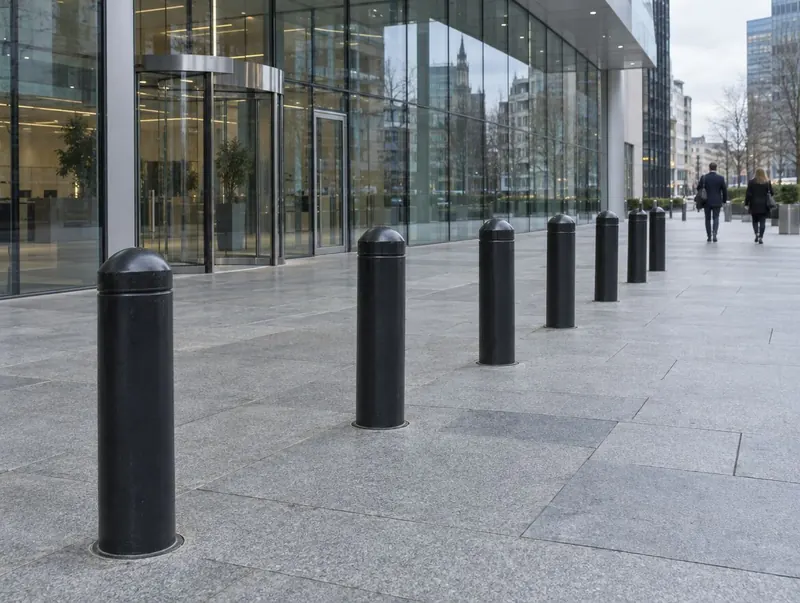 Computer-generated image
About crash-rated bollards in Whitehaven
We supply and fit crash-rated bollards throughout Whitehaven, typically for sites such as small industrial units, community car parks and filling-station forecourts. The rating only holds when the bollard is installed to the same foundation design that was tested.
We work across CA28, CA24, CA25, CA27, CA26 and CA23 — Whitehaven itself and places including Moresby Parks, Parton, Lowca and Sandwith. Jobs in Whitehaven can be combined with work in Workington (6.7 miles) (straight-line distances).
Local details
- Area
- Cumbria, England
- Highway authority
- Cumberland Council (local roads)
- Planning authority
- Cumberland Council
- Postcodes
- CA28, CA24, CA25, CA27, CA26, CA23 and CA22
- Guide price
- Typically £1,945–£9,795 per bollard + VAT; minimum job £3,895
- Survey
- Free, with a fixed written quote
- Nearby
- Workington (6.7 mi)
Where crash-rated bollards go in around Whitehaven
Common uses in a place like Whitehaven:
- Data centres, utilities and critical infrastructure perimeters
- Pedestrianised streets, plazas and crowded public spaces
- Building entrances and forecourts flagged in a security risk assessment
Guide prices for Whitehaven
| Specification | Guide price | Includes |
|---|---|---|
| Standard | £1,945–£5,245 + VAT | Rated for a 7.5 t vehicle at 30 mph (48 km/h), tested foundation |
| Upgraded | £4,295–£7,595 + VAT | Rated for 7.5 t at 40 mph (64 km/h), tested foundation |
| Premium | £6,645–£9,795 + VAT | Rated for 7.5 t at 50 mph (80 km/h), or a specialist foundation |
Per bollard, supplied and installed on a standard tested foundation; -2% for North West. Guide only — the fixed price follows a survey.
What we check first in Whitehaven
The highway authority for local roads in Whitehaven is Cumberland Council; motorways and trunk roads sit with National Highways. Crash-rated bollards on the adopted footway are a matter for the highway authority, so we only install there with its written agreement.
Many private-land installations in Whitehaven need no planning application, but the rules don't clearly cover bollards, so listed buildings, conservation areas and prominent frontages are worth raising with the planning team at Cumberland Council before posts go in.
Rated foundations are large, and excavation is often where projects run into trouble. Made ground, a high water table or soft clay may need an engineer to confirm the tested design suits the site; any change to depth, width or reinforcement must be agreed in writing by the manufacturer, or the rating may no longer apply.
- Confirm who owns the land: works on public highway usually need the highway authority's agreement, and permanent street furniture there may need a licence.
- Check that the test certificate matches the exact model, configuration and foundation being installed, and keep it with the site records.
Installation, step by step
Set out and excavate
Positions are set out to the drawing and excavated to the tested depth and width, with shoring where the ground needs it. Spoil is removed as work progresses.
Fix reinforcement and set the posts
The reinforcement cage is built to the drawing and the bollards are held to line and level in templates. Concrete is poured to the specified grade, with samples taken for testing if the specification calls for them.
Cure, protect and reinstate
The posts are protected while the concrete gains strength, and the surface is reinstated to match. The line should not be treated as fully effective until the specified curing period has passed.
Choosing the right spec
| Option | Detail |
|---|---|
| Rated removable or automatic posts | Where an entrance must open for deliveries or emergency vehicles, rated removable, retractable or automatic models are available. Check that the rating stated is for the exact model and position you are buying. |
| Static rated bollards | Fixed posts for permanent lines where vehicles never need to pass. They are a straightforward rated option to install and maintain. |
| Deep or standard foundation designs | Deep foundations suit open ground where excavation is unrestricted. Where services or slabs get in the way, shallow-mount tested designs may be a better fit. |
What moves the price in Whitehaven
Our North West guide prices are a starting point; the survey in Whitehaven firms them up. What tends to move them:
- The rating required and the product range that achieves it
- Traffic management, restricted working hours or night work in occupied sites
- Covers, finishes and any integrated lighting
After installation
Static rated bollards need little routine work, but they should be inspected periodically and always after any impact. Movable rated bollards need a planned servicing schedule.
For damaged or loose posts in Whitehaven, repairs and replacements are priced in writing first.
Common questions
Do you install crash-rated bollards in Whitehaven?
We cover all of Whitehaven (CA28, CA24, CA25, CA27, CA26 and CA23) and the rest of Cumbria. We also work in Workington.
Do I need consent for crash-rated bollards on a public footway in Whitehaven?
In Whitehaven, work on adopted pavements and verges needs consent from Cumberland Council, the local highway authority. Car parks, forecourts and other private land only need the owner's permission.
What's a typical price for crash-rated bollards in Whitehaven?
In Whitehaven, typically £1,945–£9,795 per bollard, supplied and installed on a standard tested foundation, plus VAT, with a minimum job of £3,895 plus VAT, using our North West guide prices. The fixed figure comes in writing after we've seen the site.
Will you design our HVM layout?
No. Scheme design and threat assessment belong with your security adviser, a specialist consultant or the manufacturer's technical team. We install the products they specify, to the tested foundation, and work alongside them on site so the build matches the design.
Why can't the foundation be adjusted to suit our ground?
Because the rating belongs to the bollard and foundation as tested together. Making the hole shallower, narrower or lighter on steel changes how the system behaves on impact. If site conditions force a change, the manufacturer has to approve it in writing, and some changes mean choosing a different product such as a shallow-mount system.