Cumbria · England
Ram-raid protection bollards in Whitehaven
Ram-raid bollards supplied and fitted in Whitehaven, Cumbria: surveyed, scanned for services, set in proper foundations and finished to match the ground.
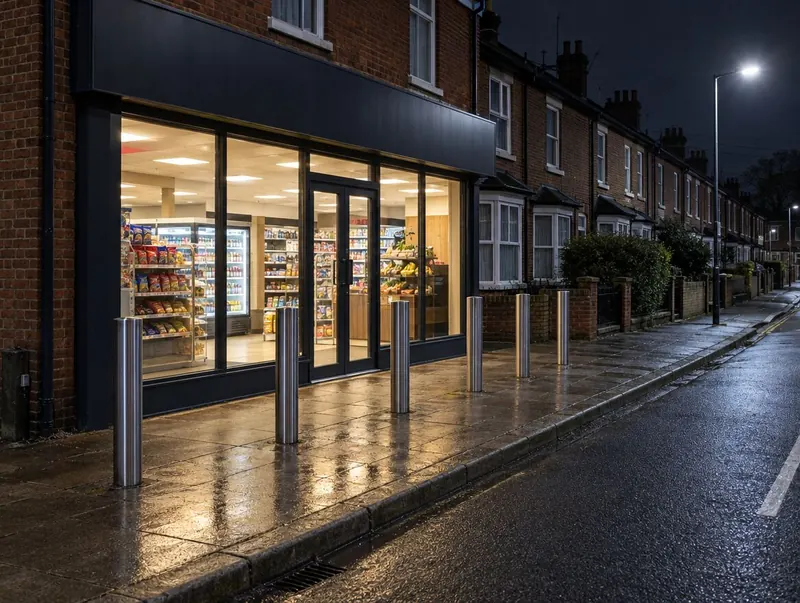 Computer-generated image
Ram-raid bollards in Whitehaven
Whether it's filling-station forecourts, community car parks and town-centre squares, ram-raid bollards in Whitehaven are planned around who needs to get through and who doesn't. Bollards fitted in front of shopfronts, ATMs, jewellers and convenience stores to stop vehicles being used to break in.
We work across CA28, CA24, CA25, CA27, CA26 and CA23 — Whitehaven itself and places including Moresby Parks, Parton, Lowca and Sandwith. Nearby, we also work in Workington (6.7 miles), measured as the crow flies.
Key facts for this area
- Area
- Cumbria, England
- Highway authority
- Cumberland Council (local roads)
- Planning authority
- Cumberland Council
- Postcodes
- CA28, CA24, CA25, CA27, CA26, CA23 and CA22
- Guide price
- Typically £385–£1,445 per bollard + VAT; minimum job £925
- Survey
- Free, with a fixed written quote
- Nearby
- Workington (6.7 mi)
What ram-raid bollards cost in Whitehaven
| Specification | Guide price | Includes |
|---|---|---|
| Standard | £385–£835 + VAT | Standard post, foundation, reinstatement |
| Upgraded | £715–£1,145 + VAT | Upgraded finish or fittings, reflective band, matched keys |
| Premium | £1,045–£1,445 + VAT | Heavy-duty or architectural spec, premium finish |
Per bollard, supplied and installed; -2% for North West. Guide only — the fixed price follows a survey.
What Whitehaven sites use ram-raid bollards for
Common uses in a place like Whitehaven:
- Through-the-wall and freestanding ATMs
- Convenience stores and off-licences with glazed frontages
- Premises that have already been targeted once
Before we dig in Whitehaven
The highway authority for local roads in Whitehaven is Cumberland Council; motorways and trunk roads sit with National Highways. Ram-raid bollards on the adopted footway are a matter for the highway authority, so we only install there with its written agreement.
Bollards on private land often don't need planning permission, but it depends on the council's view, the height and the location; in a conservation area, next to a listed building or under an Article 4 direction, ask the local planning authority (Cumberland Council) first — we flag this at survey.
Shopfronts often sit over cellars, coal holes, vaults and service entries, so what lies under the pavement can be more complicated than it looks. We hand-dig near known services, adjust positions if a vault or duct is found, and reinstate the surface to match, whether that is slabs, block paving, asphalt or a sealed forecourt finish.
- If an insurer has asked for protection, confirm what standard or product they expect before ordering.
- In conservation areas or on listed buildings, ask the local planning authority whether consent is needed.
Installation, step by step
Look at how a vehicle would approach
At the free site survey we look at where a vehicle could reverse from, the kerb line, the forecourt and the frontage construction. Ownership of the pavement in front of the shop is checked at the same time.
Excavate and set the posts
Each position is hand-dug near services and taken to depth, then the post is set plumb in a reinforced concrete base. Work is planned around trading hours where possible.
Reinstate the pavement
Paving, tarmac or forecourt concrete is made good flush with the base of each post, leaving no trip edges.
Choosing the right spec
| Option | Detail |
|---|---|
| PAS 170-1 tested bollards | Tested against low-speed vehicle impacts and suited to ram-raid risks where a tested product is requested. |
| Removable posts | Lockable removable positions allow deliveries, shopfitting or shutter maintenance without leaving the frontage open permanently. |
| Reflective and contrasting bands | Bands near the top help pedestrians, including partially sighted people, see the posts on a busy pavement. |
What affects the quote
Our North West guide prices are a starting point; the survey in Whitehaven firms them up. What tends to move them:
- Unrated, PAS 170-1 or crash-rated product
- Out-of-hours working to avoid closing the shop
- Foundation depth and what is found under the pavement
Keeping them working
Check them after any knock, because a post that has been hit may have cracked its foundation even if it still looks straight. Keep visibility bands clean, repaint chips before rust sets in on steel, and keep locks on removable posts lubricated so staff can actually use them.
For damaged or loose posts in Whitehaven, repairs and replacements are priced in writing first.
Ram-raid bollards in Whitehaven: FAQs
Which parts of Whitehaven do you cover for ram-raid bollards?
We cover all of Whitehaven (CA28, CA24, CA25, CA27, CA26 and CA23) and the rest of Cumbria. We also work in Workington.
Do I need consent for ram-raid bollards on a public footway in Whitehaven?
Cumberland Council is the highway authority covering Whitehaven's local roads. If any post would stand on adopted highway rather than your land, that consent is the first thing we sort out.
What's a typical price for ram-raid bollards in Whitehaven?
In Whitehaven, typically £385–£1,445 per bollard, supplied and installed, plus VAT, with a minimum job of £925 plus VAT, using our North West guide prices. The fixed figure comes in writing after we've seen the site.
Can bollards go on the pavement outside my shop?
Only if you own the ground or have the highway authority's agreement. Many shop frontages include a strip of private forecourt, which is simpler. We check ownership as part of the survey.
How many bollards does a shopfront need?
Enough to leave no gap a car could pass through across the vulnerable part of the frontage. For a typical small shop that is often three to five posts, but it depends on the frontage width and where a vehicle could approach from. The survey sets the number.