Cumbria · England
Pedestrian protection bollards in Whitehaven
Planning pedestrian protection bollards in Whitehaven? We check ownership, consents and buried services first, then quote a fixed price.
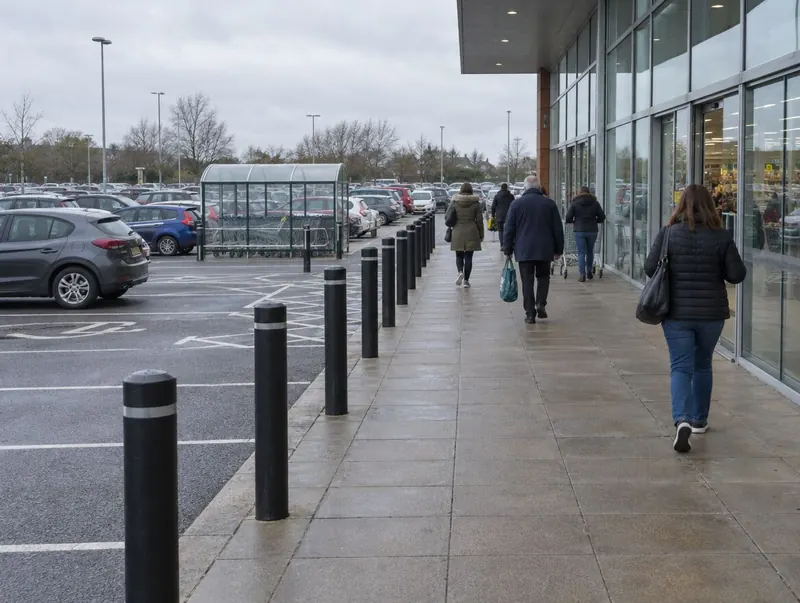 Computer-generated image
Pedestrian protection in Whitehaven
In the town of Whitehaven, pedestrian protection bollards tend to go in at community buildings, high street shopfronts and small industrial units. Products range from unrated steel posts to bollards tested against low-speed impacts under PAS 170-1.
Coverage in Whitehaven takes in the CA28, CA24, CA25, CA27, CA26 and CA23 postcode districts and nearby places like Moresby Parks, Parton, Lowca and Sandwith. Jobs in Whitehaven can be combined with work in Workington (6.7 miles) (straight-line distances).
Key facts for this area
- Area
- Cumbria, England
- Highway authority
- Cumberland Council (local roads)
- Planning authority
- Cumberland Council
- Postcodes
- CA28, CA24, CA25, CA27, CA26, CA23 and CA22
- Guide price
- Typically £245–£1,195 per bollard + VAT; minimum job £575
- Survey
- Free, with a fixed written quote
- Nearby
- Workington (6.7 mi)
Where pedestrian protection bollards go in around Whitehaven
Common uses in a place like Whitehaven:
- School and hospital drop-off zones
- EV charging points and trolley shelters
- Walkways through supermarket and retail park car parks
Guide prices for Whitehaven
| Specification | Guide price | Includes |
|---|---|---|
| Standard | £245–£635 + VAT | Standard post, foundation, reinstatement |
| Upgraded | £515–£915 + VAT | Upgraded finish or fittings, reflective band, matched keys |
| Premium | £795–£1,195 + VAT | Heavy-duty or architectural spec, premium finish |
Per bollard, supplied and installed; -2% for North West. Guide only — the fixed price follows a survey.
Consents, ground and services in Whitehaven
In Whitehaven, work on adopted pavements and verges needs consent from Cumberland Council, the local highway authority. Car parks, forecourts and other private land only need the owner's permission.
Bollards on private land often don't need planning permission, but it depends on the council's view, the height and the location; in a conservation area, next to a listed building or under an Article 4 direction, ask the local planning authority (Cumberland Council) first — we flag this at survey.
Raised kerbs also change the picture: a high kerb slows a wheel but does not stop a bumper, so the post still needs to sit within reach of the overhang rather than behind it. Where bollards protect a shopfront, the building's own foundations and any canopy columns may sit close to the line, which limits how deep and wide each base can go.
- Keep clear gaps of typically at least 1,000–1,200 mm and keep main walkways wide enough, referring to Inclusive Mobility guidance.
- Use contrasting bands so posts are visible to partially sighted people, and avoid linking chains across routes.
What happens on site
Watch how the site works
The free site survey looks at where cars park, where people walk and queue, and where incidents or near misses have happened. You receive a fixed written quote with positions marked.
Set out the line
Posts are set out allowing for bumper overhang and keeping clear routes for pedestrians, trolleys and wheelchairs.
Add bands and markings
Reflective bands are fitted and any wheel stops or line markings agreed in the scheme are installed.
Options to consider
| Option | Detail |
|---|---|
| Concrete-filled steel posts | Root-fixed galvanised and powder-coated steel, the standard unrated choice for walkways and frontages. |
| Lit bollards | Low-level lighting bollards double as protection on walkways where the product is robust enough for the job. |
| Visibility bands | Reflective and contrasting bands help drivers and partially sighted pedestrians see posts. |
What moves the price in Whitehaven
When we price pedestrian protection bollards in Whitehaven, these make the biggest difference:
- Ground conditions and services along kerb lines
- Working around trading hours and live car parks
- Number of posts and length of line
Looking after them
Keep a simple note of strikes and their locations; over a year it shows which parts of the car park drivers find awkward, which is useful when the site is next resurfaced or re-lined. If one post keeps being hit, look at the bay layout or add a wheel stop rather than replacing the same post repeatedly.
We can also service, repair or replace existing posts anywhere in Whitehaven.
Pedestrian protection in Whitehaven: FAQs
Which parts of Whitehaven do you cover for pedestrian protection bollards?
We cover all of Whitehaven (CA28, CA24, CA25, CA27, CA26 and CA23) and the rest of Cumbria. We also work in Workington.
Who gives permission for bollards on the pavement in Whitehaven?
In Whitehaven, work on adopted pavements and verges needs consent from Cumberland Council, the local highway authority. Car parks, forecourts and other private land only need the owner's permission.
What's a typical price for pedestrian protection bollards in Whitehaven?
In Whitehaven, typically £245–£1,195 per bollard, supplied and installed, plus VAT, with a minimum job of £575 plus VAT, using our North West guide prices. The fixed figure comes in writing after we've seen the site.
Do pedestrian protection bollards need to be crash-rated?
Not usually. They deal with low-speed driver errors, so firmly founded steel posts often suffice. Where an owner, insurer or designer wants proven performance, PAS 170-1 tested products are the usual choice.
Are wheel stops enough on their own?
Wheel stops help drivers judge where to stop but a car can mount them with a firm press on the accelerator. Used with bollards, they reduce daily knocks on the posts. On their own they are not a barrier.