Dorset · England
Crash-rated bollard installation in Weymouth
Planning crash-rated bollards in Weymouth? We check ownership, consents and buried services first, then quote a fixed price.
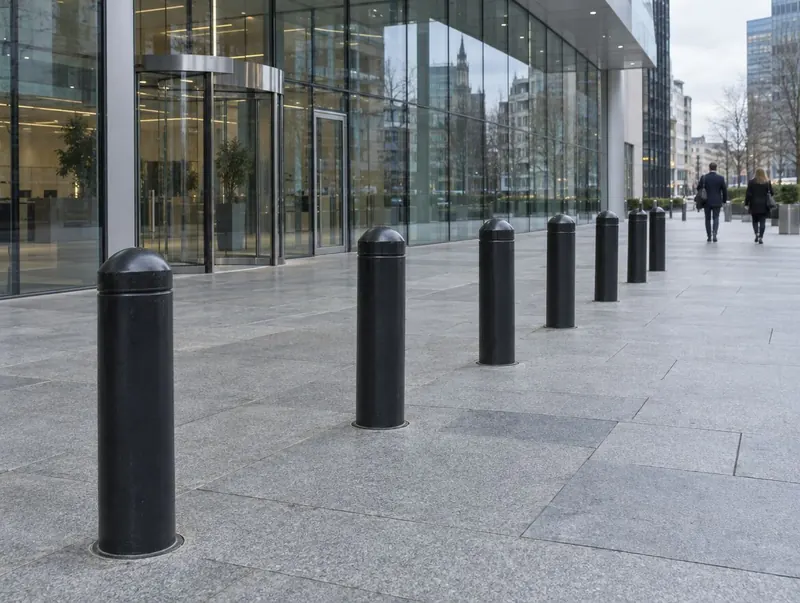 Computer-generated image
Crash-rated bollards in Weymouth
We supply and fit crash-rated bollards throughout Weymouth, typically for sites such as small industrial units, schools and filling-station forecourts. The rating only holds when the bollard is installed to the same foundation design that was tested.
Coverage in Weymouth takes in the DT4, DT3 and DT5 postcode districts and nearby places like Fortuneswell and Portland Bill. We also cover neighbouring Poole (21.9 miles) — distances are straight-line.
Local details
- Area
- Dorset, England
- Highway authority
- Dorset Council (local roads)
- Planning authority
- Dorset Council
- Postcodes
- DT4, DT3 and DT5
- Guide price
- Typically £1,995–£9,995 per bollard + VAT; minimum job £3,995
- Survey
- Free, with a fixed written quote
- Nearby
- Poole (21.9 mi)
Where crash-rated bollards go in around Weymouth
Around Weymouth, crash-rated bollards usually solve one of these:
- Sites where a vehicle dynamics assessment shows a long straight run-up
- Stadiums, arenas and event venues with predictable crowd flows
- Data centres, utilities and critical infrastructure perimeters
Crash-rated bollard prices in Weymouth
| Specification | Guide price | Includes |
|---|---|---|
| Standard | £1,995–£5,345 + VAT | Rated for a 7.5 t vehicle at 30 mph (48 km/h), tested foundation |
| Upgraded | £4,395–£7,745 + VAT | Rated for 7.5 t at 40 mph (64 km/h), tested foundation |
| Premium | £6,795–£9,995 + VAT | Rated for 7.5 t at 50 mph (80 km/h), or a specialist foundation |
Per bollard, supplied and installed on a standard tested foundation; no regional adjustment. Guide only — the fixed price follows a survey.
Consents, ground and services in Weymouth
In Weymouth, work on adopted pavements and verges needs consent from Dorset Council, the local highway authority. Car parks, forecourts and other private land only need the owner's permission.
If your site in Weymouth is listed or inside a conservation area, check with the local planning authority (Dorset Council) before choosing a finish — heritage settings often favour cast iron or painted steel over stainless.
Utility records, radar scanning and hand-dug trial holes come before any machine work, and service diversions can take longer than the bollard installation itself. Footways and forecourts in towns are usually crowded with cables, gas mains, water pipes and old drainage, and a single unexpected duct can stop a bollard position.
- Ask the local planning authority whether consent is needed, particularly in conservation areas or near listed buildings.
- Agree how emergency vehicles will get through, and refer to guidance on selecting and installing vehicle security barriers such as PAS 69 or ISO 22343-2.
Installation, step by step
Start from the specification
We work from the specification issued by your security adviser or the manufacturer: product, rating, positions and foundation drawing. If no specification exists yet, we can put you in touch with the manufacturer's technical team, but we do not set the threat level ourselves.
Fix reinforcement and set the posts
The reinforcement cage is built to the drawing and the bollards are held to line and level in templates. Concrete is poured to the specified grade, with samples taken for testing if the specification calls for them.
Hand over a build record
You receive photographs of the reinforcement and excavation before each pour, concrete delivery tickets, as-built positions and the manufacturer's product certification, ready for your adviser and insurers.
Specification choices
| Option | Detail |
|---|---|
| Heights and diameters | Exposed heights are commonly around 800 to 1,000 mm, with core diameters varying by model and rating. Larger diameters are not always needed to achieve a given rating. |
| Rated removable or automatic posts | Where an entrance must open for deliveries or emergency vehicles, rated removable, retractable or automatic models are available. Check that the rating stated is for the exact model and position you are buying. |
| Finishes and visibility bands | Galvanised and powder-coated finishes in RAL colours, with contrasting or reflective bands near the top so the posts are visible to pedestrians and drivers. |
What affects the quote
Two Weymouth jobs with the same number of posts can price quite differently. The usual reasons:
- Number of posts and whether a linked beam system is needed
- Traffic management, restricted working hours or night work in occupied sites
- Depth and volume of excavation, reinforcement and concrete
Keeping them working
A rated bollard that has stopped a vehicle has done its job and should be assessed with the manufacturer; in most cases the post, and sometimes the foundation insert, is replaced rather than straightened. Look for cracked surfacing at the base, movement, damaged covers and faded bands.
If posts in Weymouth are later hit or damaged, we can repair or replace them — see bollard repairs.
Common questions
Which parts of Weymouth do you cover for crash-rated bollards?
We cover all of Weymouth (DT4, DT3 and DT5) and the rest of Dorset. We also work in Poole.
Do I need consent for crash-rated bollards on a public footway in Weymouth?
The highway authority for local roads in Weymouth is Dorset Council; motorways and trunk roads sit with National Highways. Crash-rated bollards on the adopted footway are a matter for the highway authority, so we only install there with its written agreement.
What's a typical price for crash-rated bollards in Weymouth?
In Weymouth, typically £1,995–£9,995 per bollard, supplied and installed on a standard tested foundation, plus VAT, with a minimum job of £3,995 plus VAT, using our South West guide prices. The fixed figure comes in writing after we've seen the site.
Why can't the foundation be adjusted to suit our ground?
Because the rating belongs to the bollard and foundation as tested together. Making the hole shallower, narrower or lighter on steel changes how the system behaves on impact. If site conditions force a change, the manufacturer has to approve it in writing, and some changes mean choosing a different product such as a shallow-mount system.
What does a crash rating code actually tell me?
It tells you the vehicle used in the test, how fast it was travelling, the angle it hit at and how far it got past the bollard line. Your security adviser compares those figures with the vehicle and speed achievable on your approach. A rating that does not match the site's real risk is either more than you need or not enough.