Dorset · England
Warehouse and loading-bay bollards in Weymouth
Planning warehouse impact bollards in Weymouth? We check ownership, consents and buried services first, then quote a fixed price.
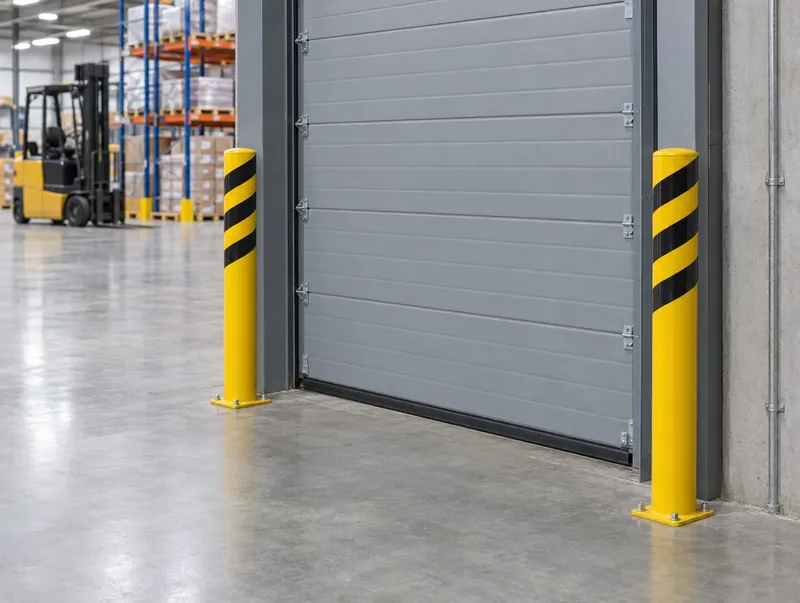 Computer-generated image
Warehouse bollards in Weymouth
Across Weymouth, typical sites for warehouse impact bollards include community car parks, community buildings and small industrial units. Yellow steel and polymer impact bollards for forklift zones, loading bays, doors, columns and racking inside warehouses.
We cover Weymouth's DT4, DT3 and DT5 postcode districts, including places such as Fortuneswell and Portland Bill. Jobs in Weymouth can be combined with work in Poole (21.9 miles) (straight-line distances).
Key facts for this area
- Area
- Dorset, England
- Highway authority
- Dorset Council (local roads)
- Planning authority
- Dorset Council
- Postcodes
- DT4, DT3 and DT5
- Guide price
- Typically £175–£1,195 per bollard + VAT; minimum job £445
- Survey
- Free, with a fixed written quote
- Nearby
- Poole (21.9 mi)
Where warehouse impact bollards go in around Weymouth
Typical reasons Weymouth sites choose warehouse impact bollards:
- Loading dock doors, shutter guides and dock levellers
- Pedestrian crossings and the ends of walkways
- Fire exit doors and emergency routes
What warehouse impact bollards cost in Weymouth
| Specification | Guide price | Includes |
|---|---|---|
| Standard | £175–£605 + VAT | Standard post, foundation, reinstatement |
| Upgraded | £485–£905 + VAT | Upgraded finish or fittings, reflective band, matched keys |
| Premium | £785–£1,195 + VAT | Heavy-duty or architectural spec, premium finish |
Per bollard, supplied and fixed; no regional adjustment. Guide only — the fixed price follows a survey.
Before we dig in Weymouth
The highway authority for local roads in Weymouth is Dorset Council; motorways and trunk roads sit with National Highways. Warehouse impact bollards on the adopted footway are a matter for the highway authority, so we only install there with its written agreement.
If your site in Weymouth is listed or inside a conservation area, check with the local planning authority (Dorset Council) before choosing a finish — heritage settings often favour cast iron or painted steel over stainless.
Warehouse floors vary from thick reinforced slabs to thin toppings over older concrete, and some contain underfloor heating, ducting or wire-guidance systems for automated trucks that must not be cut. Where a slab is too thin or poor, the options include through-bolting, a larger base plate to spread load, a polymer bollard that reduces anchor forces, or breaking out and casting a new local foundation.
- Check with the building owner before drilling into slabs with underfloor heating, guidance wires or post-tensioned reinforcement.
- Use your workplace transport risk assessment to decide where protection is needed, in line with HSE guidance on workplace transport.
How the job runs
Check the slab
Slab thickness, joints, cracks and any underfloor services or heating are checked, and anchors are chosen for the floor rather than taken from a standard list.
Plan around operations
Work is phased by aisle or zone, or done out of hours, with each area barriered off while drilling. Dust is controlled with extraction where products are stored nearby.
Fix, torque and mark
Bollards and guards are fixed and torqued, then any associated floor markings are applied so drivers can see protected zones.
Choosing the right spec
| Option | Detail |
|---|---|
| Polymer impact bollards | Flex and recover on impact, reducing damage to anchors, floor and vehicle. Need clearance to deflect. |
| Door frame protection | Bollards or low barriers either side of dock doors and roller shutters to protect frames and guides. |
| Cast-in or base-plated | Base plates suit existing slabs. External yard posts can be cast into concrete foundations for heavier duty. |
What affects the quote
Our South West guide prices are a starting point; the survey in Weymouth firms them up. What tends to move them:
- Removal of damaged existing protection
- Number of positions and types of guard
- Floor marking and associated signage
After installation
Inspect warehouse bollards regularly as part of routine site checks, and after any reported impact. Polymer bollards should return to their original shape; one that stays deformed or has split needs replacing.
If posts in Weymouth are later hit or damaged, we can repair or replace them — see bollard repairs.
Common questions
Do you install warehouse impact bollards in Weymouth?
We cover all of Weymouth (DT4, DT3 and DT5) and the rest of Dorset. We also work in Poole.
Who gives permission for bollards on the pavement in Weymouth?
In Weymouth, work on adopted pavements and verges needs consent from Dorset Council, the local highway authority. Car parks, forecourts and other private land only need the owner's permission.
What's a typical price for warehouse impact bollards in Weymouth?
In Weymouth, typically £175–£1,195 per bollard, supplied and fixed, plus VAT, with a minimum job of £445 plus VAT, using our South West guide prices. The fixed figure comes in writing after we've seen the site.
How close to a column should a bollard sit?
Close enough that a vehicle cannot reach the column around it, but with enough gap that the bollard does not hit the column when struck. Polymer bollards need more clearance than steel because they deflect. The gap is set from the product data.
What is PAS 13?
PAS 13 is a code of practice for safety barriers used in workplaces, including a method for impact testing them. Products tested to it state how much impact they can take. It helps compare products on performance rather than appearance.