Dorset · England
Shallow-mount security bollard installation in Weymouth
Shallow-mount bollards for sites across Weymouth and the rest of Dorset, from the first measurement to the last relaid paving block.
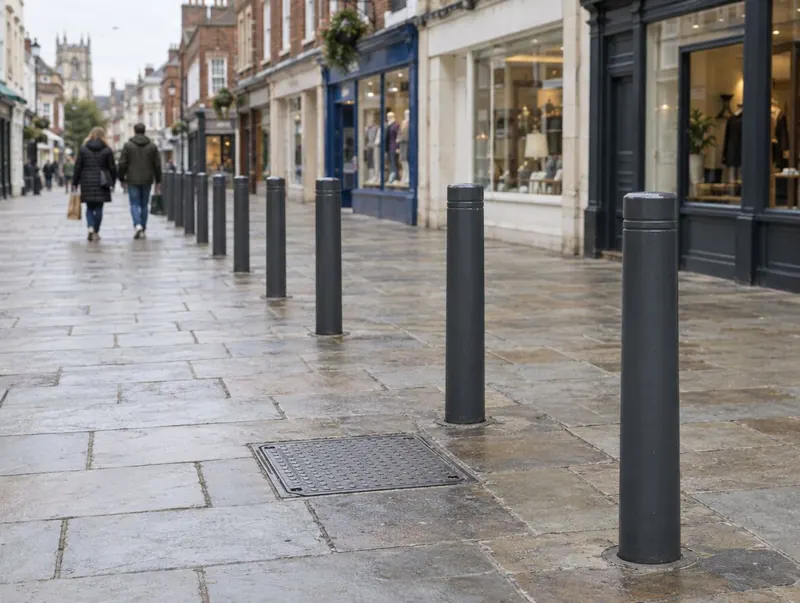 Computer-generated image
Shallow-mount bollards in Weymouth
From filling-station forecourts, high street shopfronts and town-centre squares, Weymouth has plenty of places where shallow-mount bollards earn their keep. Rated shallow-foundation bollard systems installed where buried services, basements or slabs rule out deep excavation.
Coverage in Weymouth takes in the DT4, DT3 and DT5 postcode districts and nearby places like Fortuneswell and Portland Bill. Jobs in Weymouth can be combined with work in Poole (21.9 miles) (straight-line distances).
Weymouth at a glance
- Area
- Dorset, England
- Highway authority
- Dorset Council (local roads)
- Planning authority
- Dorset Council
- Postcodes
- DT4, DT3 and DT5
- Guide price
- Typically £1,995–£8,995 per bollard + VAT; minimum job £4,995
- Survey
- Free, with a fixed written quote
- Nearby
- Poole (21.9 mi)
Shallow-mount bollard prices in Weymouth
| Specification | Guide price | Includes |
|---|---|---|
| Standard | £1,995–£4,945 + VAT | Rated for a 7.5 t vehicle at 30 mph (48 km/h), tested foundation |
| Upgraded | £4,095–£7,045 + VAT | Rated for 7.5 t at 40 mph (64 km/h), tested foundation |
| Premium | £6,195–£8,995 + VAT | Rated for 7.5 t at 50 mph (80 km/h), or a specialist foundation |
Per bollard position, supplied and installed; no regional adjustment. Guide only — the fixed price follows a survey.
Shallow-mount bollards in Weymouth: common uses
Common uses in a place like Weymouth:
- Retrofits outside occupied buildings with tight programmes
- Bridges and structures where excavation depth is limited
- Listed or historic streets where deep digging is unwelcome
Consents, ground and services in Weymouth
Dorset Council is the highway authority covering Weymouth's local roads. If any post would stand on adopted highway rather than your land, that consent is the first thing we sort out.
Bollards on private land often don't need planning permission, but it depends on the council's view, the height and the location; in a conservation area, next to a listed building or under an Article 4 direction, ask the local planning authority (Dorset Council) first — we flag this at survey.
Utility owners may set minimum separation distances or ask to be present when digging near their apparatus. Paving is often natural stone in the streets where these systems are used, so careful lifting, storage and relaying is part of the job.
- Get written confirmation from a structural engineer before installing on slabs, decks, basements or over voids.
- Agree works and separation distances with utility owners, and with the highway authority where the line is on public highway.
From survey to handover
Map what is underground
Utility records, radar scanning and trial holes establish exactly how much depth is available along the line. This is the survey that decides whether a shallow system will fit at all.
Cut and excavate the trench
Paving is lifted and kept for reuse where possible, and a shallow trench is excavated by hand near known services. Where a service sits higher than expected, work stops and the detail is referred back.
Pour, cure and reinstate
Concrete is placed to the specified grade and finish depth, then the surface is rebuilt to match. The line is protected until the specified curing period has passed.
Choosing the right spec
| Option | Detail |
|---|---|
| Surface-mounted rated units | Some tested products sit on or very close to the surface with minimal digging. These are often used for temporary or semi-permanent protection and need careful checking of the surface they bear on. |
| Linked-frame systems | Posts are welded or bolted to a continuous steel frame laid in a shallow trench and encased in concrete. Suited to straight or gently curved lines. |
| Covers and sleeves | Stainless, cast or powder-coated covers fitted over the cores to match surrounding street furniture, supplied or approved by the manufacturer. |
Pricing shallow-mount bollards in Weymouth
When we price shallow-mount bollards in Weymouth, these make the biggest difference:
- Length of run and the system needed to achieve the rating
- Changes of direction, end details and removable positions
- Lifting, storing and relaying natural stone paving
After installation
Any later utility work beside the line should be supervised so the frame is not undermined. Once cured, a shallow-mount line needs much the same care as any static rated barrier: periodic visual checks, cleaning of covers and renewal of visibility bands.
If posts in Weymouth are later hit or damaged, we can repair or replace them — see bollard repairs.
Common questions
Can you install shallow-mount bollards anywhere in Weymouth?
We cover all of Weymouth (DT4, DT3 and DT5) and the rest of Dorset. We also work in Poole.
Do I need consent for shallow-mount bollards on a public footway in Weymouth?
Dorset Council is the highway authority covering Weymouth's local roads. If any post would stand on adopted highway rather than your land, that consent is the first thing we sort out.
How much do shallow-mount bollards cost in Weymouth?
In Weymouth, typically £1,995–£8,995 per bollard position, supplied and installed, plus VAT, with a minimum job of £4,995 plus VAT, using our South West guide prices. The fixed figure comes in writing after we've seen the site.
What if a service turns out to be higher than the records show?
Work stops at that position and the finding goes back to the manufacturer and your adviser. Sometimes the frame can be adjusted within tested limits; sometimes the utility has to be lowered or the line moved. We do not improvise a change to a rated foundation on site.
Can I install a single shallow-mount bollard on its own?
Usually not. Most shallow systems rely on several posts working together, and the rating applies to a tested run with a stated minimum number of posts. A single position generally needs a different solution.